• Home
  • About
    • About
    • Achievements
    • International Partners
    • Frequently asked questions
    • Media Enquiries
    • Contact
  • Campaigns
    • Petition: End Overbreeding of Racehorses
    • Nup to the Cup
    • Deathwatch
    • Jumps Racing
    • The Whip
    • Wastage
    • 1 % To Stop The Slaughter (Retirement Plan)
    • New Zealand Campaign
    • Two-year-old Racing
    • Racing in Extreme Heat
  • Issues
    • Racehorses Killed for Human Consumption
    • Racing NSW on horse slaughter
    • Bits
    • JIGGERS
    • Undercover Knackery Investigation
    • Tongue Ties
    • Drug Use
    • Industry Funded Studies
    • Confinement
    • Racing in the Heat
    • Other Health Issues
    • Life of a Racehorse
    • Greyhound Racing
  • Take Action
    • The National Horse Traceability Register has lost its way
    • End Jumps Racing in Victoria
    • Make Reporting of Racing Deaths Mandatory
    • Donate
    • Bequests
    • #ditchthewhip
    • Take The Pledge To Never Bet On Or Attend A Horse Race
    • Volunteer
    • Businesses That Sponsor Horse Abuse
    • Outreach Toolkit
    • Register Your Own Nup To The Cup!
    • Nup to the Cup at your Workplace
    • Your Nup to the Cup Support Kit
    • Stencil Your Car
    • Equinileaks
    • Subscribe to our mailing list
  • Resources
    • Videos
    • Music
    • Reports & submissions
    • Outreach Toolkit
    • Download a banner
    • Download a poster
    • Your Nup to the Cup Support Kit
    • Nup to the Cup at your Workplace
    • A guide to rescuing race horses
  • Store
    • Store
    • Basket
    • My Account
    • Checkout
  • News
    • CPR Media Releases: AU
    • CPR Media Releases: NZ
  • Events

Horse Racing Kills

Horse Racing Kills

Advocating for race horses

  • Home
  • About
    • About
    • Achievements
    • International Partners
    • Frequently asked questions
    • Media Enquiries
    • Contact
  • Campaigns
    • Petition: End Overbreeding of Racehorses
    • Nup to the Cup
    • Deathwatch
    • Jumps Racing
    • The Whip
    • Wastage
    • 1 % To Stop The Slaughter (Retirement Plan)
    • New Zealand Campaign
    • Two-year-old Racing
    • Racing in Extreme Heat
  • Issues
    • Racehorses Killed for Human Consumption
    • Racing NSW on horse slaughter
    • Bits
    • JIGGERS
    • Undercover Knackery Investigation
    • Tongue Ties
    • Drug Use
    • Industry Funded Studies
    • Confinement
    • Racing in the Heat
    • Other Health Issues
    • Life of a Racehorse
    • Greyhound Racing
  • Take Action
    • The National Horse Traceability Register has lost its way
    • End Jumps Racing in Victoria
    • Make Reporting of Racing Deaths Mandatory
    • Donate
    • Bequests
    • #ditchthewhip
    • Take The Pledge To Never Bet On Or Attend A Horse Race
    • Volunteer
    • Businesses That Sponsor Horse Abuse
    • Outreach Toolkit
    • Register Your Own Nup To The Cup!
    • Nup to the Cup at your Workplace
    • Your Nup to the Cup Support Kit
    • Stencil Your Car
    • Equinileaks
    • Subscribe to our mailing list
  • Resources
    • Videos
    • Music
    • Reports & submissions
    • Outreach Toolkit
    • Download a banner
    • Download a poster
    • Your Nup to the Cup Support Kit
    • Nup to the Cup at your Workplace
    • A guide to rescuing race horses
  • Store
    • Store
    • Basket
    • My Account
    • Checkout
  • News
    • CPR Media Releases: AU
    • CPR Media Releases: NZ
  • Events

Our Review of the Thoroughbred Aftercare Welfare Working Group Report

December 20, 2021 by admincpr 1 Comment

Our two-year investigation exposing the brutal reality for thousands of racehorses every year once no longer wanted, (available here) led to the formation of the Thoroughbred Aftercare Welfare Working Group (TAWWG).

The TAWWG panel is comprised of:
Dr Denis Napthine – former veterinarian, former Victorian Premier and former Minister for Racing
Dr Ken Jacobs – equine veterinarian and former director of the AVA and the EVA
Dr Bidda Jones – Chief Science and Strategy Officer for RSPCA Australia, Honorary Associate with the Sydney School of Veterinary Science
Jack Lake – Former senior government advisor on agricultural policy. Current advisor to pastoral and poultry industries on policy development and implementation and government relations. Part-owner of racehorses

The panel was supported by an industry steering committee comprising of Tom Reilly, chief executive of Thoroughbred Breeders Australia; leading trainer Chris Waller; managing director of Godolphin Australia, Vin Cox; prominent owner and breeder Neil Werrett; chief executive of the Australian Trainers’ Association, Andrew Nicholl and the chief executive of the Australian Jockeys’ Association, Martin Talty.

CPR made a submission to the TAWWG (available here) and was part of the consultation process.

In their report, released on November 29 2021, the TAWWG made forty-six recommendations, some requiring government legislation, others designed for the industry to adopt.

The recommendations centre around greater industry transparency, government legislated horse welfare standards and the creation of a national welfare body, Thoroughbred Welfare Australia (TWA), funded by the industry itself.


Whilst we recognise these recommendations aim to improve the welfare of racehorses before, during and after racing, it is important the public recognises that:

1. these are just recommendations, with no requirement for them to be implemented

2. they are almost entirely dependent on the industry doing the right thing for the horses they have proven to use and abuse in the most horrific ways, without consequence, for so long.

3. they have only come about due to abhorrent standard practices horse racing has knowingly gotten away with for so long finally coming to light in the public domain. This report was by no means motivated out of concern for racehorses, but rather out of concern for the horse racing industry losing its social licence. This places immediate questions over not only whether the recommendations will be adopted, but can they actually be implemented and enforced?

After thirteen years of researching and investigating the horse racing industry, it is CPR’s position that it is beyond redemption and can never be made kind for the horses it exploits. Horse racing exists to serve the human, not the horse, making it fundamentally flawed and inherently unethical to begin with. Having said this, so long as the industry persists, we must support any measures that can improve these horses’ lives. For this reason, CPR supports the majority of the recommendations made in the report, however, we do not believe that the industry is capable of any kind of legitimate, meaningful and sincere reform, nor that any kind of reform can ever go far enough.

We do not support some of the parameters that guide the recommendations on ‘End of Life’ so have made an overall comment on this section at the very end of our review. 

Like the Martin Inquiry (our summary and comments available here), the TAWWG report once again highlights how badly this industry is failing the very horses it could not exist without, from birth to death.

It is also evident from the report that Australian’s are rightly turning their backs on horse racing due to significant welfare concerns.

Findings & Comments

Below are just some of the findings from the report (many that have long been stated by CPR), that we feel must be highlighted, along with some responses where we feel necessary. Most of them speak for themselves. The full report including its forty-six recommendations can be read here.

P10. The TAWWG has heard from many participants across the country who said that equine welfare – the task of ensuring thoroughbreds are well treated from birth to death – is the most important challenge the industry faces. Ensuring positive welfare outcomes for thoroughbreds is also crucial to the industry receiving the support of the broader Australian community. A significant project researching public attitudes to the thoroughbred industry was commissioned to support the TAWWG’s work, and it demonstrated more people were unsupportive of racing and breeding than supportive. However, this research identified that a key driver to changing those attitudes would be demonstrating that horses are well cared for, not only while in racing and breeding, but also when they retire. This provides a significant challenge as it means the industry is being assessed on the treatment of horses that are no longer in its care. Furthermore, many thoroughbreds will spend the vast majority of their lives outside the industry.
CPR: The above makes two things very clear. 1. The public has come along way in their expectations on animal welfare and they are willing to stop supporting horse racing because of its failings in this regard. 2. The horse racing model brings thousands of lives into the world each year, happily knowing they will be discarding them within a few years by either killing them or expecting someone else to care for and be responsible for them for the majority of their lives.

P11. The TAWWG has identified a number of weaknesses in the current welfare regime for thoroughbreds, such as a lack of national standards for the care of horses, no clear national definition of what constitutes good welfare, no national welfare standards for thoroughbred horses, and a state-based administrative structure that means different welfare funding levels, programs and rules across the seven principal racing authorities.

P12. For a sector as significant as thoroughbred racing and breeding, the TAWWG believes it is a weakness that there is no national strategic plan that considers the future size of the industry and the sustainable production of thoroughbreds to meet that need. A properly developed plan would lay out a vision for the industry, its objectives and goals and the actions, timelines and measurements required to realise that vision. A comprehensive national plan would consider the number of thoroughbreds required to ensure adequate field sizes in races, but also guarantee adequate opportunities for those horses post-racing. The annual Australian thoroughbred foal crop has been about 13,000 in recent years, which is a decrease of around 30% from the late 1990s. Furthermore, a greater proportion of these foals is being registered to race and is competing on the racetrack. Despite this trend, several submissions stated there was overproduction, that more thoroughbreds than needed were being produced. Others, including Racing NSW, argued the opposite. The TAWWG found there was insufficient evidence to say whether there is overproduction. Any plan should also consider the use of race programming to provide more opportunities for the many older, sound racehorses retiring prematurely, and to encourage the breeding of more durable horses.
CPR: If horses are unable to be cared for post-racing and breeding, this should be considered “overproduction”. The report does consider this later.

P12. TAWWG’s analysis of the available data estimated around 8,500 thoroughbreds a year were exiting racing and breeding.
CPR: CPR disputes the 8,500 thoroughbreds exiting the industry each year figure as it does not include the mares taken out of the breeding cycle each year (approximately 3,000). These horses are products of the racing industry and as such must also be considered when estimated the scale of the problem.  CPR estimates approximately 11,500 horses are exiting the industry each year. This figure is also in line with the annual foal crop size (allowing for some deaths after foal registration). The industry does not currently grow in size, so for every horse entering racing, another must be exiting in some way.  

P12. Finding suitable homes for this number of horses annually presents a significant challenge. Therefore this sustainable breeding plan should not only consider how many thoroughbred foals are needed each year to meet the needs of the racing industry, it should also fully and properly consider the industry’s responsibility to provide adequate and appropriate post-racing (including breeding) opportunities for the horses it produces.
CPR: Whilst CPR does not support the breeding of horses into the world for the purpose of racing them, it is with welcome relief that the TAWWG acknowledge appropriate breeding numbers should be not only what the industry needs to sustain itself but also what numbers can be cared for, for their entire lives. The reality is that there are not enough homes for the current numbers of horses the industry is producing. Considering the lifespan of a horse is approximately 25 years, in this time, the industry would add approximately 290,000 horses into the Australian horse population if they were not killing them prematurely as they are now. Considering the large number of horses killed or neglected each year across the country in need of good homes, the racing industry continuing to add to this problem is entirely irresponsible.

P13. The transition of thoroughbreds from racing and breeding to other activities is a key juncture in a horse’s life. Most are rehomed and often this is done through an informal network of people who take horses on to give them another purpose.
CPR: There is no evidence to support the claim made here by the TAWWG that “most are rehomed”.

P13. The importance of these networks is highlighted by Racing Australia’s retirement data, which shows only 2% of retiring racehorses enter a retraining or rehoming scheme overseen by a state racing authority.

P13. The TAWWG believes considerably more resources are needed to create opportunities for horses leaving the industry and to stimulate demand for these animals.

P13. Evidence presented to the panel highlighted the importance of finding horses suitable vocations in which they had a purpose and were therefore valued by their new owner
.
CPR: This statement is a poor reflection on ourselves as a society, where we base someone’s value on what they can do for us.

P13. It is evident that if a horse is well handled in early life, and exposed to other equine disciplines in foundation and ongoing training, it is easier to transition to a new career. TAWWG was told that handling practices were shifting from teaching a horse to submit, to a quiet cooperative approach. To encourage and support this transition, there is an opportunity to upskill and improve standards of those providing early handling and foundation training.
CPR: Whilst CPR recognises that horses who undergo training methods that are less abusive is not only better for the horses during their time in racing, but will also increase their chances of rehoming, the language throughout this entire section reinforces the idea that a horse is only valuable if they provide for the human in some way, which is the very reason why horses are in this awful mess to begin with.

P14. The TAWWG found the absence of an agreed end-of-life, decision-making framework, that would help guide owners when making decisions, to be a weakness that needs addressing. The TAWWG’s view, supported by an overwhelming number of submissions, accepts the principle that if circumstances arise where a horse can no longer be appropriately cared for, ensuring a humane death is preferable to its being left alive and suffering from neglect.
CPR: Only 2% of horses used by the racing industry earn enough to cover their own costs. Therefore, it is far from surprising that so many find themselves in a situation where an owner can no longer afford to care for them (or chooses not to spend their own money caring for them). It is entirely unacceptable that this multi-million-dollar industry that turns $21 billion in wagering annually, would not step in and ensure a full and healthy life for these horses. They will happily lure people into the industry on the pretence of dollars, glitz and glamour, yet walk away when the reality of racehorse ownership for most occurs.   

P14. Once a properly considered decision has been made that it is in the best interest of the horse for it to be killed, the most appropriate method is for a rapid painless death in a suitable, preferably familiar, environment.

CPR: Again, so long as this industry is turning a profit, and the horse is not suffering from incurable injury or illness, this is unacceptable.

P14. The TAWWG also considered the use of abattoirs and knackeries. A weakness with both is the lack of species-specific standards for killing horses. The TAWWG found the use of the Meramist abattoir in Queensland (the only abattoir licensed to process horses in Australia) problematic. Many horses are transported long distances to the site in conditions unsuitable for thoroughbreds and the facility is not designed for horses. The TAWWG recommends that while there is a lack of species-specific standards enforced for horses, principal racing authorities should institute rules to prevent participants sending horses to Meramist.
CPR: At the time of writing, it has been over two years since the horrors subjected to thousands of horses each year at the Meramist slaughterhouse were exposed to the world, yet the industry has not done anything to prevent horse being sent there. Whilst the number of horses killed at Meramist has decreased significantly since ‘The Final Race’ exposed their brutal treatment in 2019, CPR has evidence that racehorses are still being sent to the location to endure a most horrific end. 
Whilst Meramist continues to kill horses for human consumption, to be exported to various parts of the world, CPR has been calling on the EU Commission to ban their import due to ongoing animal welfare and food safety breaches of which they continue to deny, as does the Department of Agriculture and Fisheries and Biosecurity Queensland. CPR has sent this and further damning comments regarding Meramist made by the TAWWG in this report to the EU Commission and DAF, as further evidence against Meramist.

P14. The TAWWG found knackeries could play a useful role if they had experienced operators who could kill a horse humanely and facilitate the disposal of the carcass. TAWWG notes, however, that Racing NSW remains committed to its rule that prohibits industry participants sending horses for slaughter.
CPR: CPR supports Racing NSW position. However, it is fact that NSW horses do continue to end up at knackeries demonstrating enforcement is lacking and that not enough is being done to prohibit horses ending up at the knackery once passed on to someone outside the industry. There is also no information being provided by Racing NSW on where the approximate 4,000 horses who exit racing in NSW alone each year are going, making it difficult to believe they are all finding safe homes.

P14. Horses are highly mobile animals: they may be born in one state, race in two more, before being rehomed in a fourth. But the industry’s governance structure means its response to the welfare challenge is essentially decided at state level, which is an impediment to achieving the best welfare outcomes.

P14. A key observation of many participants, regulators and those outside racing and breeding was the lack of a national and collaborative approach to welfare.


P15. It is the TAWWG’s strongly held view that there is an urgent need to establish a single, national organisation dedicated to the development, and implementation, of a national welfare strategy. The panel suggests such a body be called Thoroughbred Welfare Australia (TWA).

P21. It is the thoroughbred industry’s responsibility to ensure thoroughbreds are cared for appropriately from birth to end of life. That is the central responsibility of the industry – to look after the horses it breeds. This is not being done adequately now. Unless that changes, the economic, emotional and social benefits of horse racing will evaporate. The TAWWG recognises that more needs to be done to fulfil that responsibility.

P21. Racing is an economic powerhouse, with the industry’s direct and indirect contribution to wealth calculated at around $9 billion annually.

P21. There are more than 100,000 individual owners, meaning about one in every 247 Australians owns a share in a racehorse. Such investment is unparalleled in any other racing nation.

CPR: A reminder that horses are viewed by many as an object to invest in, not a individual living being. Investments are made for financial returns, creating the culture of use and discard.

P22. Financially, the industry is in a strong position, especially compared to jurisdictions overseas, with prize money for the 2019-20 season at $808 million.

P22. … : some 4,000 yearlings were sold at public auction in 2020, for a total purchase price of $426,883,298 and a median value of $55,000. However, this success in Australian breeding barns and on the track creates a significant challenge for the thoroughbred industry with thousands of relatively young horses leaving racing every year

P25. As of September 2021, Racing NSW and Racing Victoria, combined, had fewer Facebook followers than the Coalition for the Protection of Racehorses, and Animals Australia had 26 times more Facebook followers than both organisations combined. The TAWWG considers the consequences of not meeting community expectations is significant.

Among the evidence heard from across the industry, including major race clubs, wagering operators, auction houses and stakeholder groups, was that failure to meet community expectations on welfare would likely result in:
• declining participation in the industry because of adverse publicity
• community pressure to increase regulation
• reduced wagering as a result of welfare concerns
• reduced corporate value of the sport, with declining sponsorships and income from media deals.

CPR: CPR has no doubt that this has already started and is the reason why this report was commissioned in the first place.

P25. A wagering operator provided a good example of such impacts. It said a 2020 survey of its customers found 44% were less interested in betting on horse racing because of equine welfare concerns.

P26. One of the challenges that became apparent early in the TAWWG’s work was the lack of an agreed industry view of its responsibility for thoroughbreds after they had finished racing or breeding. Without such agreement, it is difficult to determine where responsibility begins and ends, and impossible to develop a consistent view of the initiatives the industry would support. While some submissions stated the industry should be responsible for all the horses it produced until the end of their lives, others pointed to the fact that many thoroughbreds would spend most of their years outside of breeding or racing and
therefore their owner was responsible for their care at any given time. A number of senior racing administrators made it clear that the industry had a wider responsibility for the welfare of horses beyond their time on the track. The executive general manager, integrity at Racing Victoria, Jamie Stier, said: “In our view, it is impossible to decouple racing from both the before and after.” Racing SA’s submission stated the body operated under the Equine Welfare Framework (EWF), which has three phases: before racing, during their racing career, and after racing and retirement.

P28. Brendan Parnell, the chief executive officer of Racing Queensland, told the panel: “The smaller Principal Racing Authorities (PRAs) like Tasmania, South Australia and Northern Territory are not as well equipped commercially to support a certain level of [national] standards.” There is a pattern of horses that begin their careers in the major racing states of New South Wales and Victoria but are not competitive in city-class races. So they move to regional racing and states where there is weaker competition and the costs associated with racing, such as training fees, are significantly lower. The migration of these horses to Queensland, Tasmania, South Australia, Western Australia and the Northern Territory also creates a mismatch between the aftercare welfare task and the resources to carry it out.

P28., The TAWWG heard that Racing Australia (RA) cannot oversee a national welfare regime because it does not have a remit from its shareholders and members, the state racing authorities, to carry out such a role.


P28. RA representatives provided a submission and attended a consultation meeting with the TAWWG. The panel is grateful for their insights, which have informed this report. RA refused consent for publication of any comments from either process.


P29. The current state-based welfare programs are not based on agreed national standards or protocols, do not report in a nationally consistent, transparent manner to the industry or the public, and their impact has yet to be empirically demonstrated. The activities are extensive, but disparate and largely uncoordinated.

P29. There was also strong support among stakeholders, including the steering group, for wagering service providers to make a contribution to funding TWA. With $29 billion bet on horseracing in Australia last racing season, setting aside a very small percentage of turnover for welfare could easily make a significant funding contribution.

CPR: CPR made a submission to Racing Australia back in 2013, proposing this very thing – with 1% of all betting turnover being directed towards horse rehabilitation and rehoming. By todays standards, this would raise over $210 million for horses per year. The industry refused to adopt such a scheme yet have since adopted a 1% prize money levy to be directed to an equine welfare fund. This raises a tiny portion of what is required.

P33. A $300 welfare levy on all foals when breeders complete the foal ownership declaration. Unlike a levy on sales, this ensures all breeders contribute.
CPR: This is one of several levies directed at industry participants by the TAWWG to fund the proposed national body Thoroughbred Welfare Australia (TWA). In our submission to the TAWWG, CPR proposed a $2000 foal levy as a means of not only contributing to better welfare outcomes but also to deter indiscriminate breeding. $300 is too low a contribution for breeders who bring these lives into the world only to wipe their hands of any responsibility of them. Other industry participants, including trainers, owners and jockeys would also contribute under the suggested model.

P37. The Five Domains are nutrition, environment, health, behaviour and mental state.
While previous models of animal welfare, such as the Five Freedoms, have focused on minimising or eliminating the negative experiences of animals, such as thirst, hunger and pain, the Five Domains model incorporates the assessment of positive experiences, such as satiety, contentment and curiosity. Thus, the model provides a means of evaluating the welfare of an individual or group of animals in a particular situation, with a strong focus on mental wellbeing and positive experiences.

CPR: The Five Domains model is an improvement from the Five Freedoms model, however, horse racing as it currently stands, and perhaps even at its fundamental core, is the antithesis to both frameworks eg. traumatic foal and mare separation, whipping, spurs, bits, tongue-ties, concentrated diets, confinement and isolation, exercise-induced pulmonary haemorrhage, extreme physical exertion, breaking/training methods (coercive at best), racing-related injuries/deaths and so on.

P27. While most of the rules that govern racing and breeding are national, industry welfare policy is drawn up and implemented at a state level by the PRAs. An example of how this can lead to differences in approach is the fact that only four of the seven PRAs have adopted the Five Domains welfare philosophy.

CPR: Further to the point above – four of the seven PRA’s have adopted the Five Domains philosophy, yet the racing industry, as it functions day to day through the experience of the horses, is the same across the country. This further highlights that, on paper, such improvements sound good, but on the ground within the racing industry, they have little to no meaning.

P35. The TAWWG review of the animal welfare regulatory regimes applying to thoroughbred horses exposed some fundamental weaknesses. Firstly, there is no agreed definition of horse welfare. This is a problem both for governments charged with creating a legal framework for welfare, and for racing authorities when drafting rules for the care of horses. The development and implementation of an effective welfare regime for horses depends on a clear and agreed definition of welfare. Without it, it is difficult, if not impossible, to articulate a welfare policy both within the horse industry and to the broader community. Secondly, there are no national enforceable welfare standards for horses. There are rules for some other species that provide minimum standards for animals and, when supported by legislation, are enforceable by state governments. Without these standards for horses, their only legal protection is through broad, non-specific, animal cruelty legislation. The TAWWG’s view is that cruelty legislation does not provide sufficient safeguards for thoroughbreds (or any horse), nor sufficient protection to meet community expectations.
CPR: It is appalling, but not surprising, that horses do not have legal protections specific to their welfare needs. Australian animal welfare legislation needs a complete overhaul, and a well-funded Independent Office for Animal Protection must be established as a matter of urgency, for the sake of all animals.

P36. Welfare assumptions are also implicit in the attitudes and approaches of those whose everyday work involves handling horses, including breeders and their staff, trainers, stablehands, track riders and jockeys. Industry leaders should seek to develop organisational cultures that encourage staff to speak up about welfare issues, and be open to making changes where warranted.
CPR: It is quite telling that for an industry that has existed in Australia for well over 200 years, and that has profited so significantly from the exploitation of these animals, that no efficient welfare policy has ever and still does not exist. For the industry, that makes perfect sense.

P36. “Good welfare for horses and a life worth living can be achieved by considering physical and functional wellbeing as well as giving horses the opportunity to experience positive emotions in all areas: nutrition, health, environment, behaviour, and interactions with humans.” Australian Veterinary Association submission.
CPR: The AVA is referred to often in the TAWWG report, including as a recommended party to help select the TWA steering committee. CPR has little faith in the AVA considering they openly support not only horse racing, but also jumps racing and the use of whips in their policies.

P37. ….at present, nationally applicable standards for horses do not exist. State animal welfare laws give horses only minimum protections against overt cruelty and neglect, except in Tasmania and Victoria.
CPR: Still, CPR believes that if the very minimal standards of legislated animal welfare that exist were actually enforced, that it would be difficult to see how horse racing could exist. 

P38. Governments and horse industry stakeholders began work on the development of national standards for horses and got as far as publishing a draft standard in April 2009. However, unlike the livestock industries, work on horse standards was suspended in 2011 following a lack of agreement among horse industry groups over funding the work. The failure of this process clearly did not help improve horse welfare. The TAWWG sees the development and implementation of national enforceable animal welfare standards for horses as an essential component of a national horse welfare regime.

P43. Thoroughbreds must have speed and stamina. As such they have high risk for self-inflicted injury and injuries from high-speed activity both when in the paddock and racing.

P43. Currently, though, there are no national enforceable standards of care for thoroughbreds when in the breeding and racing industry. Instead, there are rules of racing that relate to welfare but the TAWWG’s view is that these fall short of what is required to provide the proper regulatory framework to ensure good welfare.

P43. The TAWWG notes that despite the current version of the rules of racing being some 180 pages long, there are few references to animal welfare, and most of the rules on this subject are contained in section AR231: Misconduct in relation to the care and welfare of horses. This section states a person must “not commit or commission an act of cruelty to a horse”. It goes on to say that those in charge of horses must exercise reasonable care or supervision to prevent cruelty; provide adequate feed and water; take steps to alleviate pain or suffering, and provide veterinary treatment where necessary. Only participants in the racing industry – such as owners, trainers, strappers and jockeys – are bound by the rules of racing. Therefore, once a thoroughbred has exited the industry and is in the care of somebody who is not bound by the regulations, these rules no longer provide any protection for its treatment.

CPR: This entire section implies that the racing of horses, as it currently exists, is not fundamentally and inherently cruel, and the act of committing cruelty to a horse only becomes a concern when horses leave the industry. It fails to acknowledge the use of whips, bits, spurs, tongue ties, harsh training regimes (although this is mentioned elsewhere), pushed so hard they suffer EIPH, heart attacks and catastrophic injures – just to name a few. As racing currently exists, it is impossible to not commit or commission an act of cruelty to a horse.

P45. Other groups, including Animals Australia, the Coalition for the Protection of Racehorses, and the RSPCA, also said breeders should be licensed. But some breeders, owners and trainers argued passionately that breeder licensing was against the spirit and traditions of Australian thoroughbred racing.
CPR: Licensing breeders could subject them to more rigorous welfare regulation protocols and ideally capped breeding numbers to help address the lack of homes available to retired racehorses. This appears to be less important to some industry participants than the “spirit and traditions” of horse racing.

P47. Given the submissions and evidence to the TAWWG, especially from some racing authorities, it is the panel’s view that there is still some confusion about what regulatory framework breeders are captured under.

P48. Despite the popularity of the concept with the PRAs and others, the TAWWG is unconvinced that licensing (breeders) is the best option for achieving this objective.
CPR: Not licensing breeders has and will continue to make it impossible to control breeding numbers. Until there is a home available for every single horse born for the entirety of their lives, then breeding numbers must be reduced and controlled.

P51. While all thoroughbreds are permanently identified with a microchip and are traceable while in the industry, the lack of accurate data on thoroughbreds once they leave the industry means there is no way to fully understand the life history of many former racehorses. This means the industry cannot accurately say how long racehorses live in retirement or monitor their treatment. Such information is vital to convincing the community that racehorses are properly cared for and not simply a commodity to be discarded when their racing careers are over.

P55. As RA, the body responsible for all data collection and national reporting for the industry, told the Senate committee, thoroughbred racing and breeding have the most detailed record keeping of any equine industry in Australia. But the TAWWG also heard evidence that the reliability of this data was questionable, with regulators and participants stating there were issues with compliance, and with how data was collected, that undermined the effectiveness of these traceability rules. This lack of accuracy raises a number of challenges for the industry. It cannot give credible information on the outcomes for horses if it does not have confidence in its data. Nor can it assure the broader public or politicians that horses are well cared for without robust and reliable information on where they are, and in whose care. High quality data is the foundation of sound policy development. This lack of credible information makes it difficult to accurately assess the success of welfare, retirement and rehoming initiatives.

P58. Many submissions and consultations said RA and Australian Stud Book (ASB) records were incomplete and inconsistent. Racing Victoria said a 2020 audit of horses that were recorded as not having raced or trialled in the previous six months found nearly one-third were documented incorrectly and needed to have their status updated. Similarly, an audit of Victorian broodmares covered in 2015 found 10% had not had a mare return lodged. Furthermore, the Racing Victoria audit found:
• poor knowledge among trainers of stable return requirements
• ambiguity in the “transferred’’ status about who is responsible for a horse at any given time
• possible under-counting of the foal crop
• mares can be covered again even if there is no recorded outcome of the previous covering
• stallion owners sometimes hold back registration papers in lieu of payment, if the mare’s owner cannot pay the stallion fee, meaning the foal goes unregistered
• insufficient penalties to discourage poor record keeping.

P58. During the Senate inquiry into horse traceability, RA was asked questions on notice about its retirement data. RA said it was unable to provide a figure. Instead, it said a figure would be obtained when it engaged a consultant to examine the “completeness and accuracy of Racing Australia’s horse records”. Similarly, when asked, RA did not provide the committee with the number of thoroughbreds listed as active, but which had not raced or trained in the past 12 months. TAWWG understands RA has not yet engaged a consultant to review the accuracy of its horse records.

P58. The Martin report highlighted the lack of confidence around retirement data as a particular problem. It stated: “The unreliability of retirement data for racing horses is a critical issue that the racing industry needs to address as a matter of collective priority. Without it, meaningful decisions about managing the welfare of retired racing horses is difficult and determining the amount of effort and investment it will require is impossible. A 2020 audit of horses that were recorded as not having raced or trialled in the previous six months found nearly one-third were documented incorrectly. Racing Victoria “Without it, the industry has been unable to defend itself against public and media backlash and the inquiry has been unable to accurately assess the size of the problem that it was established to address.”
CPR: It has been almost two years since the report and recommendations from the Martin Inquiry were published. This TAWWG report indicates its recommendations to Racing Australia are being ignored. This leaves little room for confidence that this TAWWG report will be any different.

P59.The Thoroughbred Breeders Association (TBA) submission called on RA to urgently embrace technology and described many of its systems as belonging “in the past century”.

P61. It is essential the industry has proper record keeping. Under its rules and obligations, it should know where all horses are and who owns them while they are racing or breeding. By racing regulators’ admissions, this is not the case.

P63. But while the number of horses born each year is published, data on the number of horses exiting racing and breeding is surprisingly hard to find, with no information publicly available on the number retired from racing or breeding. Nor is there detailed information available about those thoroughbreds that do not become racehorses, nor the fate of horses exiting the industry.

P65. If extrapolated to the whole foal crop, the findings would suggest upwards of 10% of the total foal crop – more than 1,300 thoroughbreds a year – may die before they turn four without ever entering training for a racing career.

P65. Congenital malformations are the most significant reason for death in the newborn period and remain significant during the rest of the first year of life, along with digestive conditions and fracture. Fractures in horses are serious because of the difficulty of managing horses with these injuries, meaning euthanasia is usually the most appropriate course of action. Fracture is the largest reason for the death in one- to four-year-olds.

P71. “There is currently no available evidence that the foal crop needs to be reduced in size.” Dr Meredith Flash, University of Melbourne.

CPR: If countless horses found at the sales each year are ending up in the hands of kill buyers due to no homes being available, and the NSW and VIC assisted on-site euthanasia program for horses who cannot be rehomed is not evidence enough that there are more horses than there are homes available, then we do not know what is.

P72. In her extensive studies, Dr Flash found 59% of racehorse retirements were voluntary, i.e. not associated with injury or behavioural issues. She noted the median age of retirement was five, irrespective of sex or whether the horse began its racing career at two, three or four years of age. She concluded: “The finding that the majority of horses (68.5%) are using three years or less, of a potential 11 years of racing, combined with the finding that they are predominantly leaving for voluntary reasons suggests that there is capacity for the industry to make changes to race programming and prize money distribution to positively influence racing career duration.”
CPR: This supports CPR’s findings that the vast majority of racehorses do not make money for their owners let alone cover their own living costs. To propose racing them longer to keep them alive and avoid rehoming requirements also supports our position that horses are simply not wanted by owners and trainers when they are not making their connections money. The 59% statistic means there are a remaining approximate 4,700 horses are being taken out of racing each year due to injury or “behavioural issues”.

P73. The TAWWG received a submission from RA and met with its executives. The TAWWG then requested a detailed breakdown of RA/ASB statistics to inform this report. RA refused to provide any of the information requested.

P73. The TAWWG’s analysis of retirement and aftercare needs is limited by its lack of access to official records.

CPR: Whilst Racing continues to claim to be ‘open and transparent’, data will not even be provided to industry-initiated research.

P74. The TAWWG believes the likelihood of producing excessive numbers of horses is increased because there is no medium- to long-term sustainable breeding and racing plan to ensure alignment between breeding, the needs of the domestic industry and Australia’s export market. The TAWWG also believes that fundamental to any sustainable breeding and racing plan must be provision for the long-term welfare for all horses produced under that plan.

P74. This plan should not only consider how many thoroughbred foals are needed to meet the needs of the racing industry, but it should also fully and properly consider the industry’s responsibility to provide adequate and appropriate post-racing and breeding opportunities for all the horses it produces. As noted earlier, the thoroughbred industry must accept responsibility for the lifelong welfare of all the horses it breeds. If the plan advises that the number of foals born
each year can be reduced while still providing sufficient horses for the racing industry, then reducing the foal crop would lessen the aftercare welfare need and help improve the welfare of all thoroughbreds. Such an outcome should be seen as a win-win by the industry, as it would decrease the burden of trying to ensure appropriate outcomes for the horses it produces.
CPR: Whilst the TAWWG acknowledges more select breeding as a way of reducing the number of foals born each year and therefore the number of homes needed, they also advocate for racing horses more often and for a longer period, increasing the risk of injury and the amount of time a horse is subjected to the day to day life of being a racehorse. As the report itself states, unsound horses are harder to rehome. This reinforces CPR’s position that the horse racing industry is fundamentally flawed and whilst improvements can be made, they can lead to creating other problems and ultimately the core issues remain.

82. A large number of industry participants said it could be difficult to know what options were available for rehoming, with many trainers and owners stating they relied on relatively small networks to find a suitable home for a horse. Queensland trainer, Tony Gollan, called on the industry to establish better pathways to assist this transition. He stated: “The biggest problem racing faces is the transition of horses out of the industry, and into secondary careers or homes. There’s not a clearly defined pathway or framework in place. That’s why Jane [Gollan’s wife] set up her foundation, because there’s a big void between the racing industry and the off-the-track industries. It’s not easy to rehome a horse, from a financial perspective but also from a knowledge perspective. A lot of trainers or owners in this country wouldn’t have a clue how to go about it.”

P86. Most PRAs have also established their own retraining and rehoming programs but these are generally in the early stages. According to figures published by RA in its annual report for 2019-2020, just 2% of horses retiring from racing exit into a program run by a racing authority. A number of industry participants said there was little or no available information on how industry funds were spent on these initiatives. Nor was there any way to assess whether these were successful. Trainer Tony Gollan said in his submission: “We have 1% of all prize money allocated to an equine welfare fund, but nobody really knows how that money is being spent.”

P90. In its submission, Racing Victoria called for research into why horses bred for racing become unwanted, arguing, “the horse industry in general and racing specifically must take responsibility for the unwanted horse … understanding what makes certain thoroughbreds unwanted following their racing career will focus initiatives on ensuring horses retire from racing with the best possible opportunities for a successful post-racing career, therefore reducing the number of thoroughbreds ending up in this ‘unwanted’ category”. The submission cited the work of US researcher Dr Tom Lenz who predicted that “euthanasia at the request of the owner, because they no longer want or can afford to care for an unwanted horse, may become a recognised action of a responsible owner in the future”. The British Horse Society already lists “change in owner’s circumstances” as an acceptable reason for euthanasia.
CPR: Whilst Racing Victoria advocate for changes that will help horses be rehomed once they exit racing, they are also stating that when a horse is simply unwanted that they view this as a justifiable reason for killing them and are encouraging this position be adopted in the panel’s recommendations.

P90. Racing NSW has invested significantly in four rural properties that provide indefinite homes for thoroughbreds unsuitable for rehoming. There is little publicly available information on the operations of these properties.
CPR: Racing NSW does not provide details on these programs including how many horses they are caring for or successfully rehoming through them.

P112.  In Australia there are no consistent animal welfare laws, no national animal welfare standards for horses, no national industry welfare standards for thoroughbreds, no horse-specific welfare standards for abattoirs or knackeries, and no effective welfare standards for transporting horses.
CPR: The horse racing industry has never been concerned about this.

P112. The absence of an enforceable welfare framework adds to the challenge of making the best end-of-life decisions which, in the thoroughbred industry, rarely involve ideal options. Typically, these decisions seek to balance a horse’s welfare with practical and financial considerations, which are sometimes in conflict.

P118. It is clear the industry needs to provide transparent information on its welfare standards and programs, and also communicate reliable information on actions taken against those who breach those standards. Put simply, the thoroughbred industry needs to provide credible information to the Australian public on how it is seeking to ensure the care and welfare of thoroughbreds meets the community’s expectations.

CPR: This finding supports CPR’s ongoing reports to the public that whilst the industry claims to care for the horses they exploit, they refuse to provide any transparency as to how they do this. CPR has emailed and made phone calls to the various PRA’s and RA hundreds of times, requesting information on the deaths of horses on track, concern for broodmares being sent to slaughter and many other issues only to be repeatedly ignored.

P119. Unfortunately, the TAWWG and the broader public cannot readily access official industry data that shows the exact number of horses. It is unclear whether accurate data even exists. Nor is there any information or data that provides a reasonable estimate of the number of new opportunities available each year for thoroughbreds leaving racing and breeding in the wider equestrian, recreational riding and broader horse community.

P122. The submission from TBA criticised the industry’s defensive mindset, stating: “Too often, ours is an industry that is inward looking: its default position to any questioning or scrutiny is defensive and dismissive.” It added: “It is important we take responsibility for putting accurate information in the public domain, with the proper context, so that people can make up their own mind on our industry. There may be areas where this is uncomfortable for the industry: mortality rates of young horses, fatalities on the racecourse, the number of horses that are unsuitable for a second career and euthanised, but such issues need to be addressed.’’

CPR:  CPR agrees with the TBA on this. People have a right to know what they are choosing to support or not support. It should never be the job of CPR or any not-for-profit organisation to expose the truth about an industry – especially one that is supported by tax-payer dollars. The reality of horse racing is as grim as we continue to expose – actually, it is much worse. We therefore do not expect such transparency to come any time soon. Having said this, like some sectors of the animal agriculture industry are currently attempting to achieve, transparency can for some, also lead to the normalisation of what are ultimately unjust practises, so even full transparency would still demand the industry and its inherent cruelty be battled head on.

P117. Every individual who handles thoroughbreds should have an understanding of horse behaviour and welfare. Many workers in the industry play a key role in horse development and behaviour. Often many have had little formal training. Improving the skills of the workforce will improve welfare outcomes.
CPR: Inexperienced staff, often with little to no knowledge of horses and horse welfare are often responsible for the day-to-day care of these horses. Horses are commonly ‘juiced’ (given sedatives) before being put out for trackwork, due to insufficient foundation training and inexperienced hands being allowed to manage them. Track riders have reported them to be unsteady on their feet, making them more susceptible to injury, and more skittish on race day when sedatives are not used.  

End of Life
CPR: Chapter 10 of the report (from P101) is dedicated to ‘End of Life’. This chapter covers the benefits and limitations of the different ways, locations and carcass disposal methods available in relation to killing horses and the search for what can be considered most “humane”. Whilst CPR recognises the reality that some horses become ill and must be euthanised, while others simply die of natural causes and their bodies need to be dealt with, this section is mostly relevant to the killing of horses who are simply unwanted. It highlights yet again, the inherent issues of breeding 13,000 plus horses into Australia each year, whose natural lifespan is approximately twenty-five years, but who, on average, will only be wanted for less than five years. We recommend you read this section for yourself to understand this additional unethical situation the horse racing industry creates and the challenging difficulties that then surround it.

However, we must make the following comments:

1. The TAWWG make it abundantly clear that no horse should be sent to the Meramist slaughterhouse in Caboolture QLD citing the dangers and suffering caused by long distance transport and the lack of handling and killing standards specific to horses. CPR has sent these observations along with the report’s findings regarding the lack of horse traceability in Australia to the EU Commission as further evidence as to why the import of Australian horse meat into the EU is in breach of the EU Commission’s own regulations for both food safety and animal welfare. Our letter can be read here. We have also noted this in a letter to the Department of Agriculture and Fisheries.

2. In an industry that attracts over $21 billion in wagering turnover and whose direct and indirect contribution to wealth is calculated at around $9 billion annually, there is absolutely no justification for a racehorse to ever be killed outside of on-farm humane euthanasia by the true sense of the word ie when the horse cannot be helped and death is the only option to relieve their suffering from injury or illness. Being unwanted and unable to find another home is not and will not ever be a justifiable reason, especially so long as this industry is making any amount of profit and so long as it continues to breed more horses into the world.

3. In relation to killing horses deemed to be a danger to humans  – patient and extensive rehabilitation should first be a requirement. Killing must only be allowed if all avenues for rehabilitation have been exhausted. Further, any horse who has been found to be incapable of being rehabilitated to a level that will allow them a life worth living, should result in an investigation of previous trainers, owners and breeders to determine if poor treatment, and violent and aggressive training methods contributed to the horse’s condition.

4. CPR will never support sending horses to a knackery or slaughterhouse. In the circumstance where a horse is suffering from injury or illness and cannot be helped, and a veterinarian can not make it to the horse in a timely matter to euthanise via lethal injection (due to remote location for example), only then should a skilled firearms holder perform an on-site kill. The horse should always be sedated prior to any method. Horses should not be allowed to be kept outside of a reasonable vicinity of a veterinarian in the first place.

5. In all of the above scenario’s a veterinary certificate that euthanasia (by the true meaning of the word), was required must be provided – even if that must be via postmortem.

6. If a barbiturate is used, a horse cremation service should be engaged where burial is not possible, safe or in line with EPA requirements. If the owner cannot afford this cost, it should be covered by the relevant racing authority. Not covering such an expense, that will help towards ensuring a truly humane and dignified death and safe body management/disposal in a multi-billion industry is not acceptable.


We must reiterate that whilst we support the majority of recommendations, we do not believe that the industry is capable of any kind of legitimate, meaningful and sincere reform, nor that any kind of reform can ever go far enough. Horse racing is a gambling industry that is inherently cruel, using these horses for human gain. Whilst its harm may possibly be reduced, it can never be made kind, fair, or just for the horses.

News

Industry panel recommends Meramist ban – an open letter to the EU Commissioner

December 17, 2021 by admincpr 1 Comment

6 December 2021

Attn: Stella Kyriakides

European Commissioner for Health and Food Safety

By email: [email protected]

A request for the immediate suspension of horsemeat products from Australia


Dear Stella Kyriakides

We last wrote to you on August 6 this year regarding toxic Australian horsemeat. This letter is to bring to your attention further damning evidence of the Australian horse meat trade and again request the immediate suspension of the import of Australian horsemeat into the EU and Switzerland.

In October 2019 the documentary “The Final Race”[1] aired on Australian television. It contained footage taken over a two-year period that showed the appalling conditions and cruelty that Australian horses are subjected to at the assembly centres of horse traders, during long haul transport and finally at the EU approved abattoir, Meramist.

In late February/early March 2020 the European animal welfare groups Animal Welfare Foundation (AWF) and Tierschutzbund Zürich (TSB) travelled to Australia to complete their own investigation and, in conjunction with The Coalition for the Protection of Racehorses, subsequently released a second documentary film, “Victims of the Betting Industry”[2] which was made public in July 2020. The footage in both documentaries proves a complete disregard for the welfare of slaughter bound horses in Australia.

Soon after “The Final Race” aired, an independent panel – The Thoroughbred Aftercare Welfare Working Group (TAWWG) – was formed and they have since conducted an inquiry on behalf of the racing industry. They have now released their report and we believe that it is important that you are made aware of the findings that relate to both the slaughter of horses at the Meramist abattoir as well as the lack of traceability of Australian horses. The main members of the panel include an equine veterinarian, a former Racing Minister and government veterinarian, an Honorary Associate with the Sydney School of Veterinary Science and a former senior advisor on agricultural policy. They are backed up by a steering committee of seven, all of whom have a vested interest in the racing industry.

The findings of the TAWWG that we believe are relevant for the EU (market) include the following –

On page 14 of the report –

“The TAWWG found the use of the Meramist abattoir in Queensland (the only abattoir licensed to process horses in Australia) problematic. Many horses are transported long distances to the site in conditions unsuitable for thoroughbreds and the facility is not designed for horses. The TAWWG recommends that while there is a lack of species-specific standards enforced for horses, principal racing authorities should institute rules to prevent participants sending horses to Meramist.”

On page 108 of the report –

“Much of the recent debate about horse welfare was triggered by images of the animals being treated cruelly at Meramist abattoir in Queensland. The images sickened most of the industry and public alike, and highlighted that in extreme cases, horses were treated cruelly, and considered an expendable commercial commodity. The welfare issues related not only to what happened at the abattoir but also to transporting the thoroughbreds to the facility.”


On page 109 of the report:

“Most thoroughbreds live in the southern states of Australia, meaning that transportation to Meramist often involves a journey of several hundred and, in some cases, more than a thousand kilometres. At stops along the way, they may be penned with unfamiliar horses and managed by unfamiliar handlers. This is inevitably stressful for horses.”


On page 111 of the report:

“In summary, the TAWWG considers that there are very real issues with current arrangements for the slaughter of thoroughbred horses at Meramist abattoir. Firstly, the transport requirements for them to travel to Caboolture are inappropriate and dangerous for thoroughbreds. Secondly, there are no specific Australian standards for the slaughter of horses and, finally, the current standards are not adequate to ensure the welfare of thoroughbred horses processed at that facility. It is TAWWG’s view that unless governments prioritise this matter and the above approach is adopted, it is unlikely that the transport and processing of thoroughbreds will meet acceptable welfare standards or community expectations in the foreseeable future.”


On page 112 of the report:

“In Australia there are no consistent animal welfare laws, no national animal welfare standards for horses, no national industry welfare standards for thoroughbreds, no horse-specific welfare standards for abattoirs or knackeries, and no effective welfare standards for transporting horses.”


On page 115 – recommendation 40:

“40. Racing Australia should implement national rules to prevent thoroughbred horses being sold or transported for the purpose of slaughter at an abattoir. These should remain in place unless and until mandatory national species-specific standards are developed and implemented that guarantee thoroughbred welfare during transport to and at abattoirs.”


While this report is specifically about thoroughbreds (which we believe to be at least 50% of the horses slaughtered at Meramist), it is a fact that the lack of transport and slaughter standards in Australia is relevant to all horses and the findings are just as relevant to all horses.

Other sections of the report that are relevant for the export of horsemeat to the EU relate to the lack of traceability of Australian horses.

On page 51 of the report:

“At present there is no national traceability register for horses in Australia. This means there is no way to quickly, accurately and efficiently individually identify horses, their location and current owner
.” And – “Without a database collecting information on who is responsible for every horse – no matter what its breed or for what purpose it is kept – it is difficult for enforcement agencies to hold people to account”.


On page 52 of the report:

“The committee identified significant gaps in the understanding and management of Australia’s horse population. Its report noted traceability systems existed for other livestock, but not for horses because they were not used for human food in Australia.”


This unbiased and independent report confirms that welfare standards and the traceability of horses in Australia do not meet the EU expectations. As such the only course of action is to suspend the importation of Australian horsemeat.

To read the full report please use this link The Report — Thoroughbred Welfare Initiative

We are looking forward to your reply.


Yours sincerely,

Elio Celotto

Campaign Director
Coalition for the Protection of Racehorses


[1] https://www.abc.net.au/7.30/the-dark-side-of-the-horse-racing-industry/11614022

[2] https://youtu.be/5Ih9RHiDOho

News

November 26, 2021 by admincpr Leave a Comment

For Immediate Release, 1 November 2021 

Animal Protection Groups Unite Across Australia To Say Nup To The Cup 

Perth, Melbourne, Sydney and Brisbane will all see protests outside the main racetrack gates, as animal protection groups unite to speak out against the use and abuse of horses in racing. 

This Melbourne Cup day, the Coalition for the Protection of Racehorses (CPR) will join forces with Animal Liberation Queensland (ALQ), Animal Justice Party NSW, Sydney Animal Save, Animal Liberation, and Animal Justice Party WA as a united force, all working towards the same goal of ending horse racing cruelty. 

“The Nup to the Cup movement is growing stronger each year because the racing industry has proven time and time again that they only care about maximising profit, not horses” said CPR Campaign Director Elio Celotto. 

“Despite the huge concerns Australians have for the welfare of racehorses, before, during and after racing, all the racing industry is doing is the bear minimum to try to maintain their very questionable social licence” he said.

“We saw a Melbourne Cup contender, Sir Dragonet killed in training on October 16, just a week before his scheduled Cox Plate appearance. Don’t be surprised if another horse falls victim to this year’s Melbourne Cup”.

“With so much at stake, it’s Russian Roulette for the horses” Mr Celotto said. 

“This year’s efforts to redeem themselves by implementing the new ‘global safety benchmark’ in the main Spring Carnival races only, whilst ignoring the thousands of other races that put horses at risk of painful injury and death throughout the rest of the year is the perfect example” Mr Celotto said. 

“At least 149 horses were killed on Australian racetracks in the last racing year, yet nothing is being done to prevent them. When the cameras and the eyes of the world turn away, so does the concern” he said.

For the full Deathwatch 2021 report click here. 

Chay Neal, Executive Director at Animal Liberation QLD,  said “Despite the increased scrutiny on animal welfare in recent years, we’ve seen a significant increase in trackside deaths in the last twelve months.” 

“Two years on from the 7:30 report, The Final Race, we haven’t seen any meaningful improvement. Horses are still sent to slaughterhouses and knackeries and there is still no retirement plan for them. The industry only cares about one thing – how much money they can exploit these horses for in their short lives.” 

All protests will confront racegoers with large posters and banners displaying graphic images which expose the brutal reality of horse racing to racegoers, accompanied by powerful chants from protestors on a loud PA system. 

Tuesday 2 November Protest Schedule 
Melbourne
Flemington Racecourse – 10:30am – 1pm
Brisbane
Eagle Farm Racecourse – 10:30am – 12:30pm
Sydney
Royal Randwick Racecourse – 11am – 1pm
Perth
Ascot Racecourse – 9:30am – 12pm

https://horseracingkills.com/2021/11/26/8806/

Uncategorized

November 26, 2021 by admincpr Leave a Comment

For Immediate Release, Monday 1 November 2021 

Photos: Melbourne Cup Protesters Stage Squid Game Scene Outside Flemington 

Melbourne – People for the Ethical Treatment of Animals (PETA) has joined forces with the Coalition for the Protection of Racehorses (CPR) today to protest against the Melbourne Cup. A group of protestors staged a Squid Game themed bloody scene outside the gates of Flemington, carrying signs reading, “You Are The Horses” and “We Gamble On Your Lives”, drawing a link between the plot of the movie and the way in which horses are treated in the cruel horse-racing industry.


Photos of the demonstration are available here.

“In Squid Game, the game participants’ lives are gambled on, but at least they get to choose whether they want to play or not,” says PETA Campaigns Advisor Mimi Bekhechi. “Horses used in the Melbourne Cup are forced to race, whipped to the finish line, and discarded when no longer profitable.”  

Eight horses have died at the Melbourne Cup alone over the past nine years. Rose of Peace in 2012, Verema in 2013, Admire Rakti and Araldo in 2014, Red Cadeaux in 2015, Regal Monarch in 2017, The Cliffsofmoher in 2018 and Anthony Van Dyck in 2020.

 “Much like the way participants in Squid Game are shot on the spot or fall to their deaths in the middle of games, horses used to race in the industry often collapse and die or are killed right on the track,” says CPR Communications Director Kristin Leigh.  “They are not treated as living, feelings beings, but rather as objects used for the amusement and profits of those more powerful than them.” 

According to CPR’s Deathwatch, 149 horses died on Australian tracks between August 2020 and July 2021 – that’s one every two and a half days. Read the full report here.

“The racing industry is stepping up the marketing propaganda machine even more this year, with expensive advertisments aimed at reassuring the public that the horses being used in the three main Spring Carnival races will be protected by ‘a new global safety benchmark’ yet for the thousands of other races that take place across the rest of the year, nothing has changed. This further proves that it is public perception the industry cares about, not the horses” Ms Leigh said.

“At the Melbourne Cup and in every other race across the country, horses will be beaten with a whip, have their tongues tied and be pushed well beyond their limits. The vast majority will then be discarded for not being fast enough. Like the participants in Squid Game, they are literally running for their lives and often dyingi n the process” Ms Leigh said. 

A two-year investigation, exposed by the ABC’s 7:30 in 2019 revealed approximately 5,000 racehorses are being sent to Meramist slaughterhouse each year, for the overseas human consumption trade. Thousands more are killed at Australian knackeries for pet food. More here.

https://horseracingkills.com/2021/11/26/8804/

Uncategorized

November 26, 2021 by admincpr Leave a Comment

For Immediate Release, Monday 11 October 2021 

Animal activists challenge whip use in Tasmanian court 

With support from the Coalition for the Protection of Racehorses (CPR), People for Ethical Treatment of Animals (PETA) have filed a case that will challenge the legitimacy of whips in horse racing. Court documents were filed on Friday 8th October in the Magistrate’s Court in Hobart.

“When you have a practice that has been occurring for more than 200 years, it becomes normalised in society, however, that doesn’t make it right. Whipping any other animal in any other scenario would cause public outrage” said Elio Celotto, Campaign Director for the Coalition for the Protection of Racehorses.

PETA Australia and the Coalition for the Protection of Racehorses (CPR) met with the animal welfare manager for Tasracing, Tasmania’s racing authority, several years ago, to express concern over the use of whips, point out that whipping violates the state’s anti-cruelty statute, and offer support to help implement changes.

Both groups then co-signed a letter with animal protection groups – World Animal Protection and Animal Liberation – to Tasracing requesting a meeting to discuss the issues and see if there was a way forward. In the meeting with PETA Australia’s lawyer and Tasracing CEO Paul Eriksson, Eriksson refused to engage further and informed PETA Australia that Tasracing had no plans to explore banning or restricting whips.“Whipping a horse or any animal is abhorrent. Because of the unusual status of the racing rules under the Tasmanian Animal Welfare Act 1993 and most other state’s animal protection Acts, whipping horses during racing has long been given an unofficial free pass”.

The court case will challenge the above anomaly that means horses are whipped on racetracks despite it being a clear breach of animal welfare laws.

“If you did exactly the same thing to any other animal, you would be charged with animal cruelty. This case highlights whipping a horse is a crime both on and off the racetrack”. 

“The purpose of the whip is to keep a horse running when they are really wanting to slow down because of fatigue. This is when horses are running out of fear and on adrenalin, in circumstances that can lead to serious injury or even catastrophic breakdown.”

“The racing industry for years has claimed that the whip doesn’t hurt. If it doesn’t hurt and cause fear and distress, it begs the question, why use it?”

A peer-reviewed study published on November 11, 2020 found ‘Humans and horses have the equivalent basic anatomic structures to detect pain in the skin’ (available here), something the racing industry continues to deny.

The report’s author, Professor Paul McGreevy, stated “We’re saying that although horse skin is thicker overall than human skin, the part of the skin that is thicker does not insulate horses from pain that is generated during a whip strike”.

Elio Celotto said “I put the challenge to any jockey to be whipped like a racehorse and then maintain the whip doesn’t hurt. Of course it hurts!”

“If it‘s not already abundantly obvious that whips hurt and cause unnecessary pain and suffering, then there is a mountain of evidence that confirms this”. 

“Beating horses with a whip is just the tip of the iceberg in this cruel and ruthless industry. This case is asking a magistrate to confirm that whipping racehorses causes unreasonable and unjustifiable pain. If such a conviction is handed down, it will be even more ludicrous for the industry to continue to deny this” Mr Celotto said

“Successful convictions will have serious ramifications not only for horse racing in Australia, but the entire world” he said. 

More information:
Whips were banned in Norway in 1986
Whip free races have been trialled in South Africa and the UK.
The following racing industry heavyweights have publicly voiced their objection to whips:
Lloyd Williams – prominent businessman, racehorse owner and Melbourne Cup winner
Giles Thompson – CEO Racing Victoria
Bill Cochram – racehorse breeder
Dr Peter Kerkenezov BM – former racing industry veterinarian of fifty years
Michelle Payne – current jockey, trainer and Melbourne Cup winning jockey

https://horseracingkills.com/2021/11/26/8802/

Uncategorized

November 26, 2021 by admincpr Leave a Comment

For Immediate Release, Friday 1 October 2021 

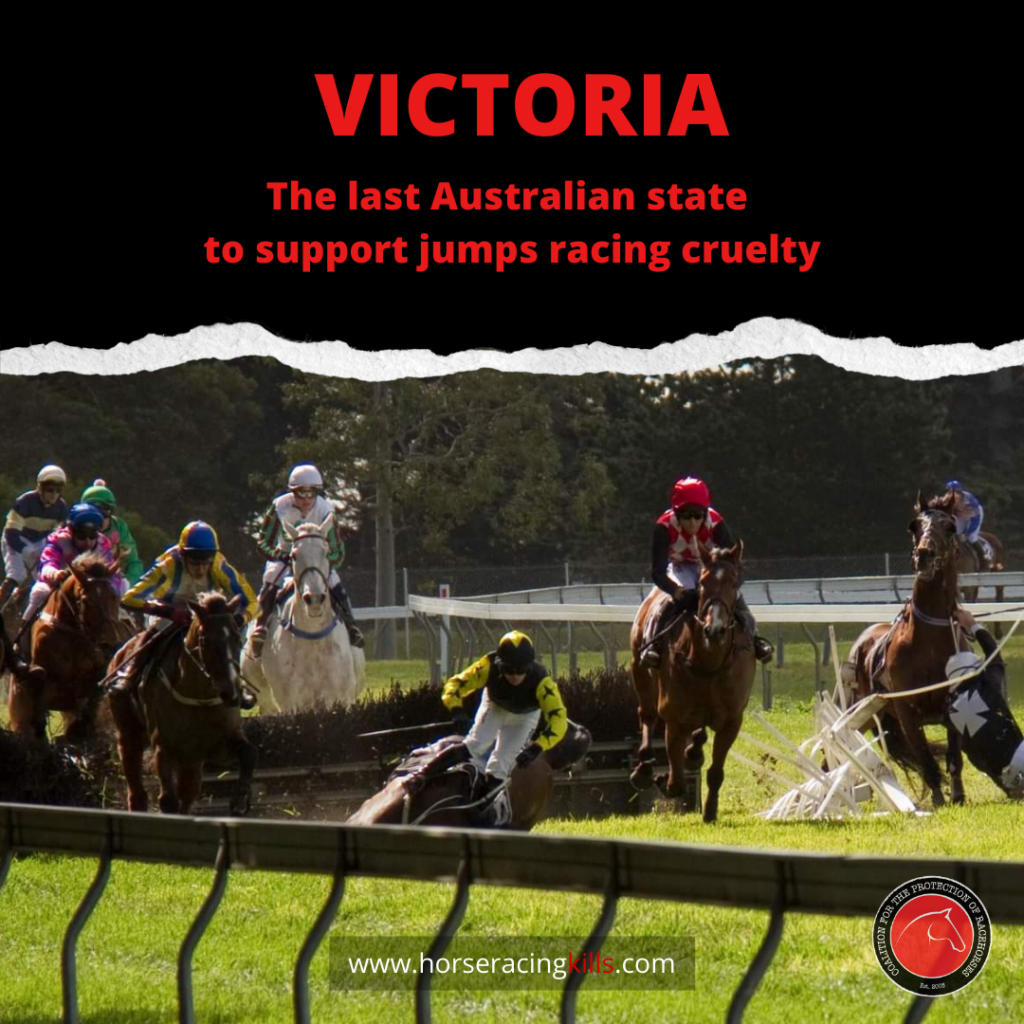
Animal advocates rejoice as jumps racing in SA meets its demise 

The Coalition for the Protection of Racehorses (CPR) welcomes the announcement of the end of jumps racing in South Australia.

“This is undoubtedly great news and will place Racing Victoria under greater pressure to do the same because blatant animal cruelty is no longer acceptable.” Said Elio Celotto, Campaign Director for CPR.

“We’ve been campaigning with Animal Liberation SA for a ban on jumps racing for the last 13 years and finally we’ve seen our hard work vindicated. Now it’s only a matter of time before Racing Victoria also comes to its senses and rids itself of one of the ugliest spectacles in horse racing -that is jumps racing.”

While Animal Liberation SA spokesperson Sally Sutton had this to say, “After more than 20 years of watching jumps racing play Russian Roulette with the lives of horses we are excited to finally be able to say the sport is now officially dead in SA.”

“While the racing industry is citing unpopularity of the sport for its demise, it needs to look at why its unpopular and the answer is because it’s blatant animal cruelty.”

“Years and years of statistics has repeatedly shown that despite the implementation of numerous safety changes, jumps racing cannot be made safe and as we have always claimed, the only way to make jumps racing safe is to get rid of it.”

Victoria is now the only state left that conducts jumps races.

“We’re very aware that despite it continuing in Victoria, there’s mounting pressure on Racing Victoria to do the same and rid itself of a very small part of its industry that attracts a disproportionate amount of negative media attention. If horse racing is to have any future at all, it must follow suit and as soon as possible.”

“At the end of the day, seeing horses regularly fall over jumps, injured and killed on a regular basis is not a sport, it’s blatant animal cruelty.”

https://horseracingkills.com/2021/11/26/8799/

Uncategorized

November 26, 2021 by admincpr Leave a Comment

For Immediate Release, Wednesday 29 September, 2021

LET THE PROPAGANDA MACHINE BEGIN
Glaringly obvious omissions from the Spring Racing Carnival marketing campaign


“The racing industry’s latest pitch to try to redeem themselves from the Spring Carnival wreckage of recent years is so obviously full of holes it is astonishing” said Coalition for the Protection of Racehorses (CPR) Campaign Director Elio Celotto. 

Launched with a full-page ad in the Herald Sun, Racing Victoria’s very first paragraph states, In every corner, on every single day of the year, we provide racehorses with the care and attention they deserve to shine, both on and off the track.

They then immediately go on to contradict themselves by reminding us they have implemented 41 recommendations to set a new global safety benchmark for horses competing in the Victorian Spring Racing Carnival, how they’ll be examining every horse before the Melbourne Cup, Caulfield Cup and Cox Plate and scanning every horse before the Melbourne Cup to prevent injuries.

“So, why are they only implementing the “global safety benchmark” for three events a year?” asks Mr Celotto. “What about the other 540 plus events in Victoria alone, which include approximately 4,300 races? Are those thousands of horses less important because the media spotlight is only on racing during the Spring Carnival?”

“Those are the horse who make up the vast majority of deaths on track and nothing is being done to protect them, simply because they are not Melbourne Cup horses who attract the media spotlight” Mr Celotto said. 

“As our annual Deathwatch proves, (available here) on average, there is another Anthony Van Dyck at least every 2.5 days, with one every eleven days being in Victoria. And that’s just the racing deaths we are fortunate enough to learn of. How many more are disposed of as a result of racing injuries, we’ll never know” he said. 

“Racing Victoria now have an ‘Onsite Euthanasia Program’ (Racing NSW has a similar program). In a desperate attempt to prevent the public seeing injured horses continuing to show up at the saleyards and knackeries, they are now actually paying racing participants to have their horses killed on their properties if they cannot be re-homed, which let’s face it, is most of them.”

CPR has emailed Racing Victoria five times asking for details about the program but are yet to receive a response.

The Spring Carnival marketing campaign also boasts about the $11.5 million dedicated to Melbourne University’s equine limb injury research prevention research which sounds good on paper but is largely being ignored (read more here). Findings demonstrate horses should be regularly rested from training to allow bone to repair yet Racing Victoria has not implemented any limits on the number of times a horse can be used to race, aside from the newly arrived international horses racing in the Melbourne Cup.

“If the racing industry wants to regain the respect of Australians, they, at the very least, need to provide the same standard for all horses. Otherwise, this is clearly just another PR stunt” Mr Celotto said.

“And let’s not forget, while they claim to be giving the Spring Carnival horses the best possible care, they too will still be beaten with a whip – the main tool (but not the only tool) used to inflict pain and instil fear into the horse, often pushing them to the point of breakdown.”

“This is not an industry that cares about their horses. This is an industry that cares about maximizing profit above everything else. And, its most powerful weapon is its clever marketing campaigns, designed to dupe as many people as they can into believing that racehorses are the best looked after animals in the world.”

ENDS

https://horseracingkills.com/2021/11/26/8796/

Uncategorized

November 26, 2021 by admincpr Leave a Comment

For Immediate Release, Monday 13 September 2021

Deathwatch 2021 shows horse racing deaths are the worst we’ve seen
 
The Coalition for the Protection of Racehorses (CPR) has just published their 2021 Deathwatch Report and the numbers are staggering.

“At least 149 horses were reported to have been killed on Australian racetracks over the 2020-2021 racing year. That is thirty-three more than last year” said CPR Campaign Director Elio Celotto. 

Read the full report here. 
View the Deathwatch summary page here.

CPR has been researching and publishing a record of deaths caused from racing related injuries since 2014 – initiated because the racing industry does not collate and publish specific information relating to on-course horse deaths themselves. From the period August 1, 2020 to July 31 2021 (the ‘racing year’), CPR monitored every race Australia-wide and gathered data on the deaths of racehorses on Australian racetracks. 

“This years death toll equates to at least one horse being killed on Australian racetracks every 2.5 days” Mr Celotto said. “And these are just the deaths we learn of from official race day reports. Countless others are taken away from the racetrack and killed behind the scenes when it is clear they cannot (or were chosen not to) be saved”.

A recent Government Information Public Access (GIPA) application to Racing NSW by the Office of Mark Pearson of the Animal Justice Party NSW found trackwork deaths, which are rarely reported publicly, are almost as frequent as raceday deaths, demonstrating the real numbers of horses killed from racing-related injuries would be far greater than the report indicates. 

“Whilst Racing Victoria are spending big bucks on advertisments aimed at luring back Australia’s trust in the Melbourne Cup and spruking new Spring Carnival safety measures, the thousands of other horses forced onto racetracks across the rest of the year are being forgotten.”

“Those are the horse who make up the vast majority of deaths on track and nothing is being done to protect them, simply because they are not Melbourne Cup horses who attract the media spotlight” Mr Celotto said. “There is another Anthony Van Dyck at least every 2.5 days.”

“We are calling on all state racing ministers to force the racing industry to publicly report on all horse deaths caused by injuries sustained in racing, trackwork, trials and training. The Australian people have a right to know the true impacts horse racing has on the very individuals the industry could not exist without” Mr Celotto said.

“It may not necessarily be that this years death toll has been any better or worse than previous years, it’s simply that we have invested more time and resources into digging deeper into unreported deaths. The more you investigate, the more you find. The real figure would actually be much, much higher and that’s why we’re asking for the reporting of all injuries and deaths of racehorses to be mandatory”.

A petition, launching today, is available to the public to support the call for mandatory reporting here.

A video compilation dedicated to the fallen horses can be viewed here. 

Key Findings

  • At least 149 horses died from racing injuries
  • One horse is killed on Australian racetracks every 2.5 days
  • A GIPA by AJP NSW found trackwork deaths are almost as frequent as raceday deaths
  • New South Wales recorded the most deaths, followed by Victoria and Queensland
  • The leading cause of death was catastrophic front limb injury with at least 41 occurrences
  • At least nine horses were two years old when they died
  • Most horses died at just four years old 
  • All states failed on several occassions to upload race replays where a horse died. Victoria was the worst culprit, editing or failing to upload replays on at least ten occassions

ENDS

https://horseracingkills.com/2021/11/26/8793/

Uncategorized

A Story Of Hope For Us All

November 26, 2021 by admincpr Leave a Comment

This is a story of hope for us all.

It’s a story of an ordinary, but paradoxically, an extraordinary woman who decided to take a stand. Her name is Alex Hodges.

In 1985, Alex went to the Oakbank Easter Jumps Racing Carnival that once attracted more than 100,000 people over two days. She didn’t go to support the races, she went to stand outside the main entrance by herself, holding a solitary handmade sign saying, “Steeplechasing is not for horses”. Year after year, it became her ritual to be there in solidarity with the horses, to be their one and only voice in what was sometimes quite a hostile environment. But she never gave up.

One person then became two, as her friend Alice joined her in her fight. It is important to know, the Easter Oakbank Carnival was the biggest ever picnic racing meet in the world and South Australia’s premier social event, but they remained steadfast in their belief that jumps racing was cruel, immoral and had to come to an end.

Many years passed before Animal Liberation South Australia jumped on board to give these two courageous women a helping hand. Their numbers were growing but the Oakbank Carnival continued. Alex has been to every Easter Saturday and Easter Monday protest since 1985 except for one year when she was overseas.

In 2008, CPR was formed and of course there was no way we weren’t going to help out in this David vs Goliath battle. Together with Animal Liberation SA, the number of protestors grew, while the numbers of patrons to the carnival started to dwindle. By 2019, they had all but disappeared. The Easter Saturday crowd was down to less than 10,000, while the Monday crowd only attracted a few thousand hard nut jumps racing supporters. The public had voted with their feet but jumps racing continued.

As we know, just a few weeks ago, a decision was made to end jumps racing in SA because it simply was no longer viable. Now, jumps racing only exists in Victoria.

When Alex first started demonstrating 35 years ago, we wonder if she thought she was really going to make a difference. To her credit, she remained resolute, determined and committed to being there for those who had no choice, year after year after year. She didn’t do it on her own but she certainly was the one who had the courage to start a movement that could not be stopped. It is because of Alex that we have won a small victory for not just horses but all animals. One person can really make a difference and Alex is a perfect example.

“Each time a person stands up for an ideal, they send forth a tiny ripple of hope—these ripples build a current which can sweep down the mightiest walls of oppression and resistance.” Robert F Kennedy

To help end jumps racing in Victoria and make Australia jumps racing free, click 👉https://bit.ly/3GJ92v5

News

Your E-News Update: Spring Carnival Wrap-Up, Squid Game and more..

November 25, 2021 by admincpr Leave a Comment

Dear Supporter,
 
This year Australia showed us yet again that there is an abundance of ways to enjoy Melbourne Cup Day that do not involve supporting animal abuse. And, whilst the majority of the public (and the racing industry no doubt) breathed a sigh of relief that the Melbourne Cup came and went without a horse fatality in the big race, those who follow more closely are all too aware that outside of Flemington this was sadly not the case.  
 
In this newsletter:

Melbourne Cup Day was not fatality free
Australia on track towards making Cup Day a party FOR the animals
Squid Game outside Flemington
Derby Day winner bled as he crossed the finish line
AAMI and David Jones end all horse racing sponsorship
Australian Greens unveil transition plan to end horse racing
$1.1 million cash injection into the traceability register working group
Pregnant mares used in racing
Protest at the Warrnambool rodeo
and more…

MELBOURNE CUP DAY WAS NOT FATALITY FREE  

At least three horses were killed on Australian racetracks on Melbourne Cup Day.

Whilst the Chris Waller Racing team celebrated their Melbourne Cup day win off the back of Verry Elleegant, another one of their horses was being carted dead from the course. Waller trained, six year old gelding, The Grinder, sustained a sesamoid fracture in Race 8 at Randwick and was killed. The team were posting Melbourne Cup celebration pics before his body had even gone cold.

Chris Waller has not mentioned the death anywhere on their socials. Had the death occurred in the Melbourne Cup, it would have been splashed across the headlines and Waller himself would surely have been expressing his out pouring of apparent grief. 

We have also discovered two additional Cup Day deaths.

Three year old filly, Mikki Mouse suffered a fracture to her near hind tibia at the Morphettville track in SA and was subsequently killed. Racing.com edited the replay footage (see here) and the stewards report was delayed from being published until well into the following day.

At the Darwin Turf Club, five year old Daly Waters “went amiss” within 15 seconds of Race 1. He was found to be lame in both front legs and was later killed. 

These horses were never given the new stringent vet checks before racing simply because the eyes of the world were not watching them. Whilst all were focused on whether a horse would die at Flemington, Mikki Mouse, The Grinder and Daly Waters deaths were ignored.  At least one horse is killed on Australian racetracks every 2.5 days.

Read the full report here.  This is not a Melbourne Cup issue. This is a horse racing issue.

Take the pledge to never bet on or attend a horse race here.

MEANWHILE AT FLEMINGTON…  
there were concerns for second place Cup horse, Incentivise. 

“He has inflammation in the near-side fetlock” managing owner Steve Tregea said. “They scanned it and didn’t see a lot but there was inflammation and fluid there and he was lame so we will see what the second scan shows.

“When you are racing horses, these things are always on the cards. It is disappointing but you just have to cop these things.”

The five year old gelding is now spelling and has been reportedly cleared of any serious injury. 

Five year old mare, Tralee Rose, was taken to the U-Vet hospital after the big race with a laceration and concerns of structural damage but has since also been cleared of any serious injury. Her owner reportedly stating:

“It is gut-wrenching, she gave her all. She would have been running under duress and pain and everyone is a bit deflated.”

Persan suffered from heat stress. In Race 2, Shepard bled from the lungs to a degree that “may have afffected his racing performance” and Royal Crown pulled up with an irregular heart rhythm.

In Race 4, Lord Vladivostok was found to be lame in the right foreleg. He was beaten with the whip five times more than that allowed before the free for all beatings in the final 100 metres.

AUSTRALIA ON TRACK TOWARDS MAKING CUP DAY A PARTY FOR THE ANIMALS

People from all walks of life spoke up for animals in such a wonderful variety of ways this Melbourne Cup Day.

Check out this epic video which shows how Australia said #nuptothecup in 2021! (available here).

There were just so many #nuptothecup posts, parties and actions this year we simply did not have the time to find and include them all. We’re terribly sorry if we missed you.

 The first Tuesday of November is absolutely becoming a party for the animals, rather than one at their expense. Huge love and thanks to playing your part in saying no to celebrating animal abuse by saying NUP TO THE CUP!

THANK YOU!  

YOU ARE THE HORSES

If you’ve watched the hit series Squid Game on Netflix, you’ve probably already made the connection between the deadly games on the show and the real-life horrors of horse racing.

On the eve of the Melbourne Cup, CPR and PETA Australia staged a scene from Squid Game outside the gates of Flemington to demonstrate that gambling with the lives of others is wrong.

The comparison between horses and Squid Game players could not be made any clearer by the show’s writers. When viewers meet Seong Gi-hun in the first episode, he is betting on horse races. By the final scene, he realises he has become just like a horse for a group of sadistic, bored gamblers.

Much like the way participants in Squid Game are shot on the spot or fall to their deaths in the middle of games, horses used to race in the industry often collapse and die or are killed right on the track. They are not treated as living, feelings beings, but rather as objects used for the amusement and profits of those more powerful than them. The only difference is that the players on the Netflix show initially get to choose whether they want to play or not, unlike horses.

Like the participants in Squid Game, they are literally running for their lives and often dying in the process.

Watch our media edit here.

DERBY WINNER BLEEDS FROM THE MOUTH  

Hitotsu was bleeding from his mouth as he crossed the finish line first in the Penfolds sponsored Victoria Derby 2021 at Flemington. Connections can be seen trying to hide the blood as he is paraded around the mounting yard. Watch the video here. We guess bleeding doesn’t look great for the winners pic. 

Hitotsu’s tongue was tied down for the race.

A 2016 survey of Australian trainers by Findley et al. analysed 535 responses. Results:
a) 85% used tongue ties.
b) 78% replied that the most common reason for using them was to prevent the tongue moving over the bit.
c) Only 37% used ties when they suspected airway obstruction.
d) 23% reported complications after the use of ties, including lacerations, swelling, bruising and head shyness. [other studies have also observed difficulty swallowing, anxiety, ‘blue tongue’ and permanent tissue damage].

Mr Roger was also recently filmed bleeding in a race, however this was caused by exercise-induced pulmonary haemorrhage. Watch here.

AAMI AND DAVID JONES END ALL HORSE RACING SPONSORSHIP 

Speaking of the Penfolds logo sitting behind an injured and bleeding Derby winner…

We are very excited to announce that AAMI are no longer a major sponsor of the Spring Racing Carnival! In fact, they are no longer a horse racing sponsor at all. Sadly, as you can see above, Penfolds took their place, so what once was AAMI Derby Day, is now Penfolds Derby Day.

AAMI are certainly not alone in making the right decision. Whilst the major fashion retailer won’t comment on its reasons, David Jones has confirmed with CPR that they will no longer sponsor horse racing and have not done so since being a major sponsor of the 2019 Spring Racing Carnival. This confirmation came to us just days after an article in the Australian Financial Review featured comments from the stores general manager of womenswear, footwear and accessories Bridget Veals.

“It’s not for David Jones to comment on political issues, but for a few years now we have thought of this season more in terms of occasions rather than spring racing.”

David Jones re-opened in Melbourne over the first weekend of the Melbourne Cup Carnival, and though the Cup was going ahead to a reduced crowd, you wouldn’t know it from visiting the Chadstone and Bourke St stores, where there were no racing window displays as in previous years.

The article also featured once influencers, now owners and creative directors of vegan shoe brand Twoobs, sisters Stef and Jess Dadon, who did not shy away from speaking out against horse racing.

“Ninety-four per cent of our followers said they did not support the Cup,” says Jess Dadon. “But interestingly, 48 per cent said they once did – so attitudes are definitely shifting.”

While several brands contacted by The Australian Financial Review refused to speak about racing season, Jess Dadon predicts this will change soon.

“The expectation when we started in fashion was that you left your opinions at the door,” she says. “But now, customers – especially young ones – expect you to have an opinion, whether or not they agree with that. Give it a few years and every designer will be shouting this from the rooftops.”

We agree. The question is, will MYER move with the times or stick with this morally bankrupt industry that is dying a slow but certain death? Read the full article here (potential paywall, sorry)

Please consider taking a moment to thank AAMI and David Jones for their smart and compassionate decision by emailing AAMI at [email protected] and sending David Jones a message via their social media pages.

You can also take a moment to express your disappointment to Penfolds via email at [email protected] and cc their overarching company [email protected] and cc [email protected]You can also tweet them @penfolds and message them on their facebook page here.

Perhaps send them the video of Hitotsu bleeding in the Penfolds Derby whilst you let them know you will no longer purchase their wine so long as they sponsor animal abuse.

For our ’10 Reasons Why Your Brand Should Not Be Associated With Horse Racing’ and to sign our boycott pledge click here.

For more hopeful news, check out this article from The Conversation on Melbourne Cup Day on changing attitudes here.

AND IN GENERAL HORSE RACING NEWS…

AUSTRALIAN GREENS UNVEIL TRANSITION PLAN TO END HORSE RACING 

“The transition plan that has been announced by the Greens consists of two steps. It involves the implementation of a horse betting levy aimed at funding the cessation of the commercial horse racing industry in Australia and the establishment of a Horse Racing Transition Taskforce.” More here. 

Senator Mehreen Faruqi explained in her op-ed published by Junkee:“Our plan would establish a taskforce to manage the shutdown, and put a new one percent levy on all betting related to horse racing to fund a just transition. This levy is projected to raise $494 million over two years, and would fund transition activities such as rehoming the animals, retraining programs for workers involved in horse racing, and repurposing racetracks to be used as open green spaces with community facilities. The levy could be increased or extended depending on the activities decided by the taskforce.”

The Australian Greens have also noted the vast spaces racetracks occupy across the country and plan to see them transitioned into green spaces that provide for the entire community. More here.

Meanwhile, just days later in the NSW parliament, it was controversial for Abigail Boyd to even ask the NSW government to step in and ensure the horse racing industry enforces it’s own rules.

“In the horse racing industry, animal cruelty literally pays”, Ms Boyd said.

Watch her speech here. Thank you Abigail. 

$1.1 MILLION CASH INJECTION TO TRACEABILITY

The National Horse Traceability Register, critical to improving horse welfare outcomes and horse and human safety, seems no further towards achieving its goals. A recently announced cash injection of $1.1 million is hoped to help spur it along. 

It has been two years since the ‘Feasibility of a national horse traceability register for all horses’ report was published after a thorough consultation process, and twelve months since the working group to design the register was established.

“We need movement from the working group and a clear commitment to getting this register off the ground as a matter of urgency” said Greens senator Mehreen Faruqi, who spearheaded the initial inquiry. Read the full ABC article here.

EVEN BEING PREGNANT WON’T SAVE THEM FROM THE RACETRACK   

The almost $1.6 million in prizemoney Sweet Deal has been used to earn for her connections was not enough to keep her off the racetrack whilst in-foal.

Sweet Deal was taken out of ‘retirement’ (that’s what they call being used as a breeding machine now), to be raced in the NSW inaugural Invitation – a $2 million race in which she placed 9th. They snuck in a race before and after that one too, resulting in her owners squeezing an additional $42,000 out of her across her three races whilst pregnant.

It is within the rules of racing to race mares up until they are 120 days in-foal.

Read the full article here.

RODEO PROTEST AT WARRNAMBOOL  

Not only is Warrnambool home to one of the cruellest, most gruelling jumps races in the world, it will now play host to yet another horrid form of blatant animal abuse – the rodeo.

Bulls, horses and more will be treated in the most appalling manner in this vile form of entertainment. Sadly, horses from the racing industry also often wind up being exploited, terrified and harmed at the rodeo. Industry proponents would consider this a valid and acceptable “retirement” from the racetrack.

According to locals, the regional city in Victoria’s west has not hosted such an event in many years. Now, with $10,000 in support from the Warrnambool City Council, Warrnambool will regress to behaviour that belongs in the dark ages.If you live in the region, or can make the trip on Saturday 4 December, please stand on the right side of history and protest outside this event to help ensure the people attending know their support of such abuse is unacceptable and to see that the rodeo never returns.

A mini bus of protest attendees will be heading there from Melbourne. Please let us know if you would like to join them. Petrol contribution of $20 required. Protest details are on Facebook here. If you are not on FB please feel free to email us for more details at [email protected]

Image: Bear Witness Australia

Huge love and thanks to the many caring souls who generously donated to our efforts over the Spring Racing Carnival. Your financial support allows us to continue our research, investigations, lobbying and advocacy for these beautiful beings who deserve so much better.

The task at hand is of mammoth proportions, but with passion, kindness, integrity and truth on our side, justice will eventually prevail. We’re here with you until it does

❤

Thank you for reading and remember… speak up, always! 

DONATE TO HELP

News

Your E-News Update: Nup to the Cup/Spring Racing Carnival Update

October 28, 2021 by admincpr Leave a Comment

Dear Supporter,
 
It has not been all that long since our last e-news yet there is so much to report on, both good and bad. And, with the Spring Racing Carnival of Cruelty in full swing there is no shortage of controversy. Read all about it below, along with plenty of ways you can take action for horses. 

In this newsletter:
Spring carnival crowds and controversy
Remembering the Melbourne Cup death of Anthony Van Dyck 
Rose of Peace – the forgotten Melbourne Cup Day victim
Victorian parliament supports a ban on whips
Whip use to be challenged in Tasmania courtRacing NSW rule against horse slaughter is not what it seems 
CPR to protest at the Melbourne Cup
NSW trainer and staff found guilty of animal cruelty
Gai Waterhouse backs campaign to reinstate SA jumps
10 ways you can help horses this Spring Racing Carnival
and more…

LIMITED CUP CARNIVAL CROWDS TO RETURN

Even though horse racing has been allowed to operate throughout the entire pandemic when it is ultimately the antithesis of an “essential service”, it is they who have been guaranteed 10,000 attendees to three major Vic events – Melbourne Cup, Oaks Day and Stakes Day. This Saturday’s Derby Day was later announced to be allowed 5,500. Meanwhile, at our #NuptotheCup picnic, we will be limited to thirty people attending. 

Vic Minister for Racing, Martin Pakula, even has the nerve to openly admit that, unlike last year, they believe they can essentially get away with this blatant double standard due to the desperation of Victorian’s to get out of lockdown. It’s nice to know Vic Labor are happy to take advantage of Victoria’s current yearning for life to resume to at least some level of normality through giving special treatment to gambling and animal abuse. 

To rub salt into the wounds, limited crowds were allowed to return to the Warrnambool track on October 14, as part of Victoria’s first trial for “hosting events in the vaccine economy.” Media reported on what a successful day it was, and how happy people were to be out again to experience at least some level of normality. The racing industry sure did their job at providing the usual level of normality, with four-year-old Rokara killed on the track in the opening race of the day.

Did The Age just happen to not notice this, or did it not fit the feel-good narrative? Would Rokara’s death have mattered if it happened in the Melbourne Cup? See the article here. A video of beautiful Rokara being recently paraded for sale, as an object for gambling profits can be viewed here. Rest in Peace Rokara. 

SIR DRAGONET – THE FIRST CARNIVAL VICTIM (that we know of) 

Five year old Sir Dragonet was killed on the morning of the first big Spring Racing Carnival event, The Caulfield Cup, after his leg broke whilst in trackwork at The Valley. More here.

A recent GIPA application by the Office of Mark Pearson (AJP NSW) found that trackwork deaths are almost as frequent as race day deaths, however we rarely learn of them as they are not reported on by the industry, meaning our Deathwatch Report figure of one horse being killed on Australian racetracks every 2.5 days, although shocking, is still grossly understated. Learn more here.

Sir Dragonet’s rider, Ben Allen, told racing.com that morning “It only happens to the good ones”. If by ‘the good ones’ he meant those who make millions of dollars, then perhaps Mr Allen needs to do his research.

As stated above, the death of four year old Rokara at the Warrnambool track was just two days prior, yet, the media never even gave him a mention. That’s the difference between a horse with a prize money of $32,905 and one who has won his owners over $5 million.

Rest in Peace Sir Dragonet 

CARNIVAL PROTOCOLS HIGHLIGHT WHY SO MANY HORSES ARE KILLED ON TRACK

The most controversial scratching yet at this Spring Racing Carnival is being sent off to race in Sydney instead, despite six vets advising Racing Victoria that the horse is too lame to be raced.

Trainers Ciaron Maher and David Eustace, whose Cox Plate hope was Sir Dragonet, had their four year old, Gold Trip, forcibly withdrawn from the Cox Plate after more stringent veterinary procedures put in place by Racing Victoria, for the carnival only, found his lameness had become worse.

Luke Murrell, co-founder of Gold Trip’s syndicator Australian Bloodstock said “The Rosehill Cup in Sydney, it’s worth good money and he’d be well suited in that. My understanding is that he’s got an invite for Hong Kong and Dubai. He could go there or we could just wait for the autumn in Sydney.” More here.

Meanwhile, Harpo Marx was a late scratching last Saturday from the Moonee Valley Cup due to a lesion identified in his left fore-limb. This was only discovered due to diagnostic tests being employed solely on horses engaged to run in the Melbourne Cup. Had he not been a Melbourne Cup runner also, this would have presumably been missed and he would have therefore been raced.

Four year old gelding Young Werther has been taken out of the upcoming big race after a CT scan, required for Melbourne Cup runners only, identified a lesion in a sesamoid that presented as a risk. Trainer Danny O’Brien stated “The protocols are there for exactly these situations – to pick up things that you wouldn’t have found through your normal veterinary procedures.”

All of the above further demonstrates that countless high risk horses are being sent out on racetracks across the country every single day of the year, where such veterinary protocols are not put in place, simply because the media spotlight is not on them as it is throughout the Spring Racing Carnival.There is an Anthony Van Dyck on Australian racetracks at least every 2.5 days. It’s just that no one is usually paying attention. But that is finally beginning to change.

MELBOURNE CUP CT SCANNER BREAKS DOWN 

Sixteen of the thirty-five Melbourne Cup horses will not be CT scanned before the big race due to the machine breaking down.

CT scans on Melbourne Cup running horses only, were made compulsory this year, as part of Racing Victoria’s latest attempts to redeem themselves after such a long spate of Melbourne Cup deaths.

Racing Victoria’s General Manager of Integrity Services, Jamie Stier said, “Whilst our preference remains to use the technology offered by the standing CT scanner, in its temporary absence we know that the X-rays taken at U-Vet will provide us with improved oversight of the remaining horses, particularly in comparison to previous years, and help to identify any areas that require further examination.

“This was deemed the fairest and most appropriate decision in the circumstances so as not to penalise the connections of those horses who had not been submitted for a standing CT scan since 16 October by excluding them from the race.” More here.

It’s good to be reminded that connections are the priority for the industry.

Whilst this story is making headlines, thousands of horses who are used to race across Victoria and the rest of the country throughout the year never undergo x-rays, let alone CT scans prior to being raced.

THE MELBOURNE CUP DEATH OF ANTHONY VAN DYCK 

Anthony Van Dyck was the eighth horse to be killed at Flemington on Melbourne Cup Day in the past nine years. Stewards stated he “sustained a serious racing injury near the 500 metres and was humanely euthanised.” The injury was in fact a fracture of the fetlock, evident by footage capturing the way the hoof flaps in the opposite direction to the normal movement of the hoof. In instances like this catastrophic injury, the only humane option is to immediately euthanise the horse. Instead, Anthony Van Dyck was loaded onto a float and taken off the course to be killed. The Coalition for the Protection of Racehorses has no doubt this was to try to avoid more bad publicity for Australia’s most famous race. The suffering Anthony Van Dyck would have experienced in those moments would have been unbearable. To have prolonged his suffering is simply unacceptable. Read more including a statement by a former industry vet here.

Unlike every other horse killed in racing throughout the year, Anthony Van Dyck’s death made global headlines for the days and weeks that followed. A horse dying in any race on any day is a tragedy, but to the racing industry, it is Melbourne Cup deaths that are of major concern. A follow up investigation into his death found he was lame a month before he broke down in the Melbourne Cup, that a nerve blocker was administered in the weeks leading up to the Melbourne Cup, and that although a CT imaging machine was available to the horse’s trainers, which would have shown the nature and severity of his injury, it was not utilised.

A horse being horrifically injured when the eyes of the world are watching calls into question how we can allow horses to be killed in the name of gambling profits and entertainment. Anthony Van Dyck’s death has forced Racing Victoria to implement forty-one new safety guidelines for entering horses into the Spring Racing Carnival and the Melbourne Cup, including improved veterinary procedures and screening measures. These guidelines do not impact horses being used in all other races at all other times across the country, clearly demonstrating that it is public perception the industry cares about, not the horses. This years Deathwatch report shows there is at least one Anthony Van Dyck every 2.5 days on Australian racetracks and their lives all matter as much as his. He was four years old.

Read the full Deathwatch Report 2021 here.

Sign to send an automatic letter to your racing minister demanding the reporting of all racing related deaths be made mandatory and publicly available here.

ROSE OF PEACE 

When we remember the names of horses killed at the more recent Melbourne Cup events, the public, the media and even ourselves, seem to have forgotten about Rose of Peace. Although not killed in the Melbourne Cup race itself, Rose of Peace was killed at the 2012 Melbourne Cup in Race 4 – the Herald Sun Stakes.

There have of course been previous Melbourne Cup deaths, but her’s was the beginning of a spate now totalling eight (at least) over nine years.

According to stewards: “Near the 600m Rose of Peace faltered and broke down in the near fore leg resulting in D Oliver being dislodged. Rose Of Peace was subsequently humanely euthanised.”

The day went on, as it always does, to see Green Moon cross the finish line first in the Cup as the crowd cheered. Rose of Peace never made headlines. It appears her death wasn’t even acknowledged, just like the countless others who have been injured and killed on racetracks since. Perhaps she would make headlines now.

She was five years old. 

VICTORIA’S PARLIAMENT SUPPORTS A BAN ON WHIPS IN RACING 

You may recall in our September e-news, we called on you to support Andy Meddick’s (AJP) proposed motion to the parliament to support a ban on whips in thoroughbred racing. Watch the reading of the motion here. Well, that went splendidly and the Victorian Parliament took an official position that they were in favour of such a ban. This is a very important step towards banning the whip not only in Victoria but across Australia.

Aside from legislative change from state to state, Andy’s speech made it clear that the only other way the use of whips will be banned is by the racing industry themselves. Racing Victoria and Racing NSW each have 35% of the vote on the Australian Racing Board. With Racing Victoria and now the Victorian Parliament already onside, WE NEED YOU to put pressure on Racing NSW to get on board and #ditchthewhip. For inspiration to fight against whip use, see this video of Saxton Rock being beaten with the whip, on and in the vicinity of his head, fourteen times by a rival jockey here. She received a fourteen day suspension before being allowed to return to racing. Take action here.

Beating horses with a whip is just the tip of the iceberg in this cruel and ruthless industry. So long as horse racing persists, banning whips is the absolute least they can do.

Huge thanks to Andy Meddick MP and his team for bringing this motion to the parliament, and to you for your ongoing dedication to this cause.

WHIP USE TO BE CHALLENGED IN TASMANIAN COURT 

PETA Australia and the Coalition for the Protection of Racehorses met with the animal welfare manager for Tasracing, Tasmania’s racing authority, several years ago, to express concern over the use of whips, point out that whipping violates the state’s anti-cruelty statute, and offer support to help implement changes. Their refusal to address these violations has led to a private prosecution being filed in the Tasmanian courts.

These charges, filed by PETA Australia, highlight that whipping a horse is a crime both on and off the racetrack and that horse racing has long been given an unofficial free pass. If you did exactly the same thing to any other animal, you would be charged with animal cruelty. This important case will challenge this anomaly  

RACING NSW RULE AGAINST HORSE SLAUGHTER IS NOT WHAT IT SEEMS

The recent case of a high-profile trainer, Trevor Sutherland, winning his appeal against a three-year disqualification from racing for sending horses to slaughter, brought to light two deeply concerning loopholes in the NSW rules of racing – the rule Racing NSW repeatedly claims sets them apart from all other states. We have officially asked Racing NSW five times if, when drafting the rule, this was intentional or an oversight and also whether the rule will be amended to ensure NSW horses are indeed protected from slaughter as they claim, but they refuse to respond.

In short – what the Sutherland case exposed was that according to the appeals panel:1. Racing NSW’s local rule 114, which they claim is designed to prevent horses being killed when no longer wanted, does not capture circumstances of intent if it is decided it was not the “primary intent” of the person sending them to be killed (something we have reported on previously)and2. the words “similarly disposed of” used in LR114(5)(e) which states a horse is not to be, directly or indirectly, sent to an abattoir, knackery or similarly disposed of should be interpreted to mean “a horse is disposed of (killed) for the purpose of its meat being used as food.” Therefore, if a racing participant kills a thoroughbred horse on their own property, and buries them in a pit, for example, they would presumably not be in breach of the rule.

The continued refusal by Racing NSW to answer our simple questions regarding both of these loopholes and also our question as to whether mares used for breeding are protected under the rule, indicates that they either intentionally created this loophole, or, at best, are now aware of it, but are refusing to make the required amendments that will do as they claim and protect all horses under their jurisdiction from being killed when no longer wanted.

When the Racing NSW retirement plan and local rule 114 was first announced, CEO Peter V’landys stated “The youth of today care more about animal welfare than any other generation and we need to keep up with their expectations… Every horse in NSW will be rehomed, whether it has raced or not.” Sadly, it has become clear this statement was nothing but a smoke screen, designed to dupe the public into believing that the horse racing industry was finally taking responsibility for the lives of the horses they could not exist without. Please send an email to Racing NSW asking them to amend local rule 114 to ensure the protection of ALL racehorses, including those used for breeding. [email protected]@[email protected]

For background on the Trevor Sutherland case click here.To read our letter sent to Racing NSW seeking clarification on this important issue, click here.

IT’S ON!   

We have two protests and a picnic in the park happening and you’re invited.  

IMPORTANT: Due to outdoor gatherings limited to 30 people, you must register via email noting which event you plan to attend. RSVPing to this facebook event will not count as a registration of attendance. Please read the event descriptions in the links below so that you are aware of all the details.

EVENT 1: Derby Day Protest outside the Flemington Gates 448 Epsom Road – this Saturday 30 October 10:30am – 1pm. More details here.

EVENTS 2 and 3: Melbourne Cup Protest outside the Flemington Gates 448 Epsom Road – Tuesday 2 November 10:30am – 1pm.ORPicnic in the Park – Newmarket Reserve, Kensington 10:30am onwardsMore details on events 2 and 3 here.

All events still have spaces available. Please email [email protected] to hold your spot. Remember to indicate which event/s you would like to attend. We will respond via email to confirm whether we have been able to hold you a place.


NSW TRAINER AND STAFF FOUND GUILTY OF ANIMAL CRUELTY 

Internal charges of animal cruelty have been laid against Warwick Farm trainer Bjorn Baker along with his ex-foreman and two stablehands of Bjorn Baker Racing.

The act of cruelty took place in the equine pool where it has been reported that a poly pipe and a piece of conduit were used to strike the two year old unnamed horse.

Still, the lawyer for the ex-foreman and two stablehands argued that:“There was no intention to cause pain, injury or suffering to the horse.” All three received suspensions and will be returning to the industry soon. More here.

Since the above article was published, Mr Baker’s case was heard and he received a $4,000 fine.

In all hearing statements Racing NSW are being very tight lipped about the actual acts of cruelty which took place. 

GAI WATERHOUSE BACKS CAMPAIGN TO REINSTATE SA JUMPS   

Just days after the fantastic news that Racing South Australia would no longer host jumps races, trainer Gai Waterhouse joined the calls to have the cruel races reinstated, telling the ABC “I love jumps racing and the reason I love it — it gives the horse an afterlife.” More here.

The racing industry will be the first to deny horses are killed when not profitable. Yet, they are also the first to use jumps racing to claim it is the mechanism that saves their lives. Gai doesn’t seem to understand she cannot have it both ways. 

In any case, it is important to note that the current rate of horses used in jumps racing failing to reappear in racing at all the following year is 47%. Meanwhile, they are placed at even greater risk of injury and death. That’s not much of the great nor long afterlife that Gai would have us believe. 

Meanwhile, the calls to ban jumps racing in Victoria continue – the only state where this brutal cruelty persists. Watch our video summary of the campaign to end jumps racing in South Australia and take action to help ensure the same happens in Victoria here. 

10 WAYS TO HELP HORSES THIS SPRING RACING CARNIVAL 

There are so many ways you can help horses this Spring Racing Carnival. From hosting or attending a Nup to the Cup event or protest, to blacking out Network 10, to signing our petitions, boycotting sponsors, donating to our work or that of a horse rescue and more.

Check out our super helpful list of 10 Ways You Can Help Horses This Spring Racing Carnivalhere.


Thank you for reading and remember… speak up, always!  

DONATE TO HELP

News, Uncategorized

10 Ways You Can Help Horses This Spring Racing Carnival

October 22, 2021 by admincpr 1 Comment

1. Say #NupToTheCup

There are plenty of ways to say #NupToTheCup in a powerful and effective way.

a) Hijack Myer Fashions on your Front Lawn


Through dressing up in your most fabulous, your wackiest, your most stylish, or even your most gruesome of outfits, you can help break through the facade and tell the world that horse racing is far from glamorous.

Myer Fashions on your Front Lawn is the horse racing industry’s COVID-19 answer to the usual Fashions on the Field. People are encouraged to dress up in their most gorgeous racing outfits and enter the competition by sending in pictures of themselves. Let’s get on board and drop some truth bombs among the ignorance.

What to do
Dress up however you feel is appropriate anytime between now and Melbourne Cup Day. Hold a sign with your anti-racing message (e.g. Nup to the Cup, Horse Racing Kills, You Bet They Die, or others). Post this to all your socials (especially Instagram) on Melbourne Cup Day (November 2nd) with the hashtags #fashionsonyourfrontlawn #cupweekfashion #cupweekcasual #familyties #cupweekcostumes #melbournecup #springracing #springcarnival #nuptothecup plus any others you’d like (and be sure to tag @flemingtonVRC).

Remember to make your post public if you are happy to.

Sound good? Any questions please get in touch. We’ll be looking out for your amazing outfits and messages and include them in our coverage of the day. Further information on the actual event here. 
CPR facebook event here.

b) Say Nup to the Cup at your Workplace!

Artwork: Jackie Wolf

Want to do some real change-making? Why not host a Nup to the Cup at work?

Possibly the greatest culprit contributing to the normalisation of the cruelty of horse racing is the ubiquity of Cup celebrations in the Aussie workplace. After all, the workplace is arguably where the pressure to conform is felt most keenly. That coupled with there being no other ‘sporting’ event for which Australian workplaces down tools and celebrates means that the workplace is also potentially the place where we can affect the most cultural change.

Learn more about how you can create a fun and successful alternative to the usual celebration of animal abuse, where you will find simple recipes, games and fundraising ideas here.

Chances are you’ll find that providing a space for people to express their own values versus following a tradition with cruelty at its centre, will be met by your co-workers with a sense of relief. The time is now ripe and you can be that beautiful catalyst for change! 

c) Share powerful graphics
Spend part of Cup Day sharing powerful and truthful graphics about horse racing on your socials to help break through the marketing spin. Our joint action with Animal Liberation and Animal Liberation QLD will help you do this. See how here.

d) Host your own public or private social Nup to the Cup event or join one near you.
You can even register it with us for promotional support and help show the world that the Nup to the Cup movement is growing. Registrations and more details here. For a listing of just some of the events happening across the country, click here.

e) Join a protest or run your own.

The racing industry hates that we rally outside their events as it helps to ensure racegoers are exposed to the reality of what it is they are supporting, hopefully to never return. Check out the list of protests against the Melbourne Cup happening across the country here.  If there isn’t one at your local racetrack and they are running races on this day, why not arrange your own. We are here to help so please reach out.


3. Join the Network 10 Blackout!

In 2018, Network 10 secured a five-year deal with the Victorian Racing Club (VRC), to be the official broadcaster of the Melbourne Cup, including live coverage of all four days of the Cup Carnival. Ten reportedly paid the VRC $100 million for the deal. This provides huge support for horse racing, not only financially, but also through continuing the normalisation and cultural acceptance of blatant animal abuse through splashing it across the screens in our homes.

To send a strong message to Channel 10, we suggest you black them out for the entire duration of Melbourne Cup Day, not just the races. Better still, black them out across all four major race days of the Spring Carnival.  
 

4. Boycott Other Racing Sponsors

Tell Penfolds, Lexus, CUB, Furphy, Myer and all the other Spring Racing Carnival major sponsors that you will no longer support them so long as they support horse abuse.

Write to them directly for the most powerful impact and click here to sign a joint letter to all racing sponsors.

5. Wear it!


Wear your message of kindness everywhere you go.

If you don’t already have any CPR t-shirts, hoodies or caps, last minute orders can still be made here.
 
6. Drive it!


Drive your anti racing message everywhere you go with these bold stencil messages

Orders and how to available here, but please be quick.

7. Watch and Share

Share the truth with horse racing supporters.

Through thorough research and investigations, CPR, journalists and other animal protection organisations are breaking through the well-oiled racing industry propaganda machine. Help this work reach the people who need to see it.

Watch and share these three powerful investigations into the systemic horrors of horse racing

One Year On – 2020

Victims of the Betting Industry: “Wastage” – Horse Meat for EU and Swiss Imports – 2020

The Finish Line – 2020

The Final Race – 2019

Wastage – 2012

CPR’s archive of short film investigations over the past decade can be viewed here.


8. Read, learn, sign and share

Our website is loaded with information about the many issues horses face when used for racing along with simple calls to action you can take. Click the take action tab, where you will see plenty of ways to help horses that are as easy as signing petitions and sharing. From #ditchthewhip, to demanding mandatory racing related death reporting, to banning jumps racing and more. Read through the various pages for all the stats and facts, and become an informed advocate for the animals. Knowledge is power, so reading and sharing this knowledge with your friends and your broader community will help us to create the change the horses need to see.


9. Donate

Edgar’s Mission Farm Sanctuary

Donate to one of the many reputable rescues rehabilitating horses in Australia, or to CPR here, so we can continue our ongoing campaigns, lobbying and investigations. You can make a one off donation or monthly contributions; everything is helpful!

10. Never Be Silent

Speak up, speak out and be heard. Every conversation is an opportunity to change hearts and minds. Every action you take is a step toward ending horse racing cruelty.

For the horses x

News

  • « Previous Page
  • 1
  • …
  • 9
  • 10
  • 11
  • 12
  • 13
  • …
  • 25
  • Next Page »

Contact Us

The Coalition For The Protection Of Racehorses
P.O Box 163, South Melbourne
Victoria 3205

Phone: 0412 039 788
Email Us

Join Our Mailing List

Sign-up to our mailing list to keep up to date. Text alerts are available for breaking news and urgent actions if you are in Australia.

Sign-up now

Find us on Social Media

© Copyright 2016 - 2026 All Rights Reserved by Coalititon for the Protection of Racehorses.

Privacy Policy