• Home
  • About
    • About
    • Achievements
    • International Partners
    • Frequently asked questions
    • Media Enquiries
    • Contact
  • Campaigns
    • Petition: End Overbreeding of Racehorses
    • Nup to the Cup
    • Deathwatch
    • Jumps Racing
    • The Whip
    • Wastage
    • 1 % To Stop The Slaughter (Retirement Plan)
    • New Zealand Campaign
    • Two-year-old Racing
    • Racing in Extreme Heat
  • Issues
    • Racehorses Killed for Human Consumption
    • Racing NSW on horse slaughter
    • Bits
    • JIGGERS
    • Undercover Knackery Investigation
    • Tongue Ties
    • Drug Use
    • Industry Funded Studies
    • Confinement
    • Racing in the Heat
    • Other Health Issues
    • Life of a Racehorse
    • Greyhound Racing
  • Take Action
    • The National Horse Traceability Register has lost its way
    • End Jumps Racing in Victoria
    • Make Reporting of Racing Deaths Mandatory
    • Donate
    • Bequests
    • #ditchthewhip
    • Take The Pledge To Never Bet On Or Attend A Horse Race
    • Volunteer
    • Businesses That Sponsor Horse Abuse
    • Outreach Toolkit
    • Register Your Own Nup To The Cup!
    • Nup to the Cup at your Workplace
    • Your Nup to the Cup Support Kit
    • Stencil Your Car
    • Equinileaks
    • Subscribe to our mailing list
  • Resources
    • Videos
    • Music
    • Reports & submissions
    • Outreach Toolkit
    • Download a banner
    • Download a poster
    • Your Nup to the Cup Support Kit
    • Nup to the Cup at your Workplace
    • A guide to rescuing race horses
  • Store
    • Store
    • Basket
    • My Account
    • Checkout
  • News
    • CPR Media Releases: AU
    • CPR Media Releases: NZ
  • Events

Horse Racing Kills

Horse Racing Kills

Advocating for race horses

  • Home
  • About
    • About
    • Achievements
    • International Partners
    • Frequently asked questions
    • Media Enquiries
    • Contact
  • Campaigns
    • Petition: End Overbreeding of Racehorses
    • Nup to the Cup
    • Deathwatch
    • Jumps Racing
    • The Whip
    • Wastage
    • 1 % To Stop The Slaughter (Retirement Plan)
    • New Zealand Campaign
    • Two-year-old Racing
    • Racing in Extreme Heat
  • Issues
    • Racehorses Killed for Human Consumption
    • Racing NSW on horse slaughter
    • Bits
    • JIGGERS
    • Undercover Knackery Investigation
    • Tongue Ties
    • Drug Use
    • Industry Funded Studies
    • Confinement
    • Racing in the Heat
    • Other Health Issues
    • Life of a Racehorse
    • Greyhound Racing
  • Take Action
    • The National Horse Traceability Register has lost its way
    • End Jumps Racing in Victoria
    • Make Reporting of Racing Deaths Mandatory
    • Donate
    • Bequests
    • #ditchthewhip
    • Take The Pledge To Never Bet On Or Attend A Horse Race
    • Volunteer
    • Businesses That Sponsor Horse Abuse
    • Outreach Toolkit
    • Register Your Own Nup To The Cup!
    • Nup to the Cup at your Workplace
    • Your Nup to the Cup Support Kit
    • Stencil Your Car
    • Equinileaks
    • Subscribe to our mailing list
  • Resources
    • Videos
    • Music
    • Reports & submissions
    • Outreach Toolkit
    • Download a banner
    • Download a poster
    • Your Nup to the Cup Support Kit
    • Nup to the Cup at your Workplace
    • A guide to rescuing race horses
  • Store
    • Store
    • Basket
    • My Account
    • Checkout
  • News
    • CPR Media Releases: AU
    • CPR Media Releases: NZ
  • Events

The Tasmanian Government Refuses to Acknowledge and Address Racehorse Slaughter

April 20, 2022 by admincpr 2 Comments

Supporters may recall, back in November 2020, we published an article titled “Racing Tasmania Admits Racehorses are Routinely Shot in the Head” – available here.

Within the article, we drew attention to an interview with the then General Manager of the Office of Racing Integrity (ORI) and Director of Racing John King, who admitted on ABC Morning Radio that a “significant” number of two, three and four year old racehorses are shot in the head due to simply not being fast enough – referring to the issue as “an unfortunate truth”.

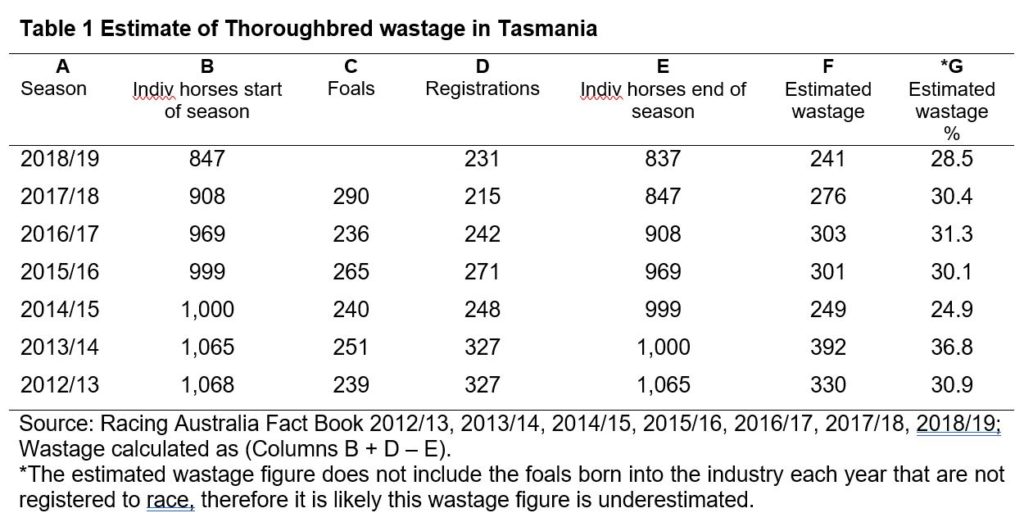
So, we crunched some numbers and found that on average, 299 horses vanish from Tasmania’s thoroughbred racing industry every year.

Mr King did shed some light on where some had gone, when he stated that 59 Tasmanian thoroughbred horses had been euthanised due to injury or illness that racing year.

This figure raised serious red flags, as according to our research of stewards reports for that racing year, 2019/20, not a single horse was reported to have been killed due to injury – at least on race day. Could all 59 injuries resulting in euthanasia have really occurred away from the racetrack?
   
Our article led to us having a discussion with the office of Tasmanian MP Andrew Wilkie, who too was appalled and outspoken when he heard the ABC interview.

Mr Wilkie subsequently put forward some questions to Tasmania’s Minister for Racing at the time, Jane Howlett, regarding:
– Mr King’s comments;
– our findings on the number of horses vanishing from racing each year;
– auditing procedures to claims horses are “retired” and,
– breeding incentive programs.

The answers to these questions came from Mr King’s replacement at the ORI, Tony Latham in June 2021. NB: Mr Latham has since been removed from his role and placed under investigation for misconduct for other matters.

Question 1
How many of those (59) deaths were caused by injuries that were sustained or likely sustained as a result of racing, trials and/or training? 

ORI Mr Latham’s answer:

36 horses were euthanised from injury – The majority of those euthanised was training related with a few injuries sustained whilst spelling. There were no racetrack deaths in 2018/2019 or 2019/2020 financial year.

7 Horses were euthanised from illness.

16 horses were euthanised by the owner’s request due to not suitable for rehoming or behavioural issues.

So, most of the 36 life-taking injuries were sustained during training (not racing) in Tasmania alone, a tiny industry comparative to other states. This is a sobering statistic when you consider our Deathwatch Report finding of one horse being killed due to racing-related injuries every 2.5 days Australia-wide is made up almost entirely of injuries sustained on race day. If deaths caused from training and trials were required to be reported across the country, it is horrifying to imagine how many actual horses are being killed due to racing related injuries each year. Having said this, considering the high number of horses who leave the racetrack injured/lame, it is highly unrealistic that none of those horses would have been euthanised from those race day injuries once being taken from the track.

Question 2
Based on figures obtained from the Racing Australia Fact Book, an average of 299 thoroughbred horses have vanished from racing in Tasmania each year over the past seven years – see Table 1 below. This is approximately 30% of the horses registered to race in Tasmania – a figure similar to that of the country average. Mr King acknowledged that a “significant” number of two, three and four-year-old racehorses are shot in the head due to simply not being fast enough. How many of the horses taken out of racing each year suffer such a fate?

ORI Mr Latham’s answer:

Regarding your comments about horses ‘vanishing’ over the past seven years is not the case, and comments regarding a significant number of two, three- and four-year-old horses destroyed due to not being fast enough is incorrect. The data provided by Racing Australia reveals that between 1 July 2019 and 30 June 2020, sixteen (16) four-year-old named horses were retired from the racing industry. Three (3) were euthanised due to injury, two (2) were retired for breeding, eleven (11) were retired for either equestrian / pleasure / working / companion horse / breeding (non-racing).

So, is Mr Latham stating that the Racing Australia Fact Book figures on the numbers of horses being bred and raced each year (where our figures come from) is incorrect? Is he also stating that his predecessor Mr King lied in his ABC interview or that he was ill informed? As to the data provided by Racing Australia on four-year-olds – well, that accounts for 16 of the several hundred to have vanished from racing that year, and whether accurate is questionable considering the data comes from owners claims on a form.

Mr Latham went on to state:

In 2018/2019 financial year there were 742 named horses notified of being retired, deceased/euthanised or retired as breeding

In 2019/2020 financial year there were 537 named horses notified of being retired, deceased/euthanised or retired as breeding.

Of all the claims made by racing authorities, this had to be one of the most absurd. The figures we calculated in Table 1 demonstrate that on average 299 horses vanish each year from Tasmania racing. Our figures are based on information provided in the Racing Australia Fact Book, which  indicates in the 18/19 racing year 241 named horses vanished from racing in Tasmania. The ORI claims that 742 were retired/deceased/euthanised/breeding. Is the ORI saying the problem is over three times greater than what we found?

Even more absurd, according to the Fact Book, there were only 847 horses in total at the beginning of the 2018/19 racing season in Tasmania. To lose 742 is a single year from racing to retirement/death/breeding is essentially to lose almost every single registered horse from racing and replace them. Mr Latham’s claim of 537 named horses notified as retired/deceased/euthanised/breeding the following year represents a similarly strange scenario.

Such figures make absolutely no sense, unless of course the situation in Tasmania is even worse than our findings suggest.

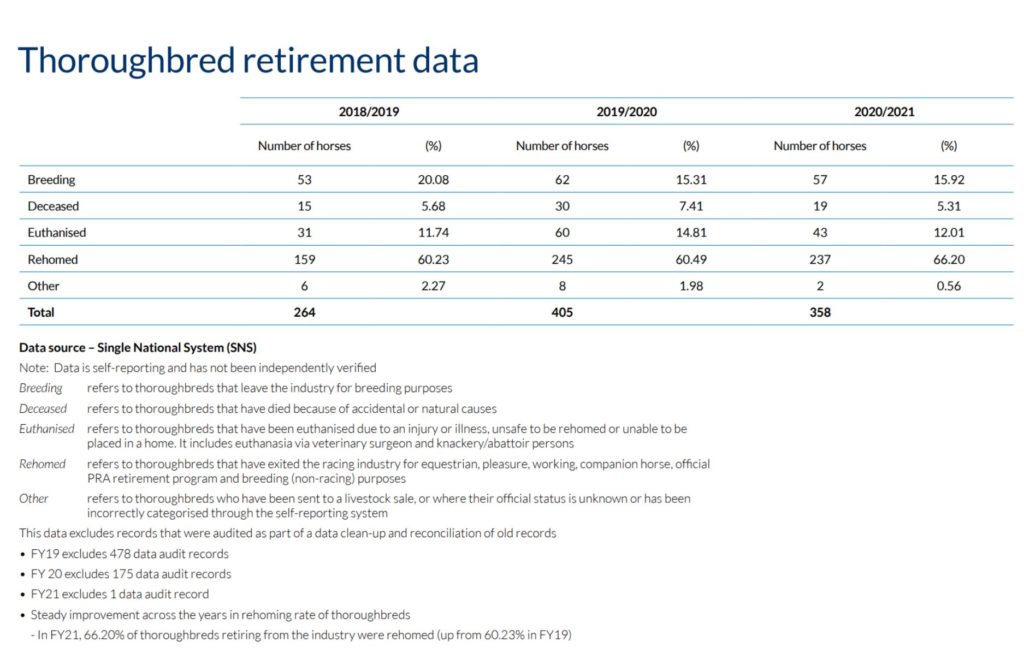
Finally, some light was shed on these claims once Tasmania’s own 2021 Annual Report was published – available here.

On page 19 they mention a “data clean-up and reconciliation of old records” under their retirement data chart.


Adding the “data audit records” to their chart figures adds up to the numbers Mr Latham provided in his response to Mr Wilkie. For example: in the 2018/19 racing year, according to the chart above, 264 horses were retired/deceased/euthanised plus 478 came from audit record clean ups – total 742, as claimed originally by Mr Latham.  

So, there are two options here – either TasRacing are just making up figures to cover for the ORI’s very odd and concerning original claims, or they are actually cleaning up shop as they claim in the above chart (on gathering retirement data at least). If the latter is in fact the truth, then why did Mr Latham not mention this in his response? It appears to us that it never even registered to him that he was providing a figure that demonstrated that almost every single horse in racing was being taken out of racing each year due to death, ‘retirement’ or for breeding and replaced. If he acknowledged how large this figure was, would he not have explained it was due to a ‘data clean up and reconciliation of old records’ as now being claimed in the chart above?

It must also be noted that 2021 is the first time in the history of the TasRacing Annual Report, that they have published thoroughbred and standardbred horse retirement figures. This is a clear indication that increased pressure on TasRacing by animal welfare groups, some politicians and the general public has forced them to demonstrate at least some form of accountability. Previously, the term ‘retirement’ more frequently appears when discussing board members and pension benefits.
 
Of particular note in the TasRacing chart above:

Euthanised refers to thoroughbreds that have been euthanised due to an injury or illness, unsafe to be rehomed or unable to be placed in a home. It includes euthanasia via veterinary surgeon and knackery/abattoir persons.

Euthanasia is when a horses suffering cannot be addressed to give quality of life – not convenience killing, and should never be done in the terrifying horrors of a knackery or slaughterhouse. There also appears to be no requirement for the owner to prove they made any rehoming attempts at all, nor proof that a horse is dangerous.

The chart also claims the majority (over 60%) of thoroughbred horses are rehomed. Yet, it also states: Data is self-reporting and has not been independently verified.

Completing retirement forms is now compulsory, and the address to which a horse is being rehomed must be provided. However, these are not fact checked by the authority. A person retiring a racehorse can say anything they like on the form. Why would one admit they are killing horses once they no longer want them when they don’t have to? And why would John King, as the General Manager of the ORI, have stated in 2020 that a “significant” number of two, three and four-year-old racehorses are shot in the head due to simply not being fast enough? Of course, ‘not being fast enough’ is not one of the descriptions of what being ‘euthanised’ (killed) refers to in the chart above.

There is no way of knowing if the rehomed figures claimed by TasRacing are accurate, but history and the known difficulty of rehoming racehorses makes it a safe bet to assume they are not. At the very least, the figures provided by the ORI in the various stages of this brief inquiry about “retired” horses, gives the public virtually no confidence in the accuracy of their record keeping.

As a final note on the above chart: there is interestingly one very obvious statistic missing. Trainers and owners constantly profess their absolute love for the horses they use. Yet, there is no category for a trainer or owner who has kept their horse after ‘retirement’. According to TasRacing figures, every single horse used to race over the past three years either died, was put into breeding, was sent to a livestock sale, or was rehomed. It is of course entirely possible that some owners/trainers may have kept a horse in their care after racing, but the fact that this is not even a category suggests they would of course be the exception to the rule. Funny that.  

Our final question to the Tasmanian Minister for Racing
The Tasmanian government has allocated $1.54 million toward the Tasbred incentives scheme designed to encourage Tasmanians to not only breed more thoroughbreds but to also race them as early as two, three and four years old. Considering there is a “significant” number of horses being killed each year for simply not being fast enough and the fact that racing horses before their skeletons are fully formed increases the chance of early injury and therefore death, is it not therefore against the industry’s and governments claims of taking animal welfare very seriously, to be encouraging bringing more horses into an industry only to be injured and/or killed at an age that is a fraction of their natural lifespan?

ORI Mr Latham’s answer:

The Tasmanian Government financial contribution to the TASBRED scheme strengthens the Tasmanian Racing Industry, providing incentives to increase breeding of racehorses in Tasmania, creating new jobs within breeding, racing, and associated primary industries. The TASBRED scheme in my opinion will not lead to an increase in animal cruelty as the horse population remains at a consistent level and the number of races held has not increased.

The TASBRED scheme will promote breeding in Tasmania which will strengthen the Tasmania thoroughbred population and in the longer term, this will decrease the number of imported horses coming into the state from the mainland.

This $1.54 million has now increased to $2 million for 2022. Even though retirement data, now officially published, shows approximately 300 thoroughbred horses alone (approx. 450 when horses from Tas harness racing are including), are in need of good homes each year, just in Tasmania, the Tasmanian Government doesn’t see incentivising more breeding to be a problem. Of course, these are just the numbers of horses who are retired after making it to the track in the first place. Plenty more who are bred do not. A horse’s natural lifespan is roughly 25 years. Where does TasRacing and the Tasmanian Government expect all of these horses to go? Sadly, we know the answer.

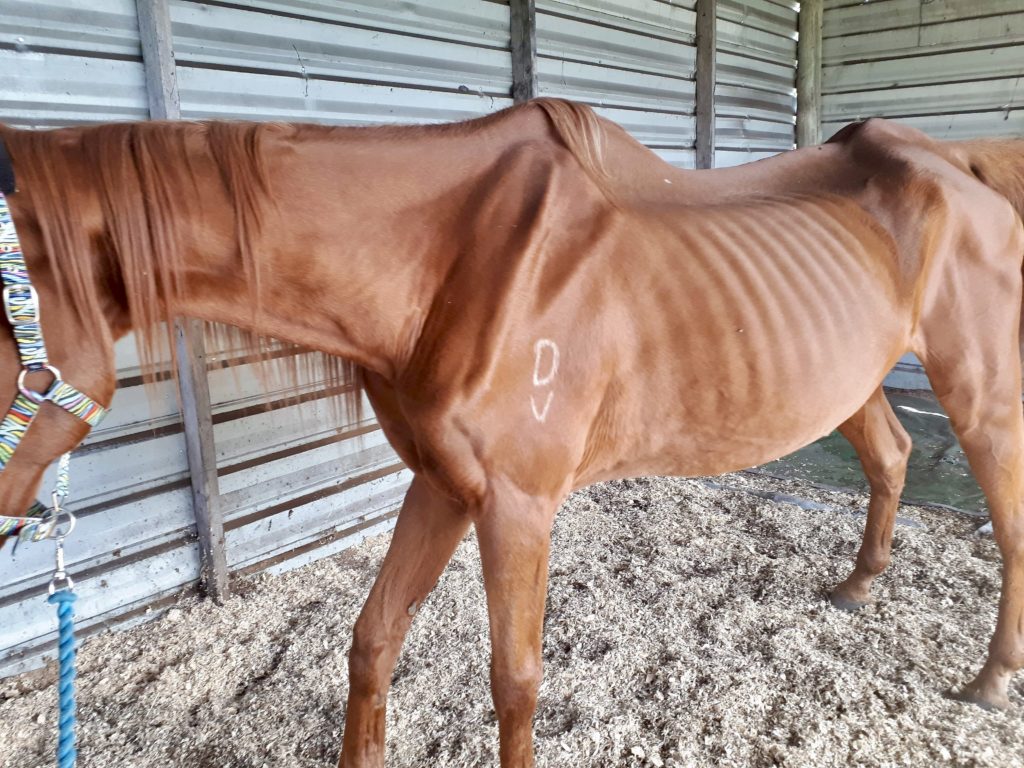
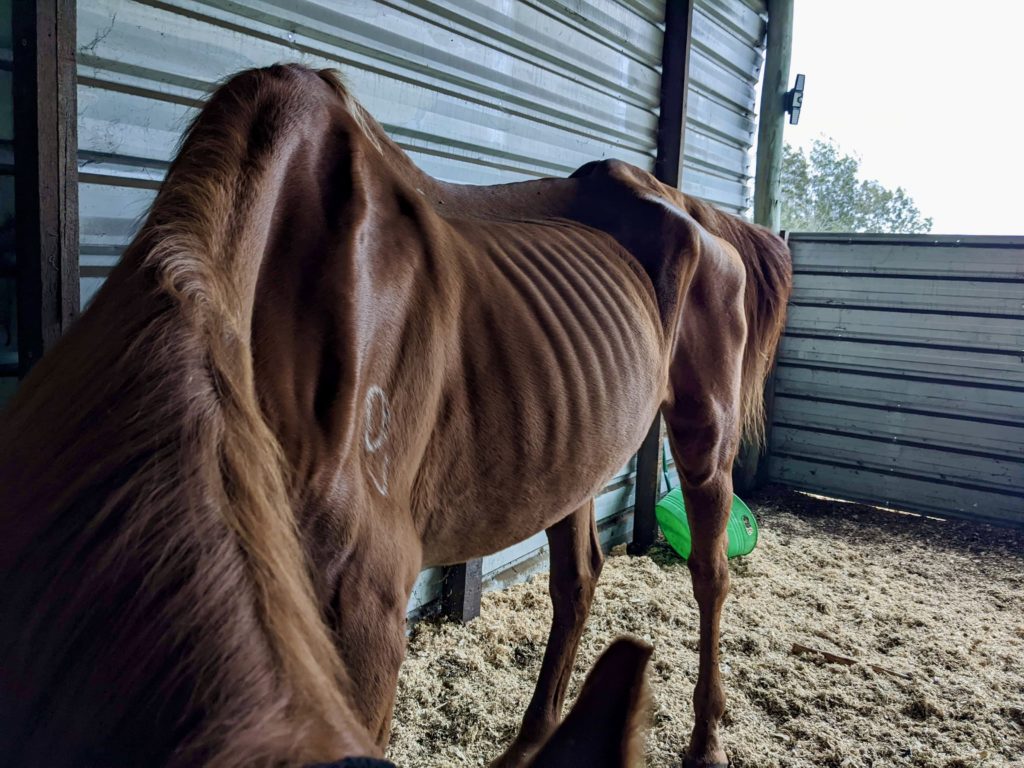
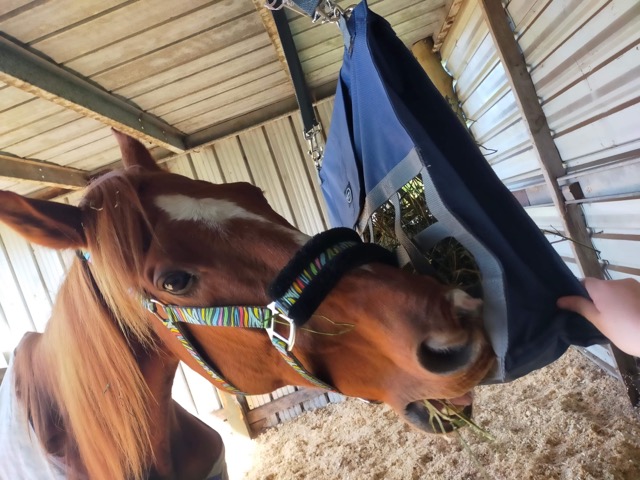
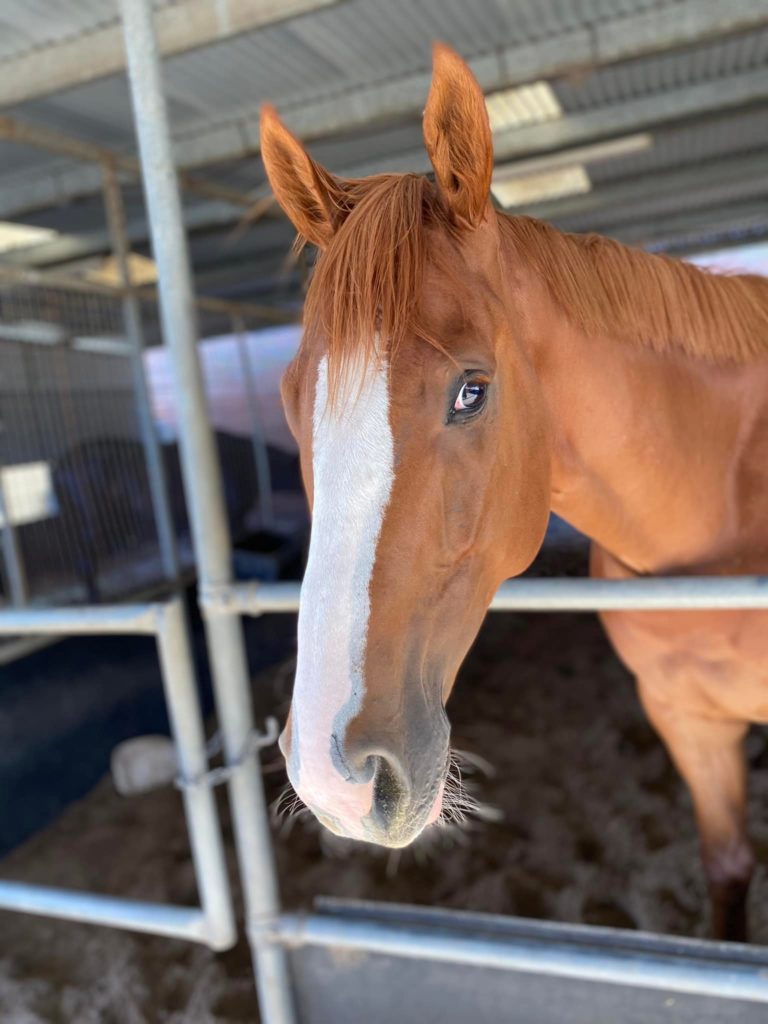
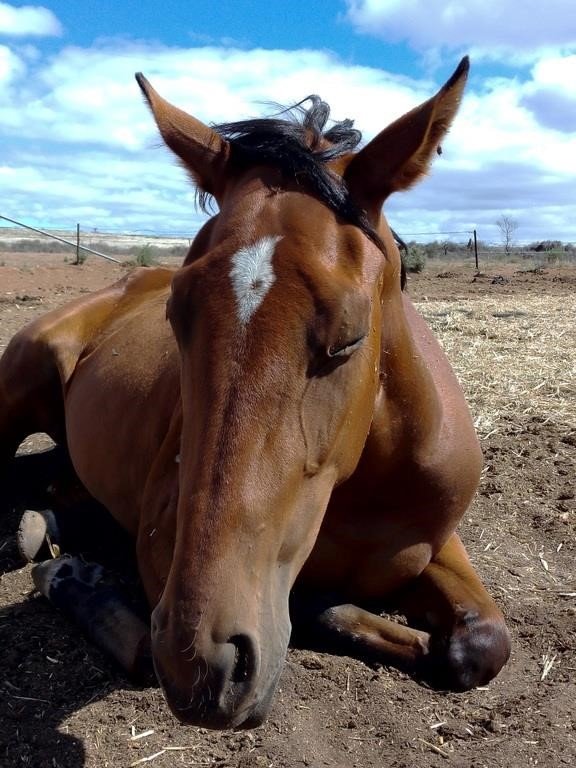
Cover image: Sneaky – a Brightside Farm Sanctuary resident, rescued from a Tasmanian racehorse trainer who was selling him for pet meat.

News

Your E-News Update: Sweden bans whips, Racing Vic calls parents ‘woke’ and more..

March 22, 2022 by admincpr Leave a Comment

Dear Supporter,
 
We are well into the new year and summer has come to a close, so we thought it was time to send out an update on just some of the things that took place over the hottest months of the racing year. We know our e-news letters can be a bit grisly due to the cruelty in horse racing knowing no bounds, so we are glad to say we are going to kick off and finish off with some more hopeful news for animals in this edition. heart

In this newsletter:
Sweden bans whips in racing
Racing calls parents ‘woke’ now they are no longer able to bribe schools
Racing WA goes from bad to worse
Sir Mark Todd whipping causes international outrage
Tragedy in the barriers
Happy Winner treated like a used car
Thoroughbreds at sales
CPR NZ annual injury and death stats
Racing NSW to capitalise on Melbourne Cup deaths
Vets who sponsor animal abuse
Nup to the Launceston Cup
NSW Greens announce animal sentience bill
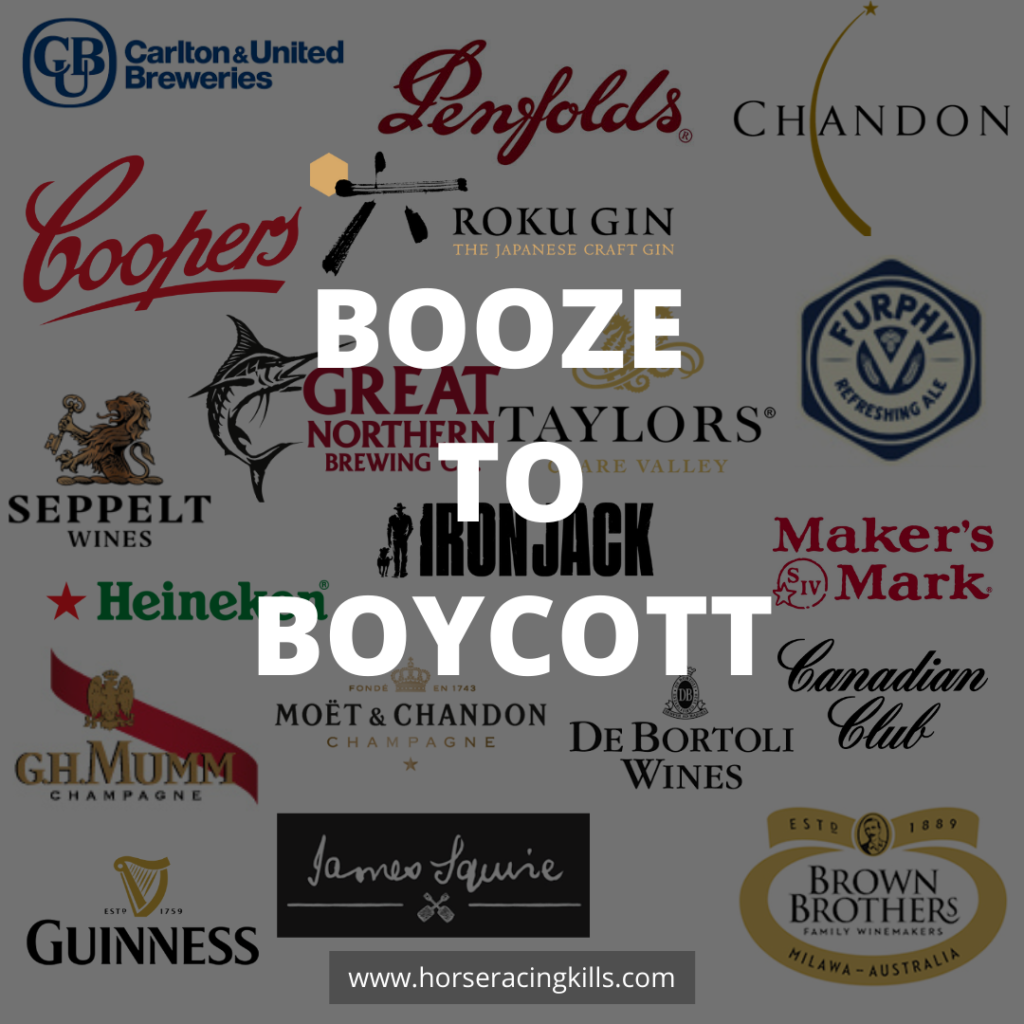
Booze to boycott
Upcoming protests
The tennis is the new races 

SWEDEN BANS WHIPS IN RACING
“The use of the whip in Sweden has been discussed for years,” said Helena Gartner, project manager of the Scandinavian Racing Regulations Committee. “The regulations have changed gradually and the foam-padded sticks were introduced some years ago, but now it is time to ban the use of the whip completely. Whip use in horse racing simply does not belong in 2022.”

Unfortunately jockeys will still be allowed to carry a whip which they claim can only be used to prevent accidents. More here.

Neighbouring Norway made changes to whip rules way back in 1986. By 2009 they banned the use of whips in almost all races. Former Norweigan Jockey Club director Hans Petter Eriksen has made it clear that there have been no accidents resulting from jockeys not being able to carry a whip and steward Helge Byrgin has stated that anecdotal evidence suggests that there have been “fewer serious injuries to horses during the races than there were before.”

Whilst whips are only the tip of the iceberg when it comes to horse racing cruelty, ending their use will without a doubt reduce horse injuries, torment and suffering. It is beyond time Australia followed suit. TAKE ACTION to #ditchthewhip here.

TOUGH TIMES WHEN RACING CAN NO LONGER BRIBE SCHOOLS 
 Earlier this week, Racing Victoria boss, Giles Thompson made no friends when he blamed ‘woke’ parents for keeping racing out of schools.

From the article:
… he admitted the industry had little luck trying to get into schools to promote all things good about racing, saying 95 per cent of schools had knocked back Racing Victoria initiatives, such as free educational incursions in schools, visits from horses or jockeys and excursions to racetracks.

“It only takes one parent to object to the headmaster or headmistress that you’re encouraging kids to gamble, and that will shut it down,” he said.
“When we could deliver [education programs], it was wildly successful. But you couldn’t get into the schools. Ninety-five per cent of schools would say, ‘we’re not interested,’ and you’d say, ‘why not?’ and they’d say, ‘the parents won’t put up with it’.

“It’s ‘wokeism’ if you like, of, it only takes one parent to kibosh it when 50 parents might be pro it.”
But Thompson said racing’s challenge when it came to engaging children wasn’t just gambling-related.

“If you think about what puts a school off racing, it’s the gambling, it’s the breakdowns of horses – horses breaking down in the Melbourne Cup is tragic for us in that environment – and it’s how we’re perceived,” he said.

“That’s a real challenge, and it certainly can’t be fixed overnight.”

Full article here.

RACING WA GOES FROM BAD TO WORSE 

Track Deaths
You may recall in our last e-news just before the holiday season, we alerted you to the fact that since October at least eight horses had been killed due to injuries sustained whilst being used to race on WA tracks – five of them at Ascot. Sadly that figure has now increased to twelve, with six of the discovered fatalities occurring at the same track – Ascot. 

Our calls to the Racing Minister Tony Buti to cancel the New Years Day Perth Cup and launch an investigation at the deadly track were denied. To demonstrate even more disregard, the Minister sent us a letter praising Racing and Wagering Western Australia for all its wonderful work in horse welfare.

Either Mr Buti knows nothing about the portfolio he carries or he is simply a tax payer funded industry mouthpiece.  

The sixth Ascot death we were unaware of at the time was beautiful Pocoyo (pictured). The four year old gelding was yet to even be raced when he was injured and killed in trackwork at the Ascot course.

Heat Illness
WA experienced some brutally hot weather over the summer period. Temperatures in Perth climbed to over 40 degrees for six consecutive days but that did not stop the races from going ahead. Many horses were reported to suffer exertional heat illness on racetracks across the state, with at least three horses suffering the illness on one race day alone. 

Exertional heat illness is a terrible condition to suffer. Symptoms vary depending on severity and include abnormal neurological function, disorientation, irritability, instability, collapse, convulsions, coma and even death. Stewards reports play down the severity with symptoms minimised or even not recorded in their reports. A milder version of the illness can be viewed here. 


Hot weather policies are very vague across Australian racetracks and allow much room to deviate from what is required to avoid horses suffering heat illness. Even when races are moved to less brutal times of the day, little if any consideration appears to be given to the fact that horses may have already endured extreme heat for several days prior to the meet and are often transported long distances in uninsulated floats without ventilation to reach the track.

Every which was you look at it there is suffering in horse racing and a lack of integrity among those bestowed to protect the horses welfare.  

WA Protests
Whilst the heat did not stop the races, it also didn’t stop our dedicated CPR team in Perth who came together to say Nup to the Perth Cup. Thank you so much to everyone who attended.


WOULD THE WORLD BE OUTRAGED IF HE AND THE HORSE WERE ON THE RACETRACK?  
Several weeks ago, footage emerged of Sir Mark Todd whipping a horse ten times with a stick to make them go through a water obstacle.

The knighted equestrian champion has been a licensed racehorse trainer in the UK since retiring from eventing three years ago.

Whilst we absolutely condemn this act of violence, we must highlight that such acts of aggression and abuse are standard practice in the racing industry. Beating a horse with a racing whip is not unlike what Mark Todd has been exposed carrying out in a cross-country training session, yet his behaviour in this scenario has outraged the world. This says a lot about how much people are willing to accept blatant animal abuse when it occurs in a scenario where they are used to seeing it. Watch the perfect example here.

Racing industry proponents were quick to go into damage control, using this incident to call on the British Racing Authority to change the name of the whip to something more palatable such as a “procush” or the “encourager” believing the public will not associate beating a horse with an object as a form of abuse if the object has a different name – see here.

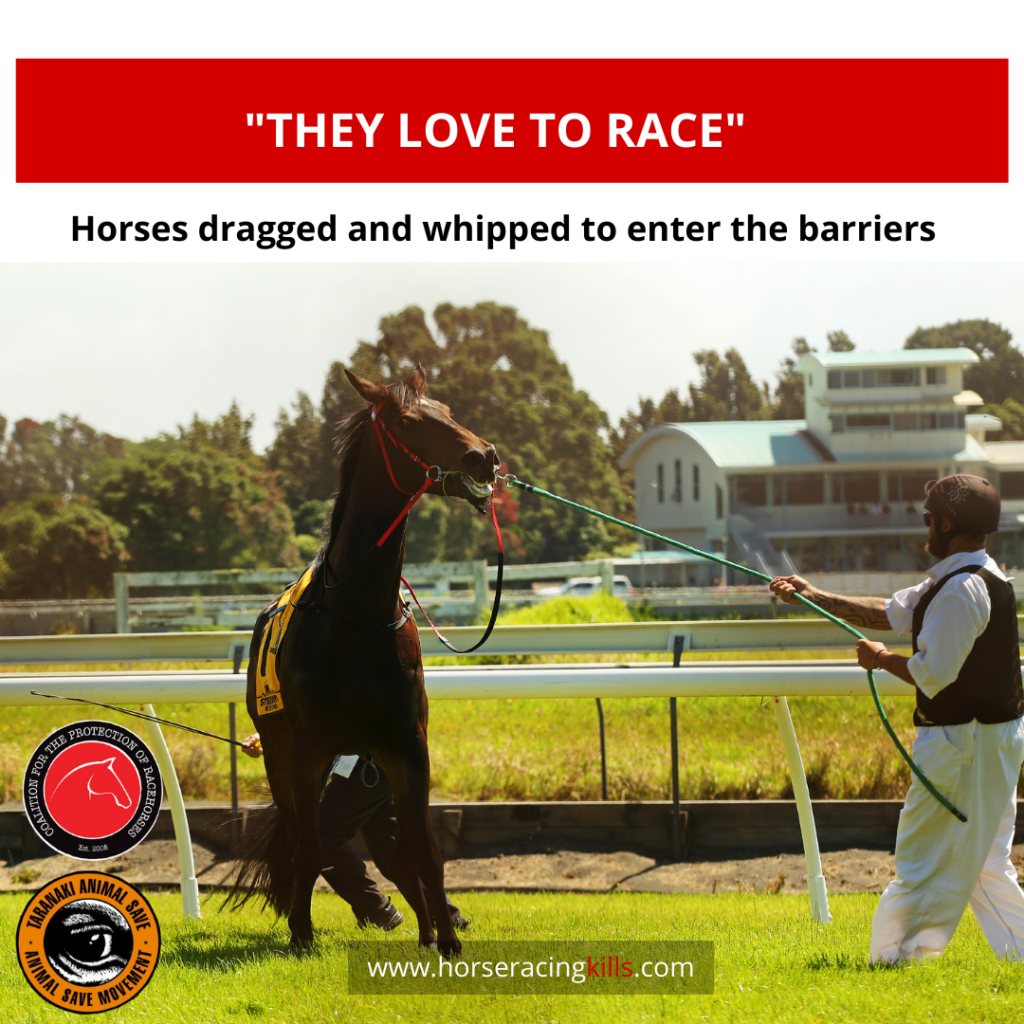
As another example of this disconnect when it comes to horse racing, New Zealand horse Rocket Science didn’t want to go into the barriers so he was struck repeatedly with a buggy whip around his croup, flank and the back of his legs. Watch here. The four year old gelding was eventually scratched from the race but had he not been, he would have also been subjected to the standard industry practice of being beaten with a regular racing whip on the course. 

The abuse Mark Todd subjected this horse to was rightly condemned by the world. We are calling on the public to make the connection between the appalling abuse Sir Mark Todd subjected this innocent horse to and the standard industry practices that occur daily in horse racing. People must join the dots and see that such abuse should never be accepted simply because it occurs on a racetrack.

TAKE ACTION to #ditchthewhip here.

For more abuse behind the barriers, watch here and here. Captured at the New Plymouth racetrack by CPR New Zealand and Taranaki Animal Save


TRAGEDY IN THE BARRIERS
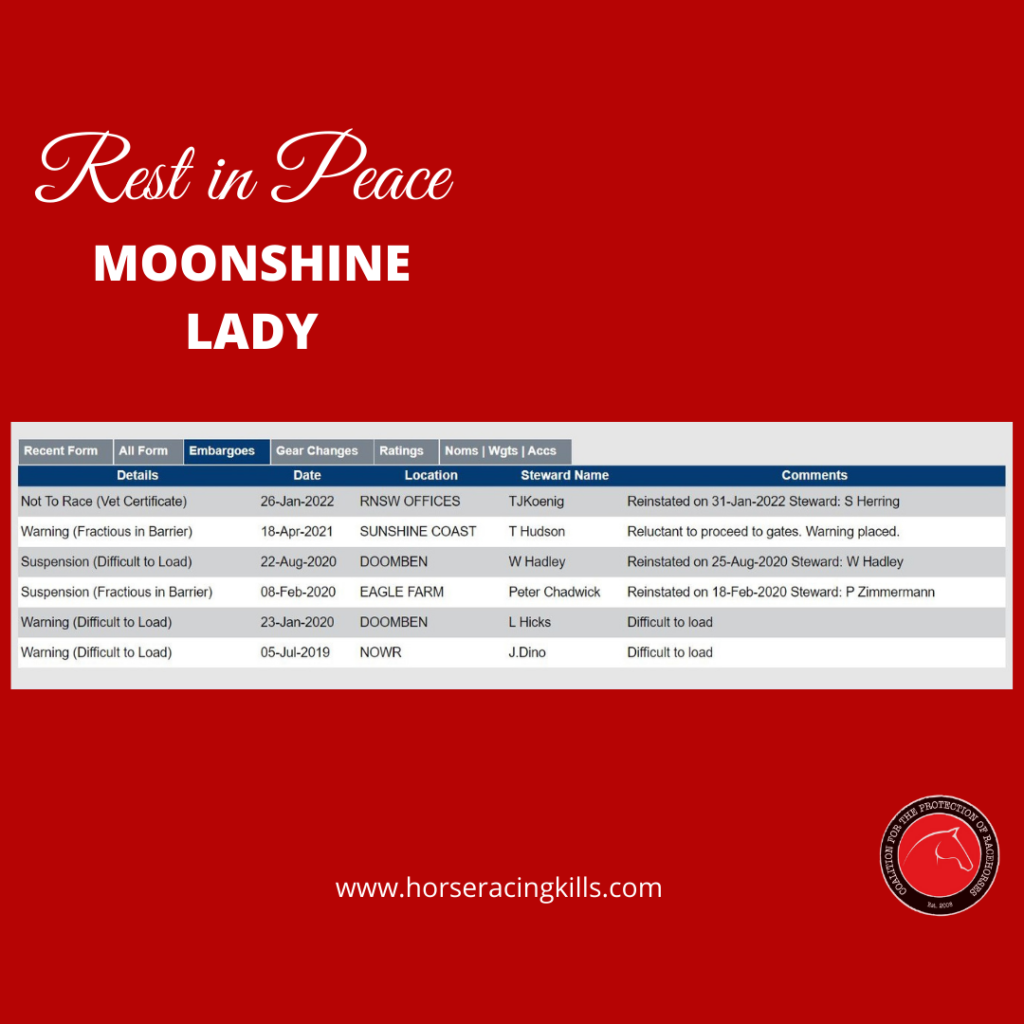
 “UNRULY”, “PLAYING UP”, “HOTHEADED”, “AWKWARD”, “A REAL PROBLEM”, “POOR BARRIER MANNERS”, “RELUCTANT TO PROCEED TO GATES”, “DIFFICULT TO LOAD”.

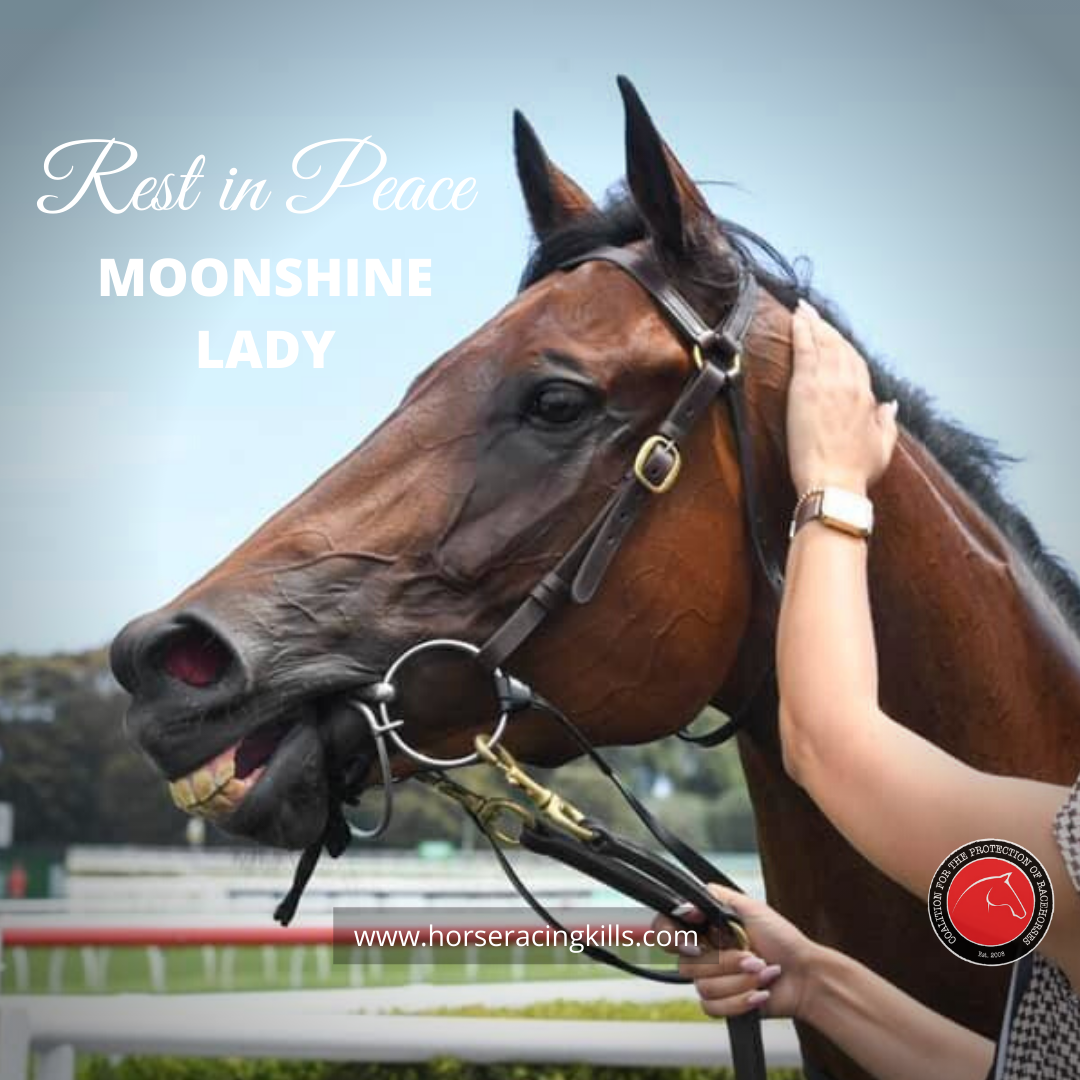
This is how Moonshine Lady has been described over the years by trainers and stewards for not wanting to be forced into the barriers to race. They repeatedly ignored her objections and this ultimately led to her death. Horses regularly become fractious and panicked inside the barriers with many dragged by the bit or hit with a buggy whip just to get them inside. For Moonshine Lady, her refusals were so great that she had been embargoed on five previous occasions.

At Randwick on February 12, the six year old mare once again panicked after being forced into the barriers. She reared and consequently became stuck, sustaining a catastrophic injury to her upper right forelimb. The veterinarian on duty decided her injury was so great that she had to be “euthanised”. The words now being said about Moonshine Lady in horse racing circles are “oh no”, “condolences to her connections”, “is she ok?”, “that looked horrible”, “has she survived?”, “that looked horrific”.
 
Moonshine Lady’s fears and objections to racing were repeatedly ignored because she was seen as an object to make money from and it cost her her life.

Rest in Peace Moonshine Lady. We are so sorry.

Read our article on how common it is for horses to become stressed from being forced into the barriers here.


A USED CAR MAY HAVE BEEN GIVEN MORE CONSIDERATION   
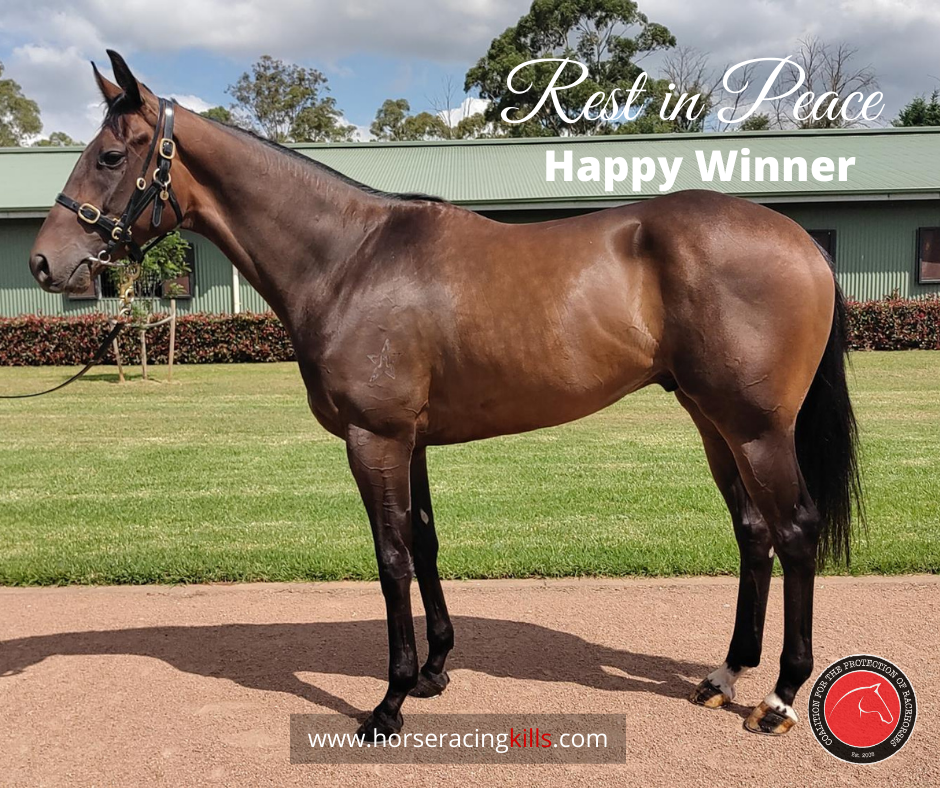
In January, Racing NSW stewards found trainer Joanne Hardy guilty of actions which likely led to the death of three year old gelding, Happy Winner.

Happy Winner suffered an injury to his off-fore superficial digital flexor tendon and required a recovery period and rehabilitation program. Ms Hardy failed to disclose this information both when advertising him for sale and to the subsequent buyer – another industry trainer Brett Robb. Mr Robb put Happy Winner into a “work program” that was contrary to the recovery period and/or rehabilitation program he required before he suffered a catastrophic injury to both fore superficial digital flexor tendons and was euthanased.

Ms Hardy paid $15,000 for Happy Winner in March 2021. By April she was aware of the injury and by June he was listed for sale. She never made a cent from him before he was injured and presumably wanted to recuperate her costs. Happy Winner was treated more like a used car than a living being, which should never surprise in an industry that uses animals for profits.

Joanne Hardy has been suspended for eight months for her actions, plus an additional two months for providing misleading evidence to stewards. Full report available here.

THOROUGHBREDS CONTINUE TO BE BRED WHEN THERE SIMPLY ISN’T THE HOMES 
 Fifteen thoroughbred horses were listed for sale in the recent Andrew Wilson Online Sales. Twelve were ‘passed in’ – many not coming close to their reserve.

💔Several were still listed as ‘ACTIVE’ by the racing authority.
💔Some have never been raced.
💔Others have been raced as recently as December last year.
💔Two horses did not even have a reserve.
💔Several remain at serious risk of being purchased by kill buyers.
💔All, once sold, will end up in the hands of strangers, with the sellers having no idea or control as to what their lives will be like and their eventual fate will be.
💔A good life expectancy of a horses is 25+ years.
💔The average time a horse is used in racing is less than three years.

The racing industry continues to breed 13,000 horses a year knowing the vast majority of industry participants no longer have an interest in keeping them once they can no longer race them (that’s if they make it to the track at all) and that there is clearly not enough demand to find them post racing homes. 
 The racing industry just doesn’t add up. It never will.

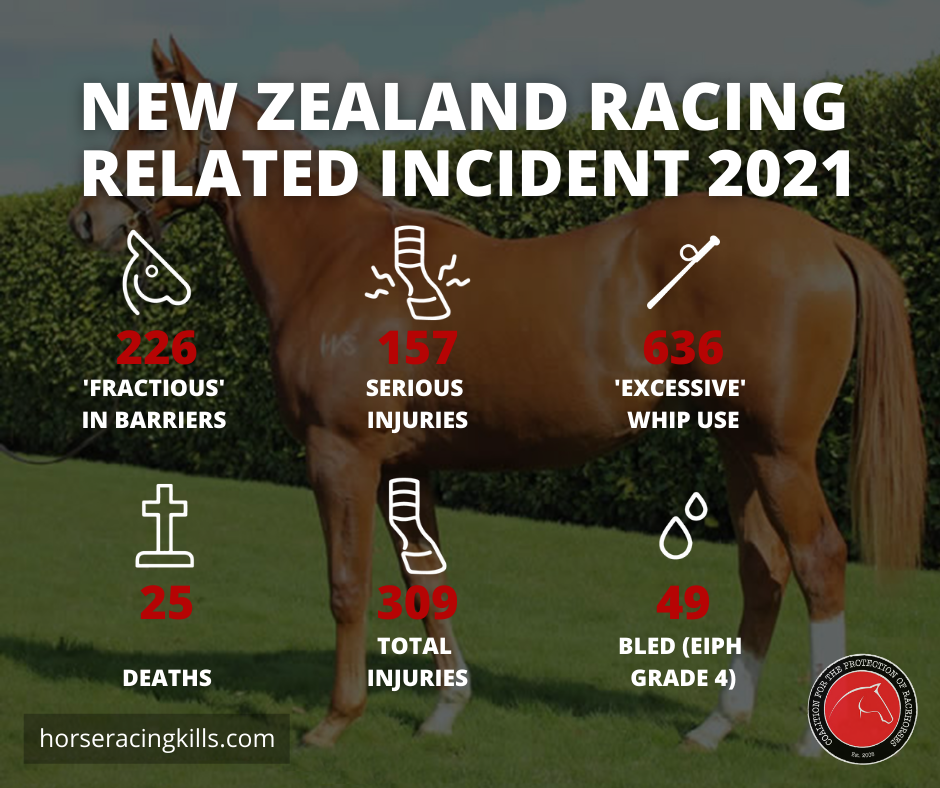
CPR NEW ZEALAND RELEASES ANNUAL INJURY AND DEATH STATS 
New Zealand racehorses suffered tremendously across 2021.Sadly, twenty-five of them lost their lives on the racetrack – their average age just five years old. Deaths resulting from injuries sustained in trials, training and trackwork are not included in this figure as the industry does not report these deaths.
 306 injuries sustained whilst racing were recorded and some contribute to the 3,000 (approx) horses who vanish from NZ thoroughbred racing each year and remain unaccounted for. More on that here.

Rest in Peace 💔
Communique – 5 years old  
Fasong – 5 years old
Megavision – 3 years old
Truefalls – 5 years old
Gamester – 4 years old
Kaharau – 10 years old
No Dancing Today – 3 years old
Man oh Man – 5 years old
Woletthefoxout – 7 years old
Kool Power – 4 years old
Pablo Esk – 4 years old
Barry’s Choice – 3 years old
Our Cuzzie – 5 years old

Cutting up Rough – 8 years old, Speck Savers – 4 years old, Canadian Mountie – 3 years old, Oceana Lad – 5 years old, Falco Three – 4 years old, On Show – 4 years old, All Night Long – 5 years old, Wowwhata Haradasun – 3 years old, Altar Boy – 4 years old, Rock on Wood – 6 years old, Americo – 4 years old, Trickle Treat – 5 years old

RACING NSW TO CAPITALISE ON CUP DEATHS  
Racing NSW is working to capitalise on the demise of the Melbourne Cup event that has seen at least eight horses killed in nine years, by scheduling a new $2 million race event ‘The Big Dance’ at Royal Randwick on Melbourne Cup Day. Article here.

Whilst ‘The Big Dance’ aims to lure the younger generations who are turning their backs on horse racing to the track, they must be made aware that track deaths are not reserved to the Melbourne Cup. What’s worse – whilst the 2021 Melbourne Cup was spared another track death, on that same day six year old gelding The Grinder was killed at the very track where ‘The Big Dance’ will be held.

Wherever there is horse racing there will be horse suffering and horse deaths.

Say #NuptotheBigDance and #NuptotheCup.

VETS WHO SPONSOR ANIMAL ABUSE 
We recently observed some interesting comments regarding a registered veterinarian being implicated in the probe into race-fixing and cocaine trafficking last year.

We 100% agree that it is an absolute disgrace to learn a vet is allegedly involved in such a rort and felt this was a good opportunity to highlight something we have long found very disturbing.

It is not uncommon to see veterinary practices sponsoring horse racing. For example – the Bendigo-based clinic Apiam Animal Health has long been a supporter and sponsor of the Bendigo Jockey Club, and in 2020 became a major partner. In fact, Apiam Animal Health were direct sponsors of at least two races that resulted in the death of horses in the last racing year – six year olds Skilled Assassin, and later Super Girl, in the Bendigo Cup.
 
Southwest Equine Veterinary Group is another regular horse racing supporter. Perhaps even more shocking is they have been a long-time and frequent sponsor of jumps races at the Warrnambool track. In 2020 they directly sponsored the jumps race which caused the shocking fall of eight-year-old Unabashed and ultimately took his life.

There are so many wonderful, dedicated and passionate vets out there who work tremendously hard and truly care about the wellbeing of animals. In becoming a vet, one must make a commitment to animal health and welfare and many suffer emotionally and physically from the heavy burden of the work.

It is possible to work as a vet to improve the health of all animals, including those who are used in racing, but to endorse the cruelty and suffering inflicted upon them as a registered veterinary practice, and use their suffering to promote your business is unacceptable and an absolute betrayal of the very animals whom they are supposed to protect.

NUP TO THE LAUNCESTON CUP 

Huge thanks to Direct Action Everywhere – DxE – Tasmania for saying Nup to the Launceston Cup last week. Racegoers could not ignore their message on the cruelty they were supporting as they entered the gates.

 Interestingly, the news article here quotes a Tasmanian government representative strongly defending the industry and stating:

“To improve transparency on animal welfare, Tasracing is providing information in their annual report on track injuries, euthanasia, retirement and re-homing statistics. The majority of industry participants provide great care to their animals.”

As far as we can tell, 2021 was the first annual report to record such statistics. Could this be in response to our damning article in late 2020 that exposed the number of horses vanishing from TasRacing each year? A finding that is supported by the Tasmanian governments own former Manager of the Office of Racing Integrity who admitted that Tasmanian racehorses are routinely shot in the head. More here.

In any case, the annual reports’ published statistic on the number of horses exiting racing each year is very close to our findings. What is farcical is the TasRacing breakdown on where those horses go. More on that shortly.

In the meantime, huge thanks again to DxE Tasmania for their presence at the track. If you’d like to do the same at your local track, please get in touch with us for guidance and support.  

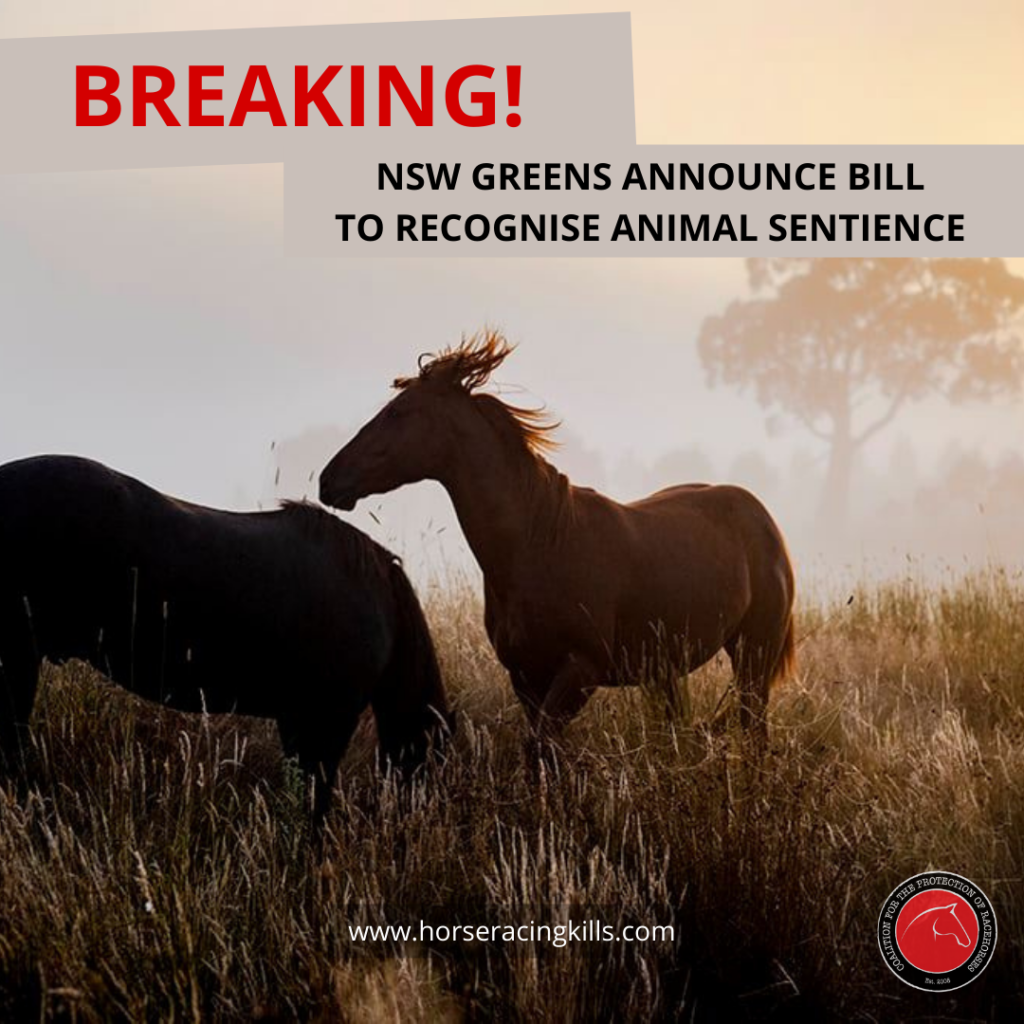
A BIG STEP IN THE RIGHT DIRECTION FOR ALL ANIMALS 

Image: Tamara Kenneally Photography ft. Ruby and Thunder

On February 24, the NSW Greens gave notice of a Bill to change their animal welfare laws to explicitly recognise that animals are sentient beings.

Greens MP Abigail Boyd stated:“Is it any wonder that the law is failing animals when NSW’s animal welfare legislation is framed to view animals as a kind of property, failing to recognise the agency or capacity for emotions and awareness that animals have? My Bill will correct this major omission and lay the foundation upon which we can build better animal welfare standards in this state.”
 Huge thanks to Abigail Boyd and the NSW Greens for this important step towards creating a better world for all animals. Governments at all levels have for too long not only disregarded the sentience of animals, but have supported, defended and benefited from their abuse and exploitation. Their strong backing of the horse racing industry and refusal to implement any desperately needed legislative changes is a clear example of this.
 

ENJOY A DROP?    
Whatever your tipple, here is a list of the booze brands who have sponsored horse racing over the past few months across the country. Only some are featured in the below graphic.

Take your business elsewhere and add your name to our letter to ensure they know about it here.

Beer
Furphy Beer, James Squire, Coopers, Carlton & United Breweries, Guiness, Heineken Australia, Hahn Beer, Swan Draught, Emu Export, Iron Jack Australian Lagers, Great Northern Brewing Company, Byron Bay Brewery, Cascade Brewery, Tooheys

Wine
Seppelt Wines, Champagne MUMM, Debortoli Wines, Penfolds, Paxton Wines, DiGiorgio Family Wines, Leconfield Wines, Mr. Riggs Wine Co., Fox Creek Wines, Zonte’s Footstep, Barossa Wine Cartel, Belvidere Winery, Devil’s Lair, Orbis Wines, Brown Brothers Winery, Angove Family Winemakers, Chandon Australia, Moët & Chandon, Petaluma Wine, Buller Wines, Bleasdale Vineyards, Hungerford Hill Wines, Bremerton Wines, Lake Breeze Wines, Taylors Wines, Oatley Fine Wine Merchants, Jackrabbit Vineyard

Spirits
Maker’s Mark, Canadian Club, Suntory ROKU GIN, White Claw Hard Seltzer

Mixers
Schweppes

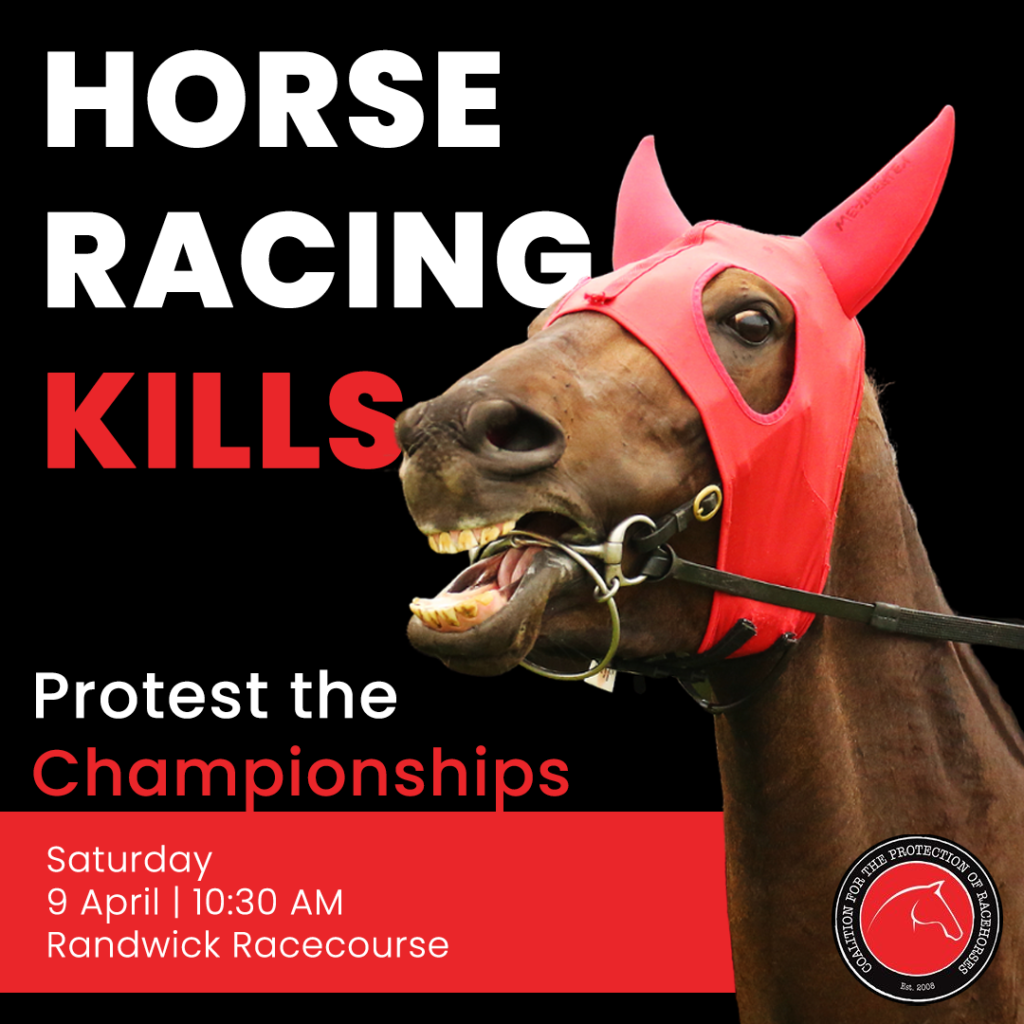
SAVE THE DATES – ADELAIDE CUP, JUMPS, ALL STAR MILE AND MORE..  
CPR will be protesting across Australia and New Zealand throughout the year. Some dates are confirmed with plenty more to come. 

Adelaide Cup – CPR is joining forces with Animal Justice Party South Australia and Animal Liberation SA to say Nup to the Adelaide Cup. Morphettville Racecourse SA – Monday 14 March 9:30am

All Star Mile – The All Star Mile is sponsored by Seppelt Wines. We will use this opportunity to encourage the public to boycott their products as we call them out for attempting to profit off the back of blatant animal cruelty. Flemington Racecourse VIC – Saturday 19 March 11:30am

The Championships – Joining AJP NSW, Animal Liberation and Sydney Animal Save, we will have a strong presence outside Royal Randwick. Saturday 9 April 10:30am

Warrnambool Grand Annual Steeplechase – Thursday 5 May, time tbc

Ballarat Grand National – Sunday 28 August, time tbc

For more details keep an eye on our Facebook events page here or our website here.

See you there!

AND THAT’S A WRAP 

But before we run, here is a promising article that appeared in a travel publication titled ‘THE TENNIS IS THE NEW RACES’

“Once upon a time, the Spring Racing Carnival was *the* social sporting event to attend in Melbourne. But the tide has turned.”
Ain’t that the truth!

For the list of just some of the great reasons why it’s a much better day out when you hit the courts not the track (with a splash of good humour) read the article here.

Thank you for reading and remember… speak up, always! 

Huge thanks to CPR New Zealand for protesting outside the recent Wellington Cupheart

 CPR relies 100% on donations to fund our investigations and campaigns. Without the generosity of our supporters we would not exist.

Thank you to all of our supporters who have donated recently. It is much appreciated and allows us to continue working toward justice for horses.
 Click here to donate 

News

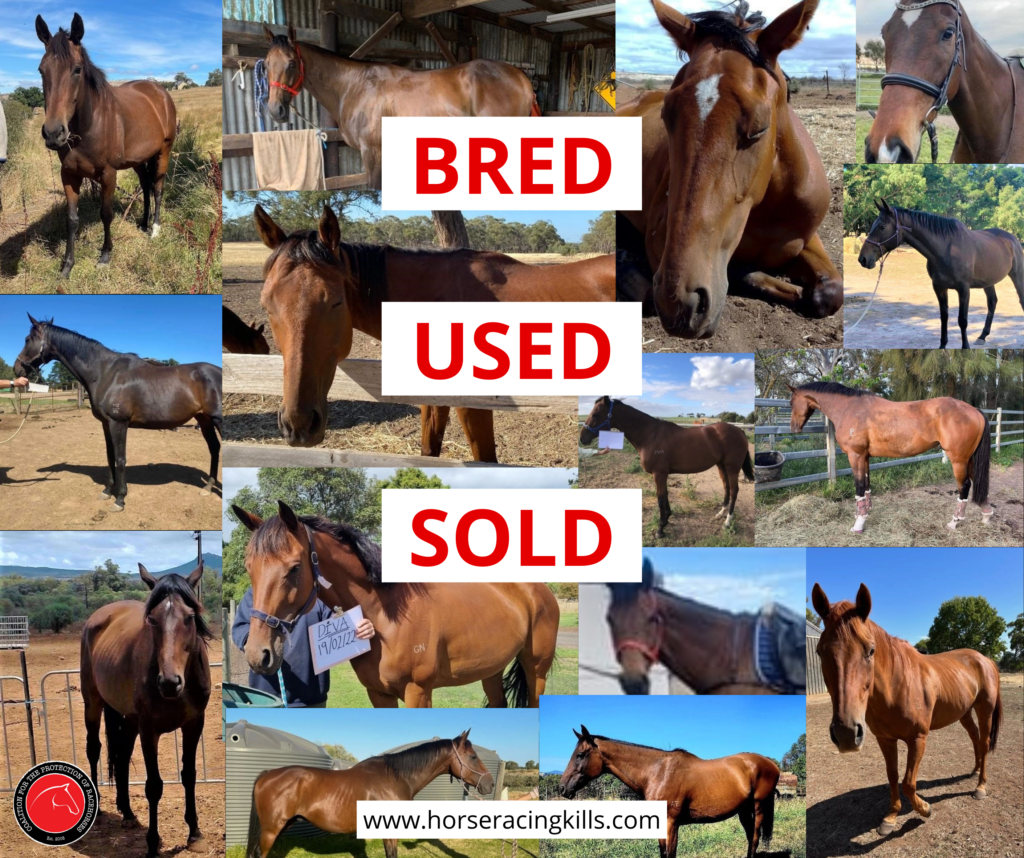
Bred, Used, Sold (or not?)

March 7, 2022 by admincpr 1 Comment

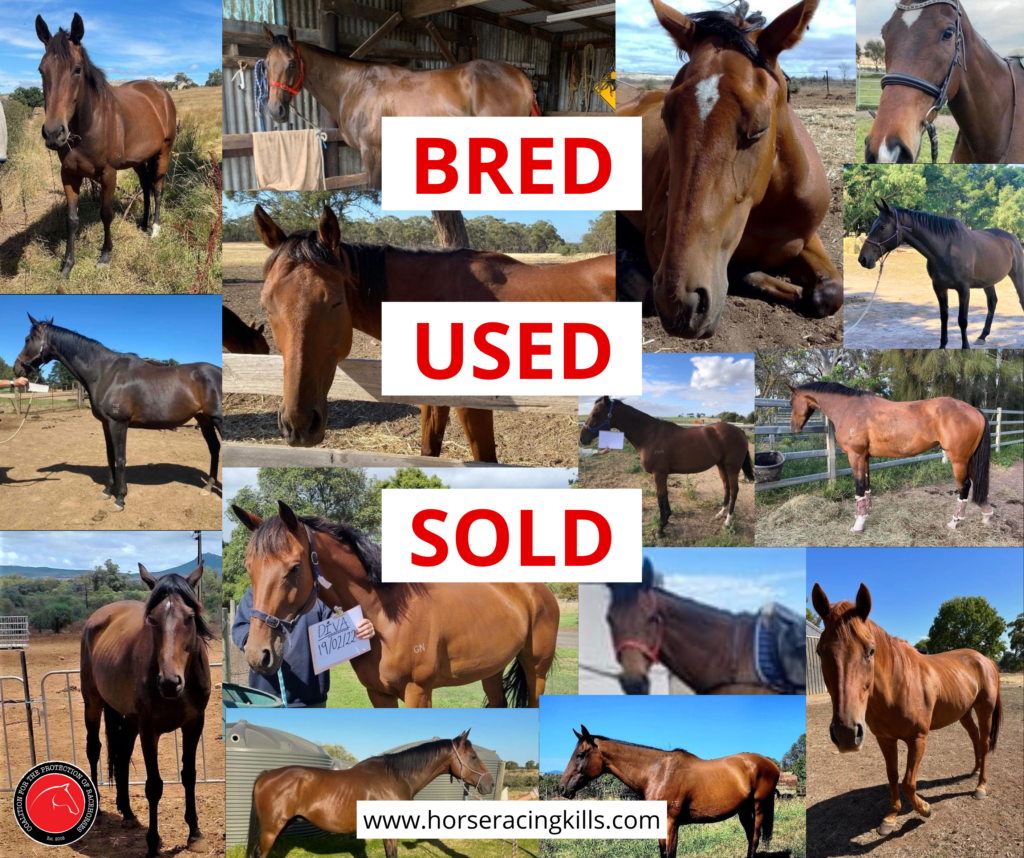
Every couple of weeks across the eastern states there is at least one horse sale, whether it be online or at sale yards. Sales where vendors have no idea who is buying their horse or what sort of life their horse will have. Vendors who sell to whoever has the highest bid, the money more important than the future of their horse. Some sellers care enough to at least put a reserve on their horse – potentially keeping them out of the hands of kill buyers (for now at least) some don’t.

The horses listed are often thoroughbreds – horses that were bred only to make money. History proves that once thoroughbreds are no longer “earning their keep” most are discarded at sales or straight to dealers or doggers. Some get lucky and go on to have happy lives with people who value them for who they are, not what they can provide. Many don’t. With the racing industry breeding around 13,000 thoroughbreds every year there is just not enough homes for them all. A recent online sale, where most thoroughbreds did not sell, (many not coming close to their reserve), further proves this.

The sale had sixteen thoroughbreds listed, only three of whom sold. Two of those didn’t have a reserve – one of them was raced until he was nine years old, had won over $66,000 and all he was worth to someone was $445, the other unreserved horse hadn’t raced at all, obviously deemed not good enough. Two of the thoroughbred mares that were listed had the comment “last chance to find a person of her own”. They did have reserves which were not met so what is their future now that their “last chance” has been and gone? Five of those sixteen horses had been listed in previous sales, which is a common occurrence, listed over and over as their reserves get less or they end up unreserved and sold to anyone. One horse was withdrawn, his sale photos so horrific that his breeder bought him back, presumably to save face. Yet it still remains unclear what his future holds.

Appleholic – mother to Dixie

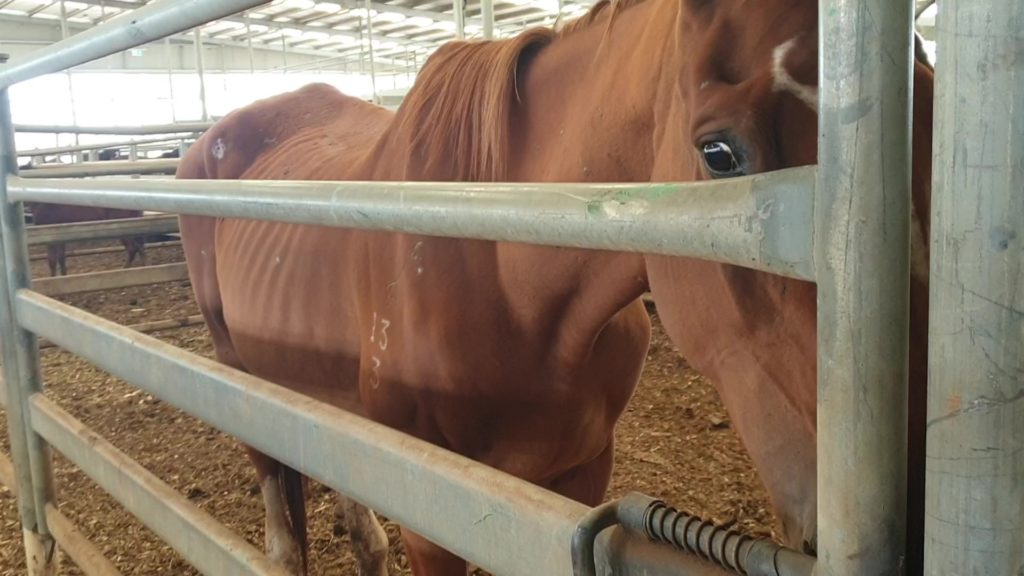
An unraced filly born in 2018, referred to as Dixie (with no registered racing name) was among those ‘passed in’. Coincidentally, her mother Appleholic was at the Echuca sales two years earlier, almost to the day. She was so emaciated that the RSPCA stepped in to ensure she not be purchased by anyone that would lead to her enduring the long trip to Meramist Slaughterhouse, Queensland in such condition. Appleholic gave birth to seven foals over the eleven years she was used for industry breeding, her final being Dixie, before being dumped at the sales sickly thin. She sold for $700 to an unknown buyer.

Dixie – three year old filly

Her three year old filly Dixie didn’t reach half the reserve placed on her – her fate remains unknown.

At a saleyard last year, a group of unnamed thoroughbreds were destined for slaughter until members of the public bought them from the dogger, lining his pockets in the process. Those horses weren’t even in the sale to have a chance at finding a home, they were in a holding yard already wearing their death tags. Why were they bred? They were living proof of the consequences of overbreeding.

The racing industry is well aware that thoroughbreds showing up at sales, knackeries and slaughterhouses is a bad look, so are pulling out all stops to prevent that from happening. Sadly that does not mean pushing for national traceability, a ban on horse slaughter, reducing breeding or adequately funding life-long care. It means introducing ‘on-farm euthanasia’ programs, where owners and trainers are encouraged to kill their unwanted horses on-farm, after a token rehoming attempt is made. The industry will even cover the expense of the body disposal.

All horses should be valued and have good lives. We focus on racehorses because they are bred for one reason and one reason only, money. The average time a horse is used for racing is less than three years, whilst the life span for a horse is twenty-five years or more. If the owners of these horses loved them as much as they profess to, they would make sure that their futures were protected for life, that they would never end up in a sale or in a doggers yard, it’s that simple.

The racing industry continues to breed 13,000 horses a year knowing the vast majority of participants no longer have an interest in keeping them once they can no longer race them – and that’s if they make it to the track at all.

The racing industry just doesn’t add up. It never will.

News

January 25, 2022 by admincpr Leave a Comment

For Immediate Release, Tuesday 8 June 2021

Animal Rights Activists Protest at Wellington Calling to Ban Jumps Racing

What: Protest to Ban Jumps Racing
Where: Outside the Children Centre – 414 Fergusson Drive, Heretaunga, Upper Hutt 5018, New Zealand.
Date: Saturday 12th June 2021
Time: 10:30am – 12:30pm


At Wellington Racing Club, animal rights activists will protest jumps racing season, after the Coalition for the Protection of Horses (CPR) released their shocking compilation video exposing the brutal reality of jumps racing in NZ – available here.

“Many New Zealanders will agree jumps racing is a cruel and unnecessary practice,” said a spokesperson for CPR NZ, Frances Baker. 

“Jumps racing was banned on cruelty grounds in NSW decades ago, so why is this carnage still taking place in progressive New Zealand, a country of animal lovers? This blood sport forces 500kg horses to jump hurdles whilst travelling at high speeds and being flogged by the jockey on their back” she said. “Many in the racing industry are even against this barbaric practice”. 


Image credit: SAFE 

“In Australia, sponsors have been pulling out of their partnership with the Oakbank Carnival after CPR’s campaign educated the public on the horrors that occur at a jumps event. This has even caused a decline in revenue for Australian events because the younger generation are starting to understand the inherent cruelty that’s involved.” Read more here.

“Recently, we contacted the sponsors of Wellington Racing Club, Jennian Homes and Woodridge Homes to challenge them on their partnership with the Club. We appreciate that Jennian Homes took the time to meet with us personally to hear our views and we hope that after exposing the truth on horse racing overall, that they will discontinue contributing towards animal cruelty. Despite numerous attempts to engage with Woodridge Homes, they have refused to respond to us. It is important for the public to know that it’s not OK to sponsor animal abuse.”

“Four horses were reported to have been killed in the 2020 NZ jumps racing season. Many more suffered painful injuries and have not been seen on the racetrack since. Just watch our jumps video from last year; you will agree with what many people are thinking, that it is carnage.”

“We need people to join us in calling out this brutal animal abuse in the name of gambling profits and entertainment,” she said. “It is completely unacceptable that this poor excuse for a sport continues.”

Supporters can also plan their own protests at their local tracks. CPR will provide support. 

On the eve of New Zealand’s jumps season, a horse was killed at a jumps race in Warrnambool Australia. Media release including video footage available here.

“Jumps racing is 21st century legalised animal abuse that MUST come to an end!” Ms Baker said. 

https://horseracingkills.com/2022/01/25/8921/

Uncategorized

RIP Happy Winner: a used car may have been given more consideration

January 25, 2022 by admincpr Leave a Comment

Racing NSW stewards have found trainer Joanne Hardy guilty of actions which likely led to the death of three year old gelding, Happy Winner.

Happy Winner suffered an injury to his off fore superficial digital flexor tendon and required a recovery period and rehabilitation program. Ms Hardy failed to disclose this information both when advertising him for sale and to the subsequent buyer – another industry trainer Brett Robb. Mr Robb put Happy Winner into a “work program” that was contrary to the recovery period and/or rehabilitation program he required before he suffered a catastrophic injury to both fore superficial digital flexor tendons and was euthanased.

Ms Hardy paid $15,000 for Happy Winner in March 2021. By April she was aware of the injury and by June he was listed for sale. She never made a cent from him before he was injured and presumably wanted to recuperate her costs. Happy Winner was treated more like a used car than a living being, which should never surprise in an industry that uses animals for profits.

Joanne Hardy has been suspended for eight months for her actions, plus an additional two months for providing misleading evidence to stewards.

Full report available here.

News

It’s Hot! Perth horses raced in record breaking heat

January 25, 2022 by admincpr 2 Comments

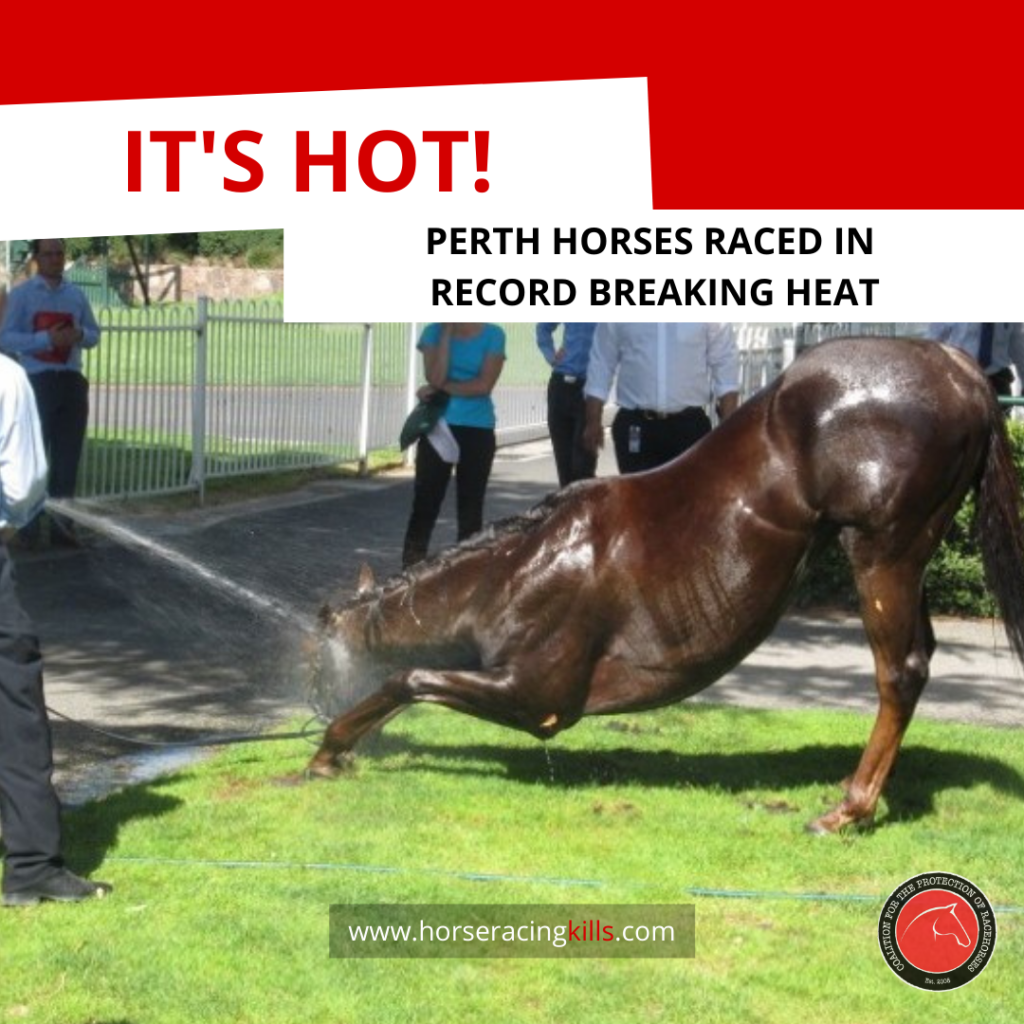
Western Australia has been experiencing some brutal weather recently with temperatures in Perth climbing to over 40 degress for six consecutive days. Even being in the midst of this record breaking heat wave didn’t stop the races at Pinjarra going ahead last Thursday.

Many horses have been reported to suffer exertional heat illness on racetracks across the state, with at least three horses suffering the illness on one race day alone at the end of last month. The conditions that day were very similar to those at Pinjarra last Thursday, yet the races went ahead anyway and miraculously not one horse was reported to have been distressed or suffered heat illness or any other injury – something we strongly question the validity of. We also strongly question the integrity of the RWWA Stewards and vets who alllow meetings to go ahead in such extreme heat.

Exertional heat illness is a terrible condition to suffer. Symptoms vary depending on severity and include abnormal neurological function, disorientation, irritability, instability, collapse, convulsions, coma and even death. Stewards reports play down the severity with symptoms minimised or even not recorded in their reports.

Hot weather policies are very vague across Australian racetracks and allow much room to deviate from what is required to avoid horses suffering heat illness. Even when races are moved to less brutal times of the day, little if any consideration appears to be given to the fact that horses may have already endured extreme heat for several days prior to the meet and are often transported long distances in uninsulated floats without ventilation to reach the track.

Every which way you look at it there is suffering in horse racing and a lack of integrity among those bestowed to protect the horses welfare.

News

January 25, 2022 by admincpr Leave a Comment

For Immediate Release, Saturday 1 January, 2022

Activists Say Nup to the Perth Cup 
Ten horses killed on WA tracks since October

What: Say Nup to the Perth Cup
When: TODAY Saturday 1 January, 9:30am – 12pm

Where: Ascot Racecourse – Main Entrance, Grandstand Road, Ascot, WA

Perth animal activists will welcome in the New Year by saying Nup to the Perth Cup!

“At least ten horses have been killed due to injuries sustained whilst being used to race on WA tracks since October – six of them at Ascot” said Coalition for the Protection of Racehorses (CPR) Campaign Director, Elio Celotto. 

“Racing and Wagering Western Australia is spending big money promoting the glitz and glamour of the Perth Cup, meanwile the horses it could not exist without are being treated as a disposable commodity” he said.

All deaths on the track are horrific, and the recent spate of WA deaths are no exception.  Witnesses say seven year old gelding Battle Storm struggled badly over the finish line and was later reported to have a broken pelvis. Boomtastic panicked pre race, dislodged her rider and galloped some distance before sustaining a serious injury jumping the running rail. Grinning Rupert was only two years old and in his second ever race when his hind leg snapped near the finish line. 

“Whilst it is the public saying Nup to the Melbourne Cup that receives the most attention, all horse races are cruel and high risk for horses, including the upcoming Perth Cup” Mr Celotto said. 

Whilst Perth Cup attendees dress up and sip champagne, horses will be beaten with a whip, have their tongues tied, a metal bit placed in their mouth and have spurs jabbed into their sides, as their bodies are pushed well beyond their limits for gambling profits and entertainment.

“If they survive the Perth Cup, for some it may still be the last time they are seen on the racetrack before being sent to the knackery or killed on-farm for not being fast enough” Mr Celotto said. 

Activists will gather opposite the main entrance as they speak out against this vile industry that uses and abuses unwilling participants for their own financial gain.

https://horseracingkills.com/2022/01/25/8909/

Uncategorized

January 25, 2022 by admincpr Leave a Comment

For Immediate Release, Monday 20 December, 2021

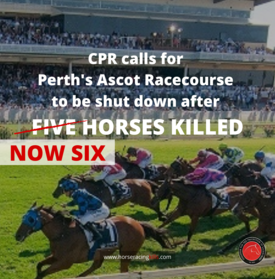
Calling on Minister Buti to close Perth’s Ascot Racecourse after five horse deaths 

The Coalition for the Protection of Racehorses is calling for Perth’s Ascot racecourse to be closed down after last weekends meeting claimed the life of yet another horse.

“At least eight horses have been killed due to injuries sustained whilst being used to race on WA tracks since October – five of them at Ascot” said Coalition for the Protection of Racehorses (CPR) Campaign Director, Elio Celotto. 

“Last Saturday five year old gelding, Expressionist, sustained a fracture to his femur whilst being raced and was killed on the track” Mr Celotto said. “His death brings the Ascot death toll to five horses in just over two months, and these are just the deaths we learn of”.

“Any death of a horse in the name of gambling profits and entertainment is unacceptable, but five in such a short space of time at the one track should be ringing major alarm bells for the industry. Instead, it appears to be business as usual at Ascot with more races scheduled for this Wednesday, and for the upcoming Perth Cup” he said. 

“Racing and Wagering Western Australia is spending big money promoting the glitz and glamour of the Perth Cup, meanwile the horses it could not exist without are being treated as a disposable commodity” he said.

“For this reason, we are calling on the WA Minister for Racing, Tony Buti, to immediately shutdown the Ascot track and to conduct an urgent investigation into this recent spate of deaths” Mr Celotto said.

CPR will be protesting outside the Ascot track on New Year’s Day to say ‘Nup to the Perth Cup’ and to stand in memorium for all five horses whose lives have recently been taken. 

Battle Storm – seven years old
Boomtastic – five years old
She’s God To You – four years old
Grinning Rupert – two years old
Expressionist – five years old

https://horseracingkills.com/2022/01/25/8905/

Uncategorized

January 25, 2022 by admincpr Leave a Comment

For Immediate Release, Monday 29 November 2021 

TAWWG report yet again highlights industry and government failings 

A two year investigation by the Coalition for the Protection of Racehorses (CPR), exposing the brutal reality for thousands of racehorses every year once no longer wanted, led to the formation of the Thoroughbred Aftercare Welfare Working Group (TAWWG).

In their report, released this morning, they made 46 recommendations.

Whilst CPR is still reviewing the reports detail, we can make the following initial observations:

Quotes attributable to CPR Campaign Director, Elio Celotto.

“The report once again highlights how badly this industry is failing the very horses it could not exist without, from birth to death.”

“Whilst it calls for greater industry transparency, government legislated horse welfare standards and the creation of a national thorougbred welfare body funded by the industry itself, it is important the public recognises that these are just recommendations. There is no requirement for them to be implemented, and again, they are entirely dependent on the industry doing the right thing for the horses they have proven to have used and abused without consequence for so long.”

“It is evident from the report that Australians are rightly turning their backs on horse racing. Whatever recommendations the industry takes from the report, they will be too little, too late. Racing has made it clear that their interest lies in making money. The horses will always be put second to that.”

A detailed review of the TAWWG Report will be published by CPR in the coming days. 

https://horseracingkills.com/2022/01/25/8902/

Uncategorized

January 25, 2022 by admincpr Leave a Comment

For Immediate Release, Monday 29 November 2021 

Media Notice 
Coalition for the Protection of Racehorses (CPR) are currently reviewing the just published report by the Thoroughbred Aftercare Welfare Working Group (available here).

CPR’s Campaign Director, Elio Celotto, will be at the Racing Victoria press conference at Flemington this morning at 10:30am and will be available for comment after the proceedings. 

https://horseracingkills.com/2022/01/25/8899/

Uncategorized

Your E-News Update: TAWWG report released, Incentivise injury downplayed and more…

December 22, 2021 by admincpr Leave a Comment

Dear Supporter,
 
It’s just about a wrap from us for 2021 at CPR HQ. But before we go a little quiet for a week or two, we just wanted to send you one final update and also send our love and thanks for your support and dedication to the horses throughout the year. We have big plans for 2022 and can’t wait to get stuck right in, but until then it’s time to take a breath, reflect on the year that has past and prepare ourselves for what we hope will be our most productive year for the horses yet. 

In this newsletter:
The Thoroughbred Aftercare Welfare Working Group findings released
CPR calls for Perth’s Ascot track to be shut down after five horses killed
Steven Pateman continues to avoid disqualification
Horse racing cruelty features in the Guardian’s ‘Human Animal’ series
The severity of Incentivise Melbourne Cup injury is slowly coming to light
Horrific track death of Australian horse in Hong Kong
Racing Victoria doubles down on jumps racing
Dirty dollars prop up The Everest
Racing targets children to help ensure its future
Rostropovich SOLD 
Unlicensed horse burial pit
Our open letter to the EU Commisioner on AU horse meat  
Upcoming protests and more…

TAWWG FINDINGS RELEASED  
A two-year investigation exposing the brutal reality for thousands of racehorses every year once no longer wanted, (available here) led to the formation of the Thoroughbred Aftercare Welfare Working Group (TAWWG). 

The TAWWG panel comprised of Dr Denis Napthine, Dr Ken Jacobs, Dr Bidda Jones and Jack Lake and was initiated and supported by a steering committee of industry participants. 

In their report, released on November 29 2021, the TAWWG made forty-six recommendations, some requiring government legislation, others designed for the industry to adopt. The recommendations centre around greater industry transparency, government legislated horse welfare standards and the creation of a national welfare body, Thoroughbred Welfare Australia (TWA), funded by the industry itself. 

Whilst we recognise these recommendations aim to improve the welfare of racehorses before, during and after racing, it is important the public recognises that: 

1. these are just recommendations, with no requirement for them to be implemented 
2. they are almost entirely dependent on the industry doing the right thing for the horses they have proven to use and abuse in the most horrific ways, without consequence, for so long. 
3. they have only come about due to abhorrent standard practices horse racing has knowingly gotten away with for so long finally coming to light in the public domain. This report was by no means motivated out of concern for racehorses, but rather out of concern for the horse racing industry losing its social licence. This places immediate questions over not only whether the recommendations will be adopted, but can they actually be implemented and enforced?

After thirteen years of researching and investigating the horse racing industry, it is CPR’s position that it is beyond redemption and can never be made kind for the horses it exploits. Horse racing exists to serve the human, not the horse, making it fundamentally flawed and inherently unethical to begin with. Having said this, so long as the industry persists, we must support any measures that can improve these horses’ lives. For this reason, CPR supports the majority of the recommendations made in the report, however, we do not believe that the industry is capable of any kind of legitimate, meaningful and sincere reform, nor that any kind of reform can ever go far enough. 

We do not support some of the parameters that guide the recommendations on ‘End of Life’ so have made an overall comment on this section at the very end of our review. 

Like the Martin Inquiry, the TAWWG report once again highlights how badly this industry is failing the very horses it could not exist without, from birth to death. 

It is also evident from the report that Australian’s are rightly turning their backs on horse racing due to significant welfare concerns.

Our summary and comments on the TAWWG Report can be read here.

CPR CALLS FOR ASCOT TO BE SHUT DOWN 
On Monday, CPR called on the Minister for Racing in Western Australia, Tony Buti, to shut down the Ascot Racecourse and launch an urgent investigation into the recent spate of deaths that have occurred at the track.

At least eight horses have been killed due to injuries sustained whilst being used to race on WA tracks since October – five of them at Ascot.

Last Saturday five year old gelding Expressionist sustained a fracture to his femur whilst being raced and was killed, making him the fifth fatality at the track in just over two months.

Any death of a horse in the name of gambling profits and entertainment is unacceptable, but five in such a short space of time at the one track should be ringing major alarm bells for the industry. Instead, it appears to be business as usual at Ascot with more races scheduled for today and for the upcoming Perth Cup.

As the Minister for Racing it is Tony Buti’s duty to, at the very least, cancel this Wednesday’s races and the Perth Cup, and launch an urgent investigation. To not take action on this dreadful situation would be unacceptable and could possibly result in more horse deaths in the coming weeks.

If our calls are ignored, CPR will be protesting outside the Ascot track on New Year’s Day to say ‘Nup to the Perth Cup’ and to stand in memorium for all five horses whose lives have recently been taken. Please join us! Details here. 

Rest in Peace
Battle Storm – seven years old
Boomtastic – five years old
She’s God To You – four years old
Grinning Rupert – two years old
Expressionist – five years old

STEVEN PATEMAN CONTINUES TO AVOID DISQUALIFICATION
Jumps jockey turned jockey/trainer Steven Pateman and his partner Jess Barton were found guilty of administering cobalt to Sir Walter Scott at the Coleraine track, yet lengthy legal delays and appeals mean they have continued to ride and train horses – well over four years after the act and 19 months after the guilty finding.

Details
In September 2017 at Coleraine, a pre-race swab of Sir Walter Scott was later found to have a cobalt reading twelve times higher than the allowed 100 milligrams.

On 13 October, 2017, Pateman and Barton reportedly admitted that injections of substances containing cobalt were given to the horse.

According to Stewards, on 24 October 2017 there was a general denial and lack of co-operation. Then, they later tried to claim they made a false admission of guilt due to being tired and still drunk after a “big night out”. Then, four months later, there was the belated production of a treatment note amidst some particularly poorly kept records.

On 16 March 2020, Pateman and Barton were found guilty of breaching AR 175 (h)(i) in that they administered or caused to be adminstered a prohibited substance, being cobalt, for the purpose of affecting the performance or behaviour of Sir Walter Scott in the race.

The penalty for such a breach is a mandatory disqualification for three years,unless special circumstances are found to exist.

After the guilty ruling, Mr Pateman and Ms Barton suddenly claimed “special circumstances” in that they had “impaired mental functioning” at the time of administering the cobalt.

The penalty hearing notes on May 2020 (available here ) make it clear why such a claim was not accepted and the stewards decision for a three year disqualification was ordered to stand.

The couple then received a ‘stay’, meaning they are not considered a disqualified person and have been allowed to continue to train and ride, based on them waiting on the outcome of another case claimed to be relevant to theirs.

Steven Patman and Jess Barton have since appealed their disqualification at VCAT, which resulted in an extension of the ‘stay’ and have their own hearing listed against Racing Victoria scheduled for May 2022 – so the ‘stay’ remains until at least then – almost five years after the offence occured.

To rub salt into the wounds, on September 12, Pateman was awarded the Tommy Corrigan medal for most outstanding jumps jockey and a tribute was made glorifying his work for the year when he should have actually been serving his disqualification – available here.

HORSE RACING CRUELTY FEATURES IN THE GUARDIAN’S HUMAN ANIMAL SERIES


Episode 4 of the new series ‘Human Animal’ from The Guardian focused on horse racing in the UK, where the issues the horses face are identical to here in Australia…. and so is the PR spin.
 Watch ‘Can horse racing clean up its image? Every single death is regrettable’, featuring our international partner from Animal Aid Dene Stansal here.


SEVERITY OF INCENTIVISE MELBOURNE CUP INJURY SLOWLY COMING TO LIGHT   
After news broke that Melbourne Cup runner-up Incentivise sustained an injury in the race, the industry was quick to report that he had “been cleared of serious injury by veterinarians.”

One month on, we were made aware his injuries are severe enough that his racing future is in serious question and now we learn the horse has been offically ‘transferred’ from the Moody stable, with both his owner and his now previous trainer refusing to comment on the situation. More here.

 Downplaying these injuries is by no means surprising when the world’s biggest horse race is on the precipice of demise.

 Incentivise is lucky to have the eyes of the world on him. Any other horse from any other race would most likely have “vanished” by now.  

HORRIFIC TRACK DEATH OF AUSTRALIAN HORSE IN HONG KONG 
 On December 12, at least two horses were killed at the Sha Tin track in Hong Kong. Six year old Australian horse, Naboo Attack and seven year old New Zealand horse Amazing Star both suffered tremendously before being killed. The footage is distressing but we share it to help raise awareness on the brutal reality of horse racing, no matter where in the world it takes place. Watch here.

RACING VICTORIA DOUBLES DOWN ON JUMPS RACING 
Rather than seeing the writing on the wall, Racing Victoria appears to be doubling down on cruel jumps races.
The 2022 season is set to see an increase in prize money and a scheduling restructure to capitalise on the demise of jumps racing in South Australia. Read more here.

Victoria is now the last state in Australia to continue hosting brutal jumps racing. Whilst Racing Victoria promotes themselves as being ‘here for the horses’ their actions are entirely in contradiction to that.
 
Proponents of jumps racing will tell you the ‘sport’ gives horses an ‘afterlife’ from flat racing, which is telling in itself, but also a short lived one. 47% of the horses who were used in jumps races in 2020 failed to reappear anywhere in horse racing in 2021.
 
CPR will be protesting jumps events again this year, calling out the industry and anyone else who supports them, including punters and sponsors. Stay tuned and take action to end jumps racing in Victoria here.

DIRTY DOLLARS PROP UP THE EVEREST
An ABC investigation released on December 16, reveals how weak regulation allowed cocaine kingpin Damion Flower to help expand NSW horseracing and fund The Everest, even though his horse business was running at a loss.

From the article:
While he was secretly building his cocaine empire, Flower bought racehorses with famous Sydneysiders including radio shock jock Alan Jones, rugby league legend Phil ‘Gus’ Gould and adman John Singleton. There is no suggestion any of his co-owners were aware of his criminal activities.
….it was Flower’s ability to turn his bankruptcy around from 2014 and flush tens of millions of dollars through the horseracing industry that has raised the most serious questions for Australia’s regulators.
What are they doing to ensure the lucrative sport is not used as a money laundry by local and foreign organised criminals?
“The exploitation by criminals of horseracing is significant,” says Nick McTaggart, a leader in Australia’s fight against money laundering.

Read the full investigation here. 

RACING TARGETS CHILDREN TO HELP ENSURE ITS FUTURE    
Racing is now getting children as young as eight onto the racetrack to help ensure the future of the killing and gambling industry.

It’s sad these young ones have absolutely no idea what it is they are supporting. Children should be taught to love and respect animals, not encouraged to use and abuse them for gambling profits.

TIC CEO Maurice said: 
“I went to this pony camp five years ago and I was talking to some of the kids and the parents and I was so alarmed that none of them knew anything about racing. Not about the career paths, not about the stars and that was the time Winx was heating up and I just thought ‘wow, were not on the map and we’ve lost this generation.’ So one of the main reasons we set up Thoroughbred Industry Careers was to set up pony racing.”

Read the full article here.

ROSTROPOVICH SOLD   
Remember that Melbourne Cup runner who came terrifyingly close to being the 2019 victim inbetween The Cliffsofmoher and Anthony Van Dyck? Remember how he struggled over the finish line a distant last with a fractured pelvis?

After sixteen months of extensive rehabilitation that would rarely be afforded to any other horse, Rostropovich failed to make the triumphant return to the track the industry would have liked, running last or near last in most of his subsequent eight races.

Of course those who have long professed to have so much love for him, recently put him up for grabs to anyone willing to make the highest bid. For $70,000 the six year old gelding is now headed to Western Australia where he will continue to be pushed beyond his limits to make his new owners some dollars. 

Read the full article here.


UNLICENSED HORSE BURIAL PIT  
Last week the ABC revealed Victoria’s EPA is investigating a pet crematorium over allegations it’s dumped hundreds of horses in a burial pit, without a landfill licence, for more than a decade.

The business is owned by VetPartners, a $250 million conglomerate with an American parent, and has been used for years by equine vets from the racing industry, along with other horse owners. 

Read the full article here.

The complicated issue of horse body disposal was raised in the recent TAWWG Report (referred to earlier in this newsletter) and highlights yet another of the countless issues that stem from breeding 13,000 horses into the Australian horse population each year, most of whom will be unwanted within five years.

Racing Victoria recently commenced their on-farm euthanisia program (Racing NSW have a similar program) to avoid racehorses being discovered at knackeries and slaughterhouses. Support, including body disposal, is provided to racehorse owners who engage this service. The only requirement is to have made two attempts to rehome the horse and the details surrounding this are private.

In our review of the report, we state:

“In an industry that attracts over $21 billion in wagering turnover and whose direct and indirect contribution to wealth is calculated at around $9 billion annually, there is absolutely no justification for a racehorse to ever be killed outside of on-farm humane euthanasia, by the true sense of the word ie when the horse cannot be helped and death is the only option to relieve their suffering from injury or illness. Being unwanted and unable to find another home is not and will not ever be a justifiable reason, especially so long as this industry is making any amount of profit and so long as it continues to breed more horses into the world.

“If a barbiturate is used, a horse cremation service should be engaged where burial is not possible, safe or in line with EPA requirements. If the owner cannot afford this cost, it should be covered by the relevant racing authority. Not covering such an expense, that will help towards ensuring a truly humane and dignified death and safe body management/disposal in a multi-billion industry is not acceptable.”

Again, our full summary and comments on the TAWWG Report can be read here.

OUR OPEN LETTER TO THE EU COMMISIONER ON AUSTRALIAN HORSE MEAT  
Even the industry appointed Thoroughbred Aftercare Welfare Working Group (covered above) has strongly recommended the racing industry place a ban on sending horses to Meramist slaughterhouse in their recently published report. Yet, the EU Commissioner for Health and Food Safety refuses to end the import of Australian horse meat – ignoring that it is in breach of their own regulations. The Department of Agriculture and Fisheries also continues to allow horses to be killed at the location.

From the report:
“The TAWWG found the use of the Meramist abattoir in Queensland (the only abattoir licensed to process horses in Australia) problematic. Many horses are transported long distances to the site in conditions unsuitable for thoroughbreds and the facility is not designed for horses. The TAWWG recommends that while there is a lack of species-specific standards enforced for horses, principal racing authorities should institute rules to prevent participants sending horses to Meramist.”
 
Read more damning statements regarding Meramist from the TAWWG Report in our open letter to the Commissioner here and take action here. 

KICK OFF THE NEW YEAR SPEAKING UP FOR HORSES   
CPR will play host to three protests before the month of January is out. Attendees to the Perth Cup at Ascot, the Magic Millions in Brisbane and the Wellington Cup in New Zealand will all be guaranteed to see our signs and hear our voices as they do the walk of shame into the racetrack. Please join us if you can. Details here.

A volunteer position for a graphic designer has become available. If you have the appropriate skills and are passionate about creating a better world for horses, please complete our volunteer application form here.

The role is approximately two hours per week (more leading up to the Spring Racing Carnival) and flexible availability is ideal but not essential. Send any queries you may have to us here.

AND THAT’S A WRAP 
Wishing you much love and thanks this holiday season. May your days be filled with joy and kindness for eachother, including the wonderful animals we are so fortunate to share our lives with ❤ Even though CPR will be going a little quiet over the next few weeks we will still have our finger on the pulse. Do not hesitate to contact us at anytime if you have important information to share at [email protected]


Thank you for reading and remember… speak up, always! 

CPR relies 100% on donations to fund our investigations and campaigns. Without the generosity of our supporters we would not exist.

Thank you to all of our supporters who have donated recently. It is much appreciated and allows us to continue working toward justice for horses.
 Click here to donate

News

Patemen continues to avoid disqualification for cobalt charge

December 21, 2021 by admincpr 1 Comment

Jumps jockey turned jockey/trainer Steven Pateman and his partner Jess Barton were found guilty of administering cobalt to Sir Walter Scott at the Coleraine track, yet lengthy legal delays and appeals mean they have continued to ride and train horses – well over four years after the act and 19 months after the guilty finding.

Details
In September 2017 at Coleraine, a pre-race swab of Sir Walter Scott was later found to have a cobalt reading twelve times higher than the allowed 100 milligrams.

On 13 October, 2017, Pateman and Barton reportedly admitted that injections of substances containing cobalt were given to the horse.

According to Stewards, on 24 October 2017 there was a general denial and lack of co-operation. Then, they later tried to claim they made a false admission of guilt due to being tired and still drunk after a “big night out”. Then, four months later, there was the belated production of a treatment note amidst some particularly poorly kept records.

On 16 March 2020, Pateman and Barton were found guilty of breaching AR 175 (h)(i) in that they administered or caused to be adminstered a prohibited substance, being cobalt, for the purpose of affecting the performance or behaviour of Sir Walter Scott in the race.

The penalty for such a breach is a mandatory disqualification for three years,unless special circumstances are found to exist.

After the guilty ruling, Mr Pateman and Ms Barton suddenly claimed “special circumstances” in that they had “impaired mental functioning” at the time of administering the cobalt.

The penalty hearing notes on May 2020 (available here ) make it clear why such a claim was not accepted and the stewards decision for a three year disqualification was ordered to stand.

The couple then received a ‘stay’, meaning they are not considered a disqualified person and have been allowed to continue to train and ride, based on them waiting on the outcome of another case claimed to be relevant to theirs.

Steven Patman and Jess Barton have since appealed their disqualification at VCAT, which resulted in an extension of the ‘stay’ and have their own hearing listed against Racing Victoria scheduled for May 2022 – so the ‘stay’ remains until at least then – almost five years after the offence occured.

To rub salt into the wounds, on September 12, Pateman was awarded the Tommy Corrigan medal for most outstanding jumps jockey and a tribute was made glorifying his work for the year where he should have actually been serving his disqualification – available here.

UPDATE 6/6/23 VCAT has reduced the disqualification for both Pateman and Barton from three years to eleven months commencing 9 June 2023. More on the VCAT decision here.

News

  • « Previous Page
  • 1
  • …
  • 8
  • 9
  • 10
  • 11
  • 12
  • …
  • 25
  • Next Page »

Contact Us

The Coalition For The Protection Of Racehorses
P.O Box 163, South Melbourne
Victoria 3205

Phone: 0412 039 788
Email Us

Join Our Mailing List

Sign-up to our mailing list to keep up to date. Text alerts are available for breaking news and urgent actions if you are in Australia.

Sign-up now

Find us on Social Media

© Copyright 2016 - 2026 All Rights Reserved by Coalititon for the Protection of Racehorses.

Privacy Policy