• Home
  • About
    • About
    • Achievements
    • International Partners
    • Frequently asked questions
    • Media Enquiries
    • Contact
  • Campaigns
    • Petition: End Overbreeding of Racehorses
    • Nup to the Cup
    • Deathwatch
    • Jumps Racing
    • The Whip
    • Wastage
    • 1 % To Stop The Slaughter (Retirement Plan)
    • New Zealand Campaign
    • Two-year-old Racing
    • Racing in Extreme Heat
  • Issues
    • Racehorses Killed for Human Consumption
    • Racing NSW on horse slaughter
    • Bits
    • JIGGERS
    • Undercover Knackery Investigation
    • Tongue Ties
    • Drug Use
    • Industry Funded Studies
    • Confinement
    • Racing in the Heat
    • Other Health Issues
    • Life of a Racehorse
    • Greyhound Racing
  • Take Action
    • The National Horse Traceability Register has lost its way
    • End Jumps Racing in Victoria
    • Make Reporting of Racing Deaths Mandatory
    • Donate
    • Bequests
    • #ditchthewhip
    • Take The Pledge To Never Bet On Or Attend A Horse Race
    • Volunteer
    • Businesses That Sponsor Horse Abuse
    • Outreach Toolkit
    • Register Your Own Nup To The Cup!
    • Nup to the Cup at your Workplace
    • Your Nup to the Cup Support Kit
    • Stencil Your Car
    • Equinileaks
    • Subscribe to our mailing list
  • Resources
    • Videos
    • Music
    • Reports & submissions
    • Outreach Toolkit
    • Download a banner
    • Download a poster
    • Your Nup to the Cup Support Kit
    • Nup to the Cup at your Workplace
    • A guide to rescuing race horses
  • Store
    • Store
    • Basket
    • My Account
    • Checkout
  • News
    • CPR Media Releases: AU
    • CPR Media Releases: NZ
  • Events

Horse Racing Kills

Horse Racing Kills

Advocating for race horses

  • Home
  • About
    • About
    • Achievements
    • International Partners
    • Frequently asked questions
    • Media Enquiries
    • Contact
  • Campaigns
    • Petition: End Overbreeding of Racehorses
    • Nup to the Cup
    • Deathwatch
    • Jumps Racing
    • The Whip
    • Wastage
    • 1 % To Stop The Slaughter (Retirement Plan)
    • New Zealand Campaign
    • Two-year-old Racing
    • Racing in Extreme Heat
  • Issues
    • Racehorses Killed for Human Consumption
    • Racing NSW on horse slaughter
    • Bits
    • JIGGERS
    • Undercover Knackery Investigation
    • Tongue Ties
    • Drug Use
    • Industry Funded Studies
    • Confinement
    • Racing in the Heat
    • Other Health Issues
    • Life of a Racehorse
    • Greyhound Racing
  • Take Action
    • The National Horse Traceability Register has lost its way
    • End Jumps Racing in Victoria
    • Make Reporting of Racing Deaths Mandatory
    • Donate
    • Bequests
    • #ditchthewhip
    • Take The Pledge To Never Bet On Or Attend A Horse Race
    • Volunteer
    • Businesses That Sponsor Horse Abuse
    • Outreach Toolkit
    • Register Your Own Nup To The Cup!
    • Nup to the Cup at your Workplace
    • Your Nup to the Cup Support Kit
    • Stencil Your Car
    • Equinileaks
    • Subscribe to our mailing list
  • Resources
    • Videos
    • Music
    • Reports & submissions
    • Outreach Toolkit
    • Download a banner
    • Download a poster
    • Your Nup to the Cup Support Kit
    • Nup to the Cup at your Workplace
    • A guide to rescuing race horses
  • Store
    • Store
    • Basket
    • My Account
    • Checkout
  • News
    • CPR Media Releases: AU
    • CPR Media Releases: NZ
  • Events

Racing Tasmania Admits Racehorses Are Routinely Shot In The Head

November 16, 2020 by admincpr 4 Comments

The killing of unwanted racehorses in Australian knackeries and slaughterhouses has now become common knowledge, largely due to the work of brave activists and journalists. However, it is not often, actually it’s unheard of, that industry representatives themselves will admit it takes place, even though they are now scrambling to put measures in place to at least seem to be addressing the issue.

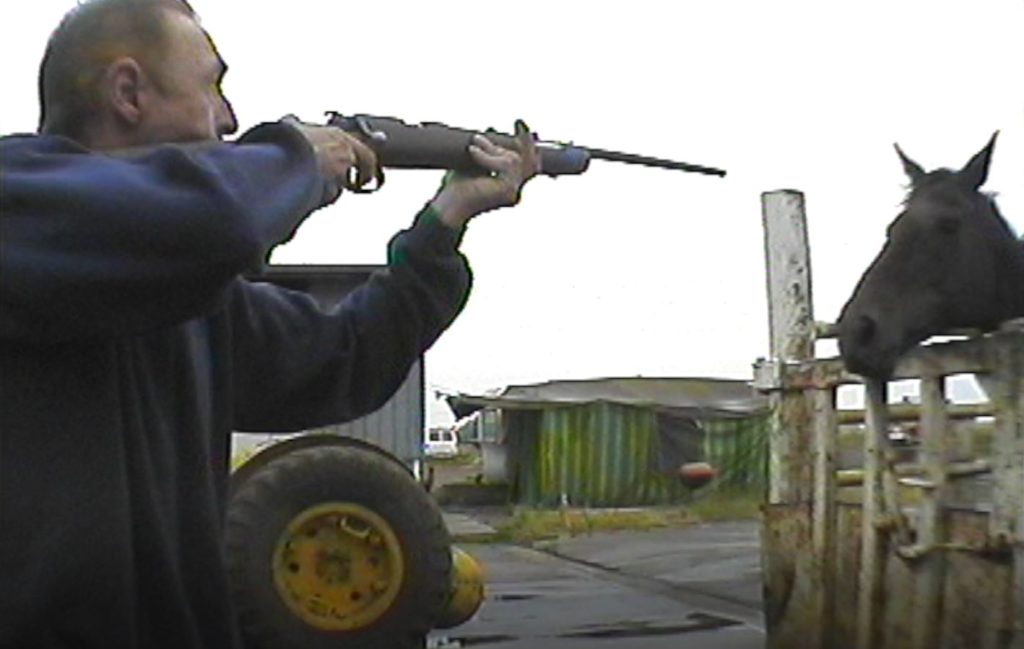
Last week, Tasmania’s General Manager of the Office of Racing Integrity and Director of Racing John King, admitted on ABC Morning Radio that a “significant” number of two, three and four year old racehorses are shot in the head due to simply not being fast enough – referring to the issue as “an unfortunate truth”. Listen to the full interview here.

Could it be that some in the racing industry are finally recognising that blatantly lying about the issue of ‘wastage’ is no longer an option, now that the average person is well aware of what really goes on? As devastating as the truth is, honesty regarding this is a refreshing change.

However, when pressed for details on how large this issue is, Mr King claimed 59 thoroughbreds were killed last year due to “illness and injury”. Is he suddenly trying to make out those who were killed were actually killed on compassionate grounds, in total contradiction to the admission he made just moments earlier? Or, were 59 thoroughbreds indeed killed due to illness and injury, and he is overlooking all the other horses who vanish from Tasmanian Racing each year?

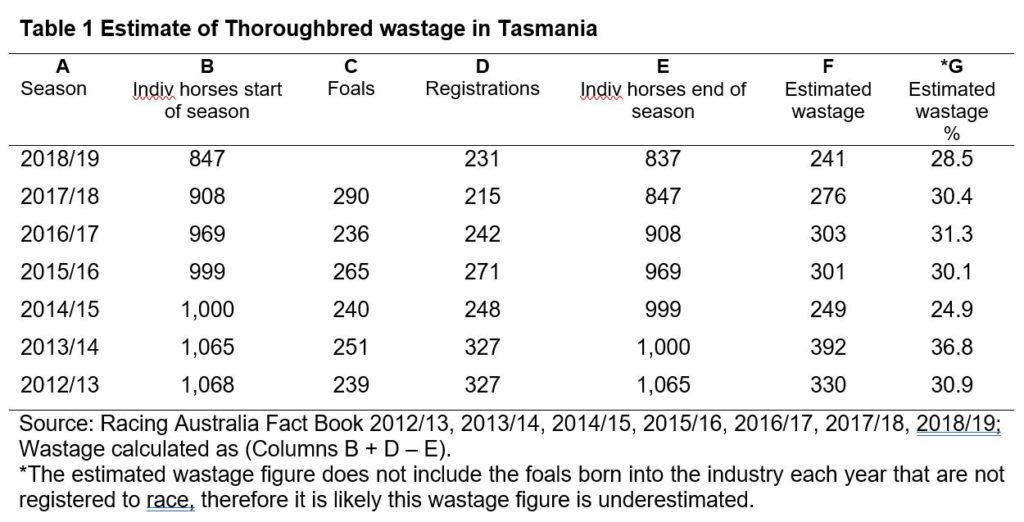
A quick number crunch from the Racing Australia Fact Book stats shows that over the past seven years, on average, 299 horses have vanished from Tasmania’s thoroughbred racing industry every year (or 30.5% of their registered to race horses)  – see table 1 below, baring in mind Tasmanian Thoroughbred Racing is one of the smallest of the states and territories.
Mr King himself acknowledged that rehoming racehorses is no easy task stating “the physical realities of rehoming become more difficult with horses to greyhounds” and that although they are working towards a system that encourages participants to make “all reasonable efforts” to rehome the horses they breed into the world, there was no racing or legal requirement for them to do so.

The true numbers of racehorses vanishing from Tasmania Racing every year being overlooked is one issue, but the claim made by Mr King also raises another important question. If 59 Tasmanian thoroughbreds were actually killed due to injury and illness last year, and not simply because they were not fast enough, it is safe to assume the majority of those injuries were caused by racing and/or training. However, as our Deathwatch Report demonstrates, not one horse was recorded as killed on a Tasmanian racetrack from injuries sustained from racing over the past racing year. The racing year prior, only one horse was recorded as killed on track in the Tasmanian stewards’ reports. This reaffirms our assertion that injured horses are being removed from the racetrack and killed behind the scenes, therefore avoiding being recorded as a Deathwatch statistic. Whether intentional or not, we cannot say. What we can say is, as we have long claimed, our findings and commonly cited statistics that one horse is killed from racing related injuries every three days is grossly understated. Our short video demonstrating how easy it is for the industry to cover up deaths from injuries in racing can be viewed here.


News

Whips Hurt! The Proof. Now Action Is Needed

November 12, 2020 by admincpr 1 Comment

It took a scientific study to prove an obvious fact that the racing industry has always denied. There is now scientific evidence that whips cause horses pain – available here.

The landmark paper, published yesterday found  “Humans and horses have the equivalent basic anatomic structures to detect pain in the skin.”

The report’s author, Professor Paul McGreevy, stated “We’re saying that although horse skin is thicker overall than human skin, the part of the skin that is thicker does not insulate horses from pain that is generated during a whip strike”. Read the full ABC article on the report here.

In response, The Conversation has published an article outlining a compelling 10 Reasons To Stop Whipping Racehorses.

In 2015, whilst denying whips hurt horses, former Racing Australia CEO Peter McGauran stated that the Australian Racing Board would consider abolishing the whip if science proved it hurt horses. The word ‘consider’ is telling as to whether the industry actually cares if horses suffer pain or not, but in any case, will the ARB now acknowledge the scientific evidence and support an immediate phase out of whips?

Perhaps the most devastating section of the study is the following:

“The role of pain in horse sports is part of the growing debate about what constitutes ethical equitation. In a flight animal, such as the horse, being unable to resolve aversive cutaneous stimulation causes distress. Horses have evolved to run away from such stimuli since the most likely natural cause of such stimulation is contact from a predator. Repeated strikes of the whip in horses that are fatigued as they end a race are likely to be distressing and cause suffering. The horses’ loss of agency is described in the literature as helplessness and repeated, inescapable, treatment of this sort is thought to lead to learned helplessness.”

Beating horses with a whip is just the tip of the iceberg in this cruel and ruthless industry. So long as horse racing persists, banning the whip is the absolute least they can do.

News

Was Extreme Suffering Prolonged To Avoid Bad PR For Melbourne Cup?

November 6, 2020 by admincpr 7 Comments

A former industry veterinarian supports activist calls for an immediate inquiry into the handling of Anthony Van Dyck after fatal Melbourne Cup incident.

The Coalition for the Protection of Racehorses (CPR), along with several animal activist groups and the Animal Justice Party, are calling for an immediate independent investigation into the handling of Anthony Van Dyck after his fetlock snapped in the Melbourne Cup on Tuesday. It is also calling for an independent necropsy report that will be made public, unlike necropsy reports currently conducted by the industry.

Former racing industry veterinarian of 50 years Dr Peter Kerkenezov is highly concerned about the treatment of Anthony Van Dyck, stating yesterday to CPR:

“It is apparent Anthony Van Dyck suffered a race induced catastrophic skeletal injury associated with extreme pain and suffering.  The usual humane response would have been to euthanise the stallion, there and then, on the track, without inflicting any further pain transporting him to a new location.  It is alleged this was not done despite the stallion being “unfit to load”.  It is claimed Anthony Van Dyck was loaded and transported.  The ethical nature of this decision needs investigating as a possible violation of animal welfare”  

Dr Peter Kerkenezov BM
Equine Veterinarian (1971 – 2020)
Wednesday 4th November 2020

Dr Kerkenezov has offered to carry out the independent investigation. His full statement can be read here.

The footage of the race, available here, shows the fetlock bone fracture as is evidenced by the way the hoof flaps in the opposite direction to the normal movement of the hoof.

CPR Campaign Director Elio Celotto said “In instances like this catastrophic injury, the only humane option is to immediately euthanase the horse. The question is, why was the horse loaded onto a float and removed from the racetrack when the prognosis was clearly evident?”

Stewards vision of the race is missing from the industry website and the regular vision has been edited to zoom in on the winning horses, cutting out the shocking vision of Anthony Van Dyck that those watching live saw.

For a close-up on the kind of suffering Anthony Van Dyck would have experienced as his death was delayed, we can look to footage captured of Australian horse, Pure Luck/Voyage King, lasy year in Hong Kong whose hoof was also flapping in the opposite direction.

“The racing industry has again shown they simply cannot be trusted, and it must now explain why Anthony Van Dyck was taken off the racecourse instead of being immediately euthanased” he said

Mr Celotto added “Anthony Van Dyck would have been in excruciating pain. To not euthanase him on the racetrack is just another example of the racing industry seeking to avoid the grim site of a green screen being pulled to hide the death of yet another horse on Melbourne Cup day.”

“This is a trend we are seeing more and more, as horses who are taken off the racetrack to be killed do not need their death recorded in the stewards’ reports, thereby reducing the on-track death statistics. The death of Anthony Van Dyck was reported simply because the eyes of the world were watching and the news could not be hidden, despite attempts to do so” Mr Celotto said. 

Vet-statement-on-Anthony-Van-DyckDownload

News

One State, One Week, Five Dead Racehorses

November 5, 2020 by admincpr 8 Comments

This is Wichita.

IMG_256
Picture: Pat Healy Photography

Irish-born horse, Wichita, was killed at Victoria’s Macedon Lodge on the 23rd of October after sustaining an injury to his hind leg. He was in rehabilitation for a fracture he suffered in Werribee trackwork. 

In his three years, Wichita had been forced into nine different races that earned his owners over $400,000. This involved being shipped from Ireland to England, France and finally Australia. He was expected to race in the Catalana Stakes at Flemington before receiving his fatal injury.

Further to the death of Wichita, another four race horses were killed on the racetrack within the same one week period, in Victoria alone.

Hadley was killed at Benalla on the 23rd of October after his very first race. Stewards reports simply state the 4 year old gelding had ‘sustained a serious racing injury and was humanely euthanized’. Hadley’s total winning was $0.

Elite Princess was killed at St Arnaud on the 25th of October. Although racings database have the date incorrect and have her death listed on the 29th of October. She was only 5 years old, winning a total of $12,612. 

Super Girl was killed after her race in Bendigo on the 28th of October after suffering a severe injury to her near foreleg.  The mare is still listed as ‘active’ on racings database. She was only 6 years old with a total prize money of $170,335.

6 year old gelding, Involved, was also killed during a track injury which was first reported in the article discussing Wichita’s death on October 23rd. His total winnings were $42,729. It is not required for the industry to list training and track work deaths.

This is one state in one week. 

It is also worth pointing out: Aiden O’Brien was trainer of both Wichita and the most recent Melbourne Cup victim Anthony Van Dyck. He was also the trainer of Cliffsofmoher, who was killed in the 2018 Melbourne Cup. Even still, he stated just hours after this years’ cup death “We’ll always be back, we’re bringing more horses here every year. Eventually they won’t have much room for us if we keep bringing them.”

Just weeks ago at Werribee. Two of the four now dead.


While the horrific death of Anothony Van Dyck during the Melbourne Cup has caused great upset these traumatic deaths happen, on average, every three days throughout the year.

If you’d like to know ways you can help out more, see 10+1 Ways You Can Help Horses During A Covid-19 Spring Carnival.

Cover image from MAURIZIO CATTELAN exhibition 2013

News

Protesters crack ‘bloody horse whips’ outside Flemington

November 2, 2020 by admincpr 1 Comment

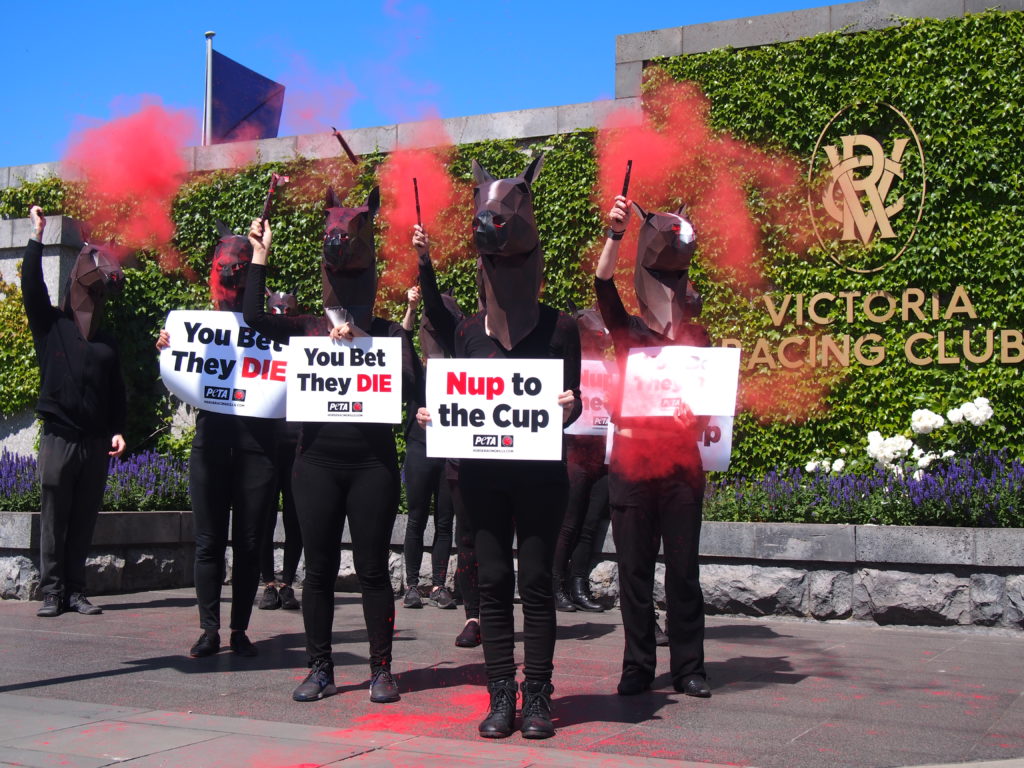
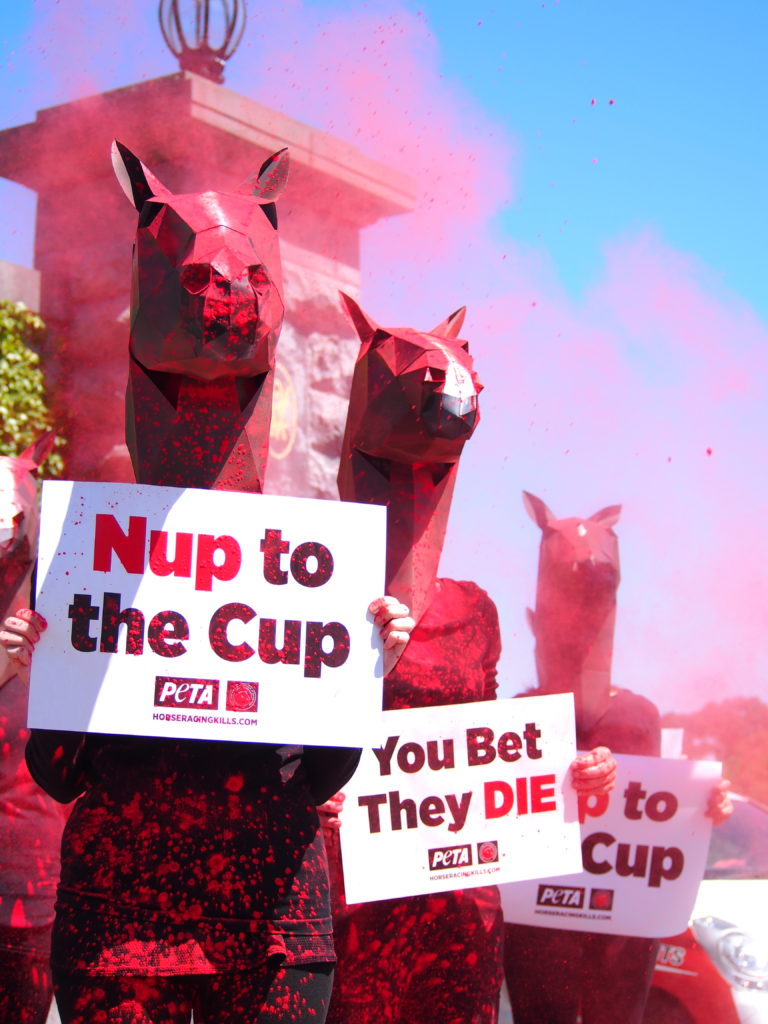
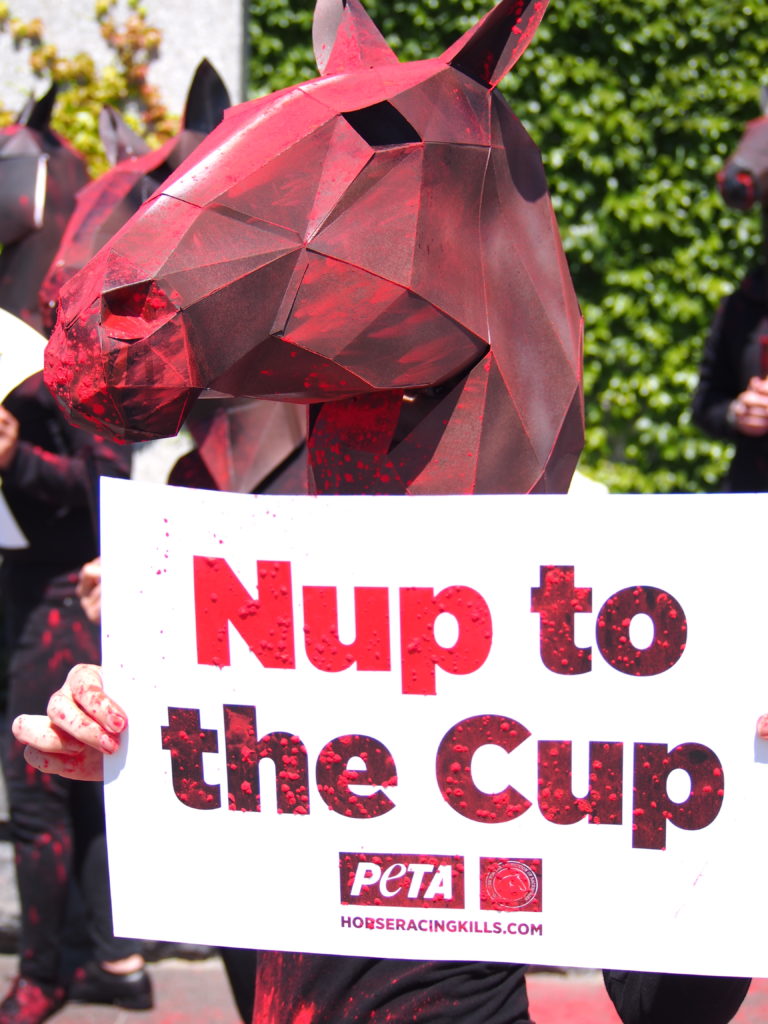
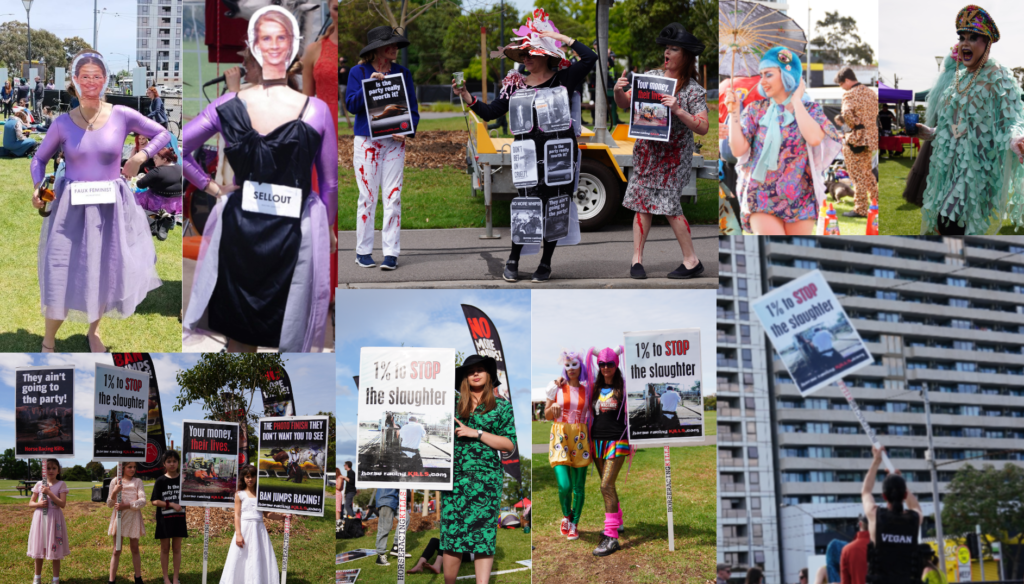
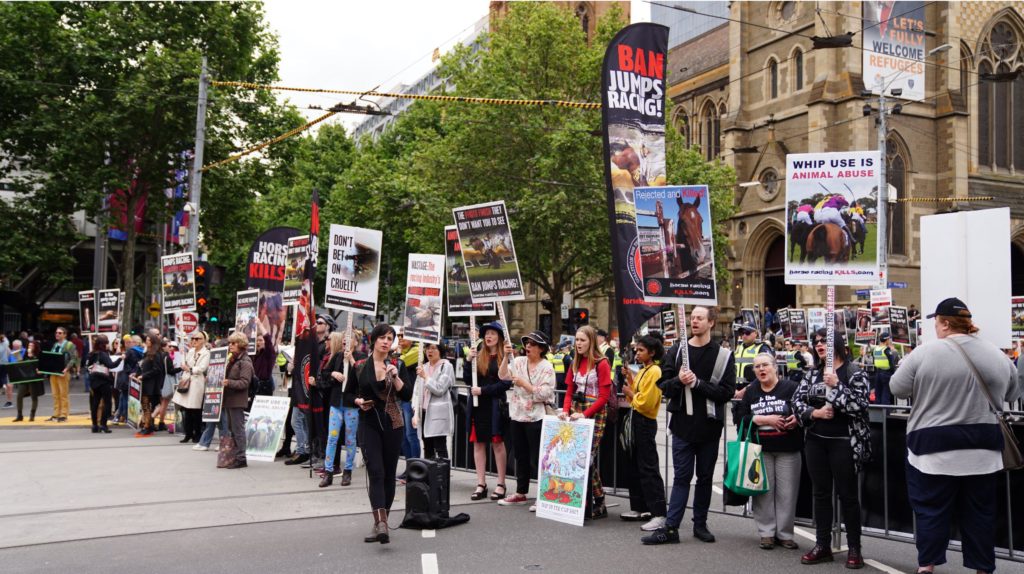
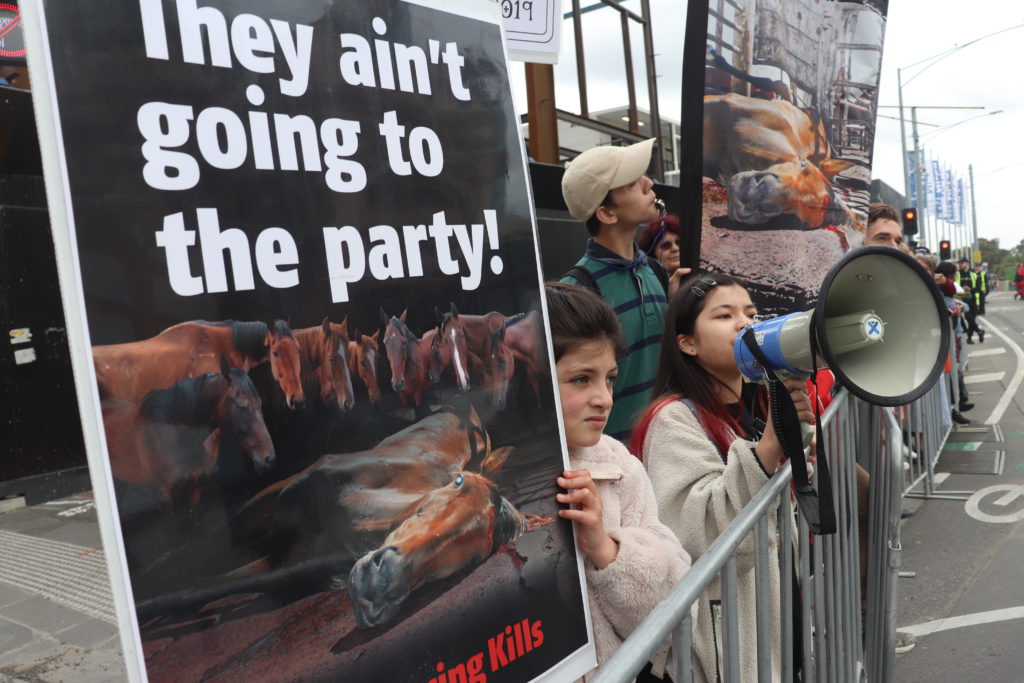
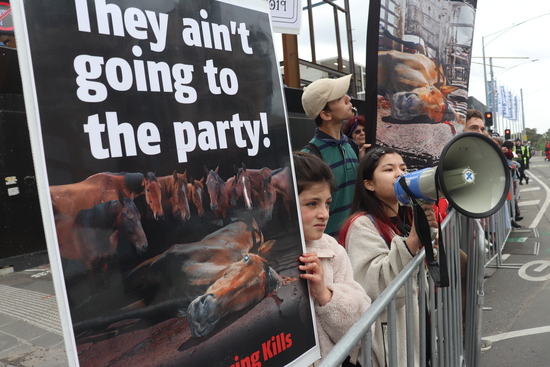
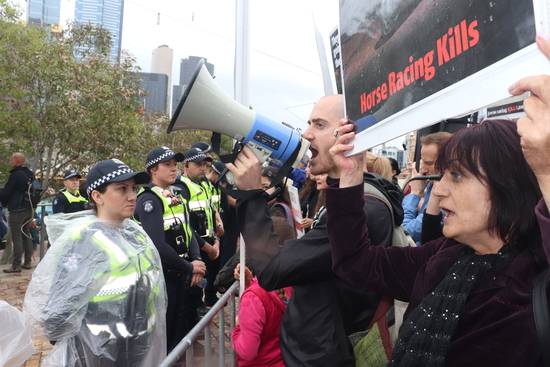
Ealier today, the Coalition for the Protection of Racehorses (CPR) joined forces with People for the Ethical Treatment of Animals (PETA) to protest against the Melbourne Cup. Wearing geometric horse masks we stood outside the gates of Flemington Racecourse carrying signs reading, “Nup to the Cup” and “You Bet They Die” and cracked “horse whips”, shooting blood-red smoke into the sky.  

NkT Photography

“A spate of recent controversies has exposed the racing industry’s ruthless slaughter of thousands of unwanted racehorses, and yet, nothing has changed,” says CPR Communications Director Kristin Leigh. “Racehorses are still being sent to slaughter while the industry pretends to have cleaned up its mess.”

NkT Photography


A report and documentary recently released by CPR reveals that every year, nearly 5,000 racehorses are killed at one Australian slaughterhouse alone. “With one other slaughterhouse killing horses for human consumption and approximately 30 knackeries, we estimate the number of Thoroughbred racehorses being sent to slaughter each year to be more than 10,000,” Leigh adds.

NkT Photography

CPR’s Death Watch reports that between August 2019 and July 2020, 116 horses died on Australian racetracks after sustaining catastrophic injuries or from heart failure. Even more horses are killed away from the track. Horses forced to race commonly suffer from stomach ulcers, internal bleeding from the lungs, and are painfully whipped to the finish line.

“While media coverage glosses over the bleeding lungs, broken bones, and tragic loss of life, horses on Australian racetracks are subject to severe abuse and even death,” says PETA Senior Outreach and Partnerships Manager Emily Rice. “How many more deaths will it take before we call time on this disgraceful demonstration of national senselessness?”

As documented by PETA US in 2019, many horses bred by the Australian racing industry are sold to South Korea, where they’re eventually slaughtered for meat. Since the 1970s, more than 3,000 horses from Australia or who had Australian parents have been killed for their flesh in South Korea. Following the release of this investigation, police in Jeju, South Korea, charged the abattoir where the footage was obtained, along with three of its workers, with killing horses in full view of other horses in violation of the nation’s Animal Protection Act.

News

10 + 1 Ways You Can Help Horses During A Covid-19 Spring Carnival

October 29, 2020 by admincpr Leave a Comment

Say #NupToTheCup

1.  Say a big Nup to the Cup

a) Join our Virtual Farshuns on the Field ‘Nup to the Cup’ Picnic Protest.

Bringing together two of Melbourne’s favourite past times – fashion and sport, we deliver to you a free alternative to the old ‘Race that stops a nation’, to say ‘NUP TO THE CUP!’ Join us from the comfort of your own personal protest party for an online version of FARSHANS ON THE FIELD! We will livestream direct to your devices from 2-4pm on Cup Day. Coinciding with the actual (disg)race. Livestream will happen via Facebook and Twitch. Details to come.

Hosted by Tenfingerz, Famous Artist Sebastian Berto and Dazza from Bogan Bingo. Featuring:
– live cross to the Coalition for the Protection of Racehorses
– interactive fashun races
– “sports”
– fun and frivolity
– absolutely no senseless torture of animalsDetails of fashun racing to come. Stay tuned. Stand by. Keep up to date here.

b) Join our Virtual ‘Nup to the Cup’ Action for Horses

As a statement against animal abuse, please take a photo of yourself wearing your CPR ‘Nup to the Cup’ face mask (available here), or if you prefer, simply hold a sign stating ‘Say Nup to the Cup’ and post it on all of your social media pages at, or as close to 9am as possible, on the morning of the Melbourne Cup.
**Make sure you use the hashtag #NupToTheCup along with any of these optional extras…
#YouBetTheyDie
#HorseRacingKills
#HereForTheHorses
#MelbourneCup

More information here.

c) Run your own Nup to the Cup or join another!

We understand COVID-19 restrictions may limit what you can do this year, but if you are able to do something, even if it is a virtual event, boycotting the sweep, gathering with small groups of like-minded people, or offering special deals from your business, it all makes a statement that you refuse to support animal cruelty. If you are planning something public, registering it with us (here) can help to demonstrate Nup to the Cup as a growing movement and encourage others to join. There are events happening across Australia. Keep an eye out here for updates.

d) Hijack Myer Fashions On Your Front Lawn

The Spring Carnival and Myer want people to believe animal cruelty is stylish, fun and glamorous. We need to hijack ‘Myer Fashions on your Front Lawn’ to help ensure people understand that it is far from it.

Step 1 – get dressed up in your message of truth and take a photo
Step 2 – upload your photo to your instagram and make sure it is set to public
Step 3 – use the hashtag #cupweekfashion followed by the hashtag of the category you are entering, either  #madhatters #cupweekcostumes #familyties or #loungeinstyle
Step 4 – Winners will be announced live on network 10 on Saturday 7 November. No you won’t win this celebration of cruelty. But you will add another win for the horses, by people seeing your photo of truth.You can do this anytime between Saturday 31 October – Thursday 5 November and make as many image posts as you like.

More information in our Facebook event here.

Myer Fashions on your Front Lawn and the various categories here

Good luck!

Watch & Share

2. Knowledge is power.

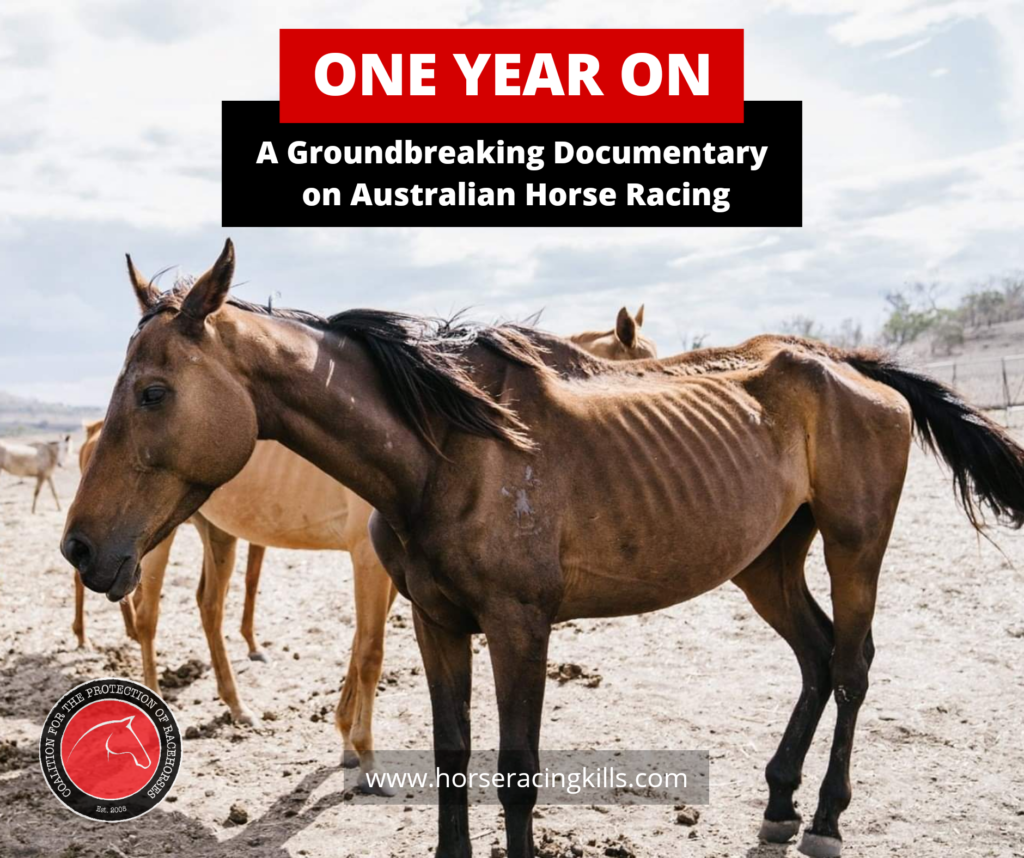
a) By sharing our just released 38 minute groundbreaking documentary, One Year On, exposing the suffering horses endure before, during and after racing, you can empower others around you to take action and end this cruelty for good. Click here to see our film, read our report and share with everyone you know. Help others see beyond the industry rhetoric and expose the truth to the world.

Watch One Year On here

b) ABCs The Final Race is still available to share online. This powerful investigation blew the lid off the Australian horse racing industry and must be seen.

Take the CPR Pledge

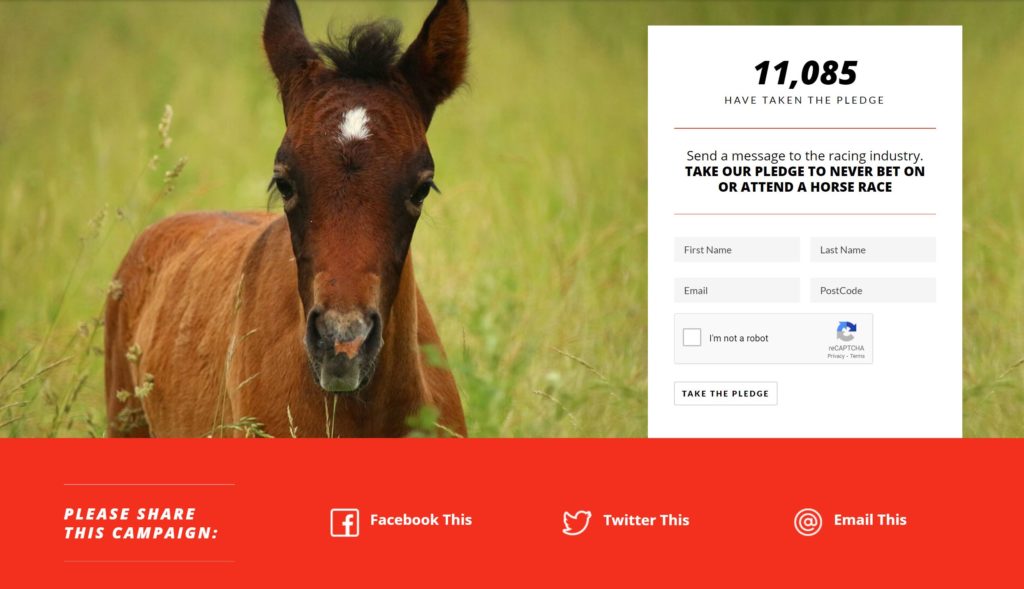
3. Pledge to never bet on or attend the races ever again. When you sign the CPR pledge an email will be sent on your behalf to all racing authorities and government ministers, showing them the decline in support for the industry in real time.

Take the CPR pledge here.

Wear It!

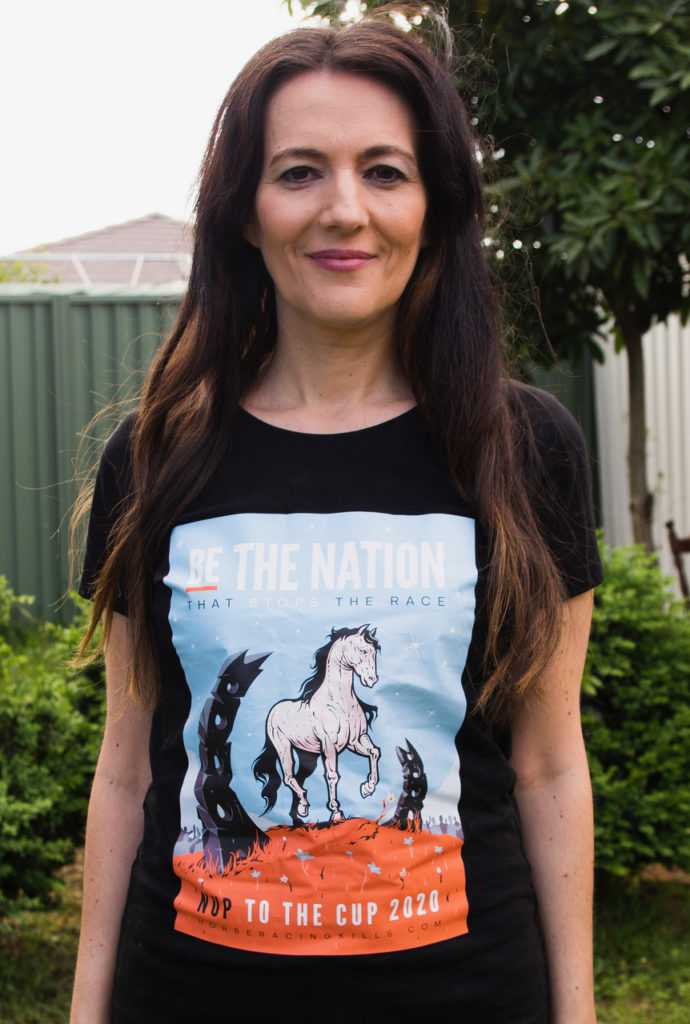
4. Be a walking billboard and advocate for the horses! Show the world you’re saying Nup to the Cup with one of our ethically traded, sustainably manufactured t-shirts. Stickers, hats, keep cups and heaps more awesome merchandise items are also available at our online store. Sales go towards funding our ongoing campaigns.

Visit the CPR Store here

Protest

5. Attend a rally or protest in your state that is inline with current COVID-19 regulations. Send a loud message to the racing industry from the track side or in a busy public place. We have multiple events listed all across Australia; come along, be seen and most importantly be heard!

See our full list of protests here.

Pressure Sponsors

6. Head to our Businesses The Sponsor Horse Abuse page, where you can easily view our list of race sponsors and sign our petition. We will send businesses who sponsor horse racing a message on your behalf that you will no longer support them so long as they support horse abuse. An important part of the horse racing industry’s survival is sponsorship, Help us show the sponsors that the community says NO to animal cruelty. Note: our sponsors list is a work in progress so please check back regularly for the companies you should no longer support.

Contact Businesses Who Sponsor Horse Abuse here

Share the Truth with Horse Racing Supporters

7. CPR has produced many documents and videos detailing and exposing the truth behind the facade. Please click on the below links and share them via emails and social media.
Report – 10 Reasons Why You Should Not Support Horse Racing
Report – Deathwatch Report 2020
Report – The Slaughter of Thoroughbreds and Standbreds in Australia
Video – Deathwatch 2020 Video Tribute
Video – Horse Racing Hides Deaths
Video – Cruel Transport of Horses in Australia
Video – Why CPR Exists
Plus many other videos on our Youtube channel

Drive It!

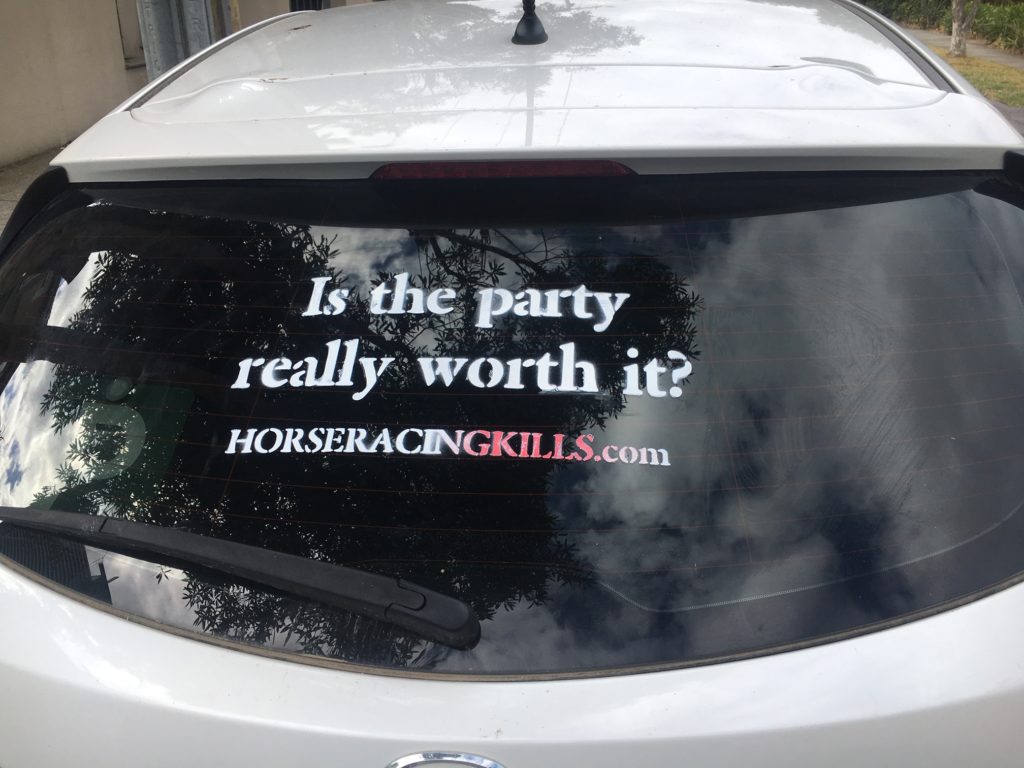
8. You’re walking the walk in your awesome new Nup to the Cup t-shirt, why not also drive the talk! Just as t-shirts are an effective means of advocacy so too are our vehicles. Order a stencil or bumper sticker for your car, watch the tutorial in the link below and make your car into a moving billboard just like you!

See how to stencil your car here.
Purchase your bumper stickers here

Donate

9. Donate to one of the many reputable rescues rehabilitating horses in Australia, or to CPR so we can continue our ongoing campaigns, lobbying and investigations. You can make a one off donation or monthly contributions; everything is helpful!

Donate here.

Volunteer

10. Consider donating your time. The racing industry is massive, and we need as many of you volunteering with us to ensure the interests of racehorses are effectively represented and the industry is held to account. There are a variety of roles and tasks that are suited to everyone!

Complete our volunteer application form here.

Never Be Silent

11. Speak up, speak out and be heard. Every conversation is an opportunity to change hearts and minds. Read through this website for all the stats and facts, and become an informed advocate for the animals.

Image by Dayaal

News

Georgia & Brian

October 21, 2020 by admincpr 3 Comments

A first-hand account from a Coalition for the Protection of Racehorses investigator and a rescuer.

This is the story of Georgia and Brian, but it could be a story about almost any ex-racehorse.

======================

Investigator:

In December 2005, the Laverton Knackery in Melbourne was under investigation. Not by authorities, but by animal activists who had learned of the plight that faced most racehorses after they had outlived their useful purpose in the racing industry.

I visited the knackery several times a week, trying to piece together why so many horses – especially racehorses – were waiting to be killed for dog meat.

One day, a striking mare appeared in the kill pens. She was almost entirely black with a white star. She may have just arrived from one of the recent horse auctions or perhaps she had come directly from a trainer.

I entered the pen to film the horses. She soon introduced herself and demanded a pat, to which I obliged.  But I had a job to do. As I moved from horse to horse, noting brands and filming through a keyhole camera sewn into my jacket, I noticed she was shadowing me. Every time I turned she was right there. She wasn’t content with just one pat. Then I noticed she was being shadowed by a much bigger bay. These two horses were to become known as Georgia and Brian.

This continued until I left the pen. Her eyes followed me for as long as I was in her sight. Her big bay stood right beside her. Emotions were welling up inside me. But, as an investigator, it is important to focus on the job at hand and not be distracted.

Over the next six visits, I became good friends with Georgia. As soon as she saw me, she would make her presence felt and demand my attention. She was a welcome distraction from the hell hole that this place was for horses and humans. With each visit, I dreaded the thought that it might be the last time I saw her and Brian.

I decided I had to do something. I registered my interest with the knackery owner and told him I would buy Georgia. Unfortunately, I didn’t have a place for her to stay.  So, I contacted Pam Ahern from Edgar’s Mission Farm Sanctuary and told her the story. Without a second thought, she agreed to collect Georgia the very next day.

Now, in the words of Pam Ahern herself, the story continues.

To me, horses are the true embodiment of strength, majesty, nobility and freedom. They have always been close to my heart. So, it was with nervous trepidation that, after receiving that fateful phone call, I arrived at the knackery and lowered the tailgate of the trailer that was to carry Georgia to a new life.

My own nostrils filled with the same putrid stench of death that had no doubt been assaulting Georgia for the days she had languished at this house of horrors. It was a stench that I was soon to find would take days to eradicate. Alas, the memories of what was to follow will haunt me forever.

Walking to the pen where my friend was waiting with his beauty, my gaze was distracted by the pile of dismembered bodies to my right. The sight of those once magnificent creatures reduced to a pile of broken bones and flesh made my blood run cold. Repelled by this horror, I looked to my left and saw those who were next. My heart sank and I whispered: “How could we do this?”

Georgia, as if recognizing that her saviour had arrived, stood patiently by the gate that held her one step from redemption. But there was another who also caught my gaze. A large bay gelding was shepherding her closely. Prising the gate open just far enough for Georgia to slip through, we were surprised when she refused to oblige. Turning constantly to her buddy, she pulled the lead and me along with it, in his direction.

“Come on Georgia,” we coaxed, “you are going to a far, far better place than this.” Reluctantly she followed our lead and walked through the gate. However, her friend became frantic at the impending prospect of their separation. Brian raced up and down the fence line, calling out to his departing friend. Tugging at the lead, and at our heartstrings, Georgia was slowly coaxed into the trailer, all the while returning the calls of the friend she quite rightly thought she would never see again.

With a heavy heart and a newfound disgust for those who so callously desert these intelligent and sensitive creatures – at the moment when they need them the most – I made the trek home. If only the people who were responsible for these animals could witness their unconscionable end. Would they betray them so easily? I pondered.

That night, I awoke repeatedly in cold sweats. The sight of the big bay horse’s head on that pile of bodies stared blankly back at me.

At daybreak I made the call to my friend, “Do you think the big bay horse is still alive?” His feverish reply told me our hearts and heads were in sync. “I’ll make the call,” he told me. Nervously I waited. “Yes, he’s still there, but not for long. I’ll meet you there.” And the phone rang off.

In double time, I moved until I was soon watching the pitiful sight of the frantic yet still majestic bay fellow’s nostrils flaring over and over. He belted out a chilling neigh then listened for the reply which did not come. For a horse we knew so little about – a strong and robust fellow, sound of mind and limb, and not too old – one had to wonder why he had ended up in such a terrible place.

Obliging, brave and trusting would now be added to his list of charms as he walked into the small, confined trailer. All the while my heart pounded so loudly that I thought it would surely scare him. The dear boy.

Just an hour later, the horse I had named ‘Brian’ on the journey had a new home and the most unexpected surprise he could ever imagine. Arriving at his destination, Brian did what many a horse does when checking out his new place to call home. Neighing the equine equivalent of, “Hey where am I?” he looked from left to right.

And then, from the back of the sanctuary, an all too familiar whinny rang out in reply. It was his Georgia. Lifting me clear off the ground, the gentle Brian became a man on a mission as he proudly carried his head high and trotted in the most elevated, proud and purposeful steps to his beloved. And as their nostrils touched, my tears flowed.

This will always be one of my most vivid memories of true happiness, joy and yes, love. If only the world could have seen this moment, there would be no doubt that horses truly experience this most sincere and deepest of emotions.

And since that very moment they have never been apart. Never that was until the day that sadly, Georgia sustained a horrific break in her stifle; the result of a freak paddock accident. A veterinarian was quickly summoned and the prognosis, grim.

Armed with the knowledge that while horses are stoic their bones are not and that death is not the worst option, but that a life of uncontrollable pain and suffering is, we did the only decent, honourable and humane thing. We honoured the pledge we make to every animal who enters our sanctuary gates and that is: “we shall give you a life truly worth living and when we cannot, we shall help you pass from this world to the next”.

Georgia loved carrots and welcomed pats. She relished sleeping stretched out in the sun and grazing peacefully beside her buddy, Brian. People often asked if we were ever going to ride Georgia or Brian, but the answer was a simple, “No”. There was nothing they ever had to do for us.

It is abundantly clear from watching animals like Georgia and Brian that they live, love and lose cherished ones in just the same way we do. What we were to witness next was the purest form of grief.

Standing vigilant by injured Georgia’s side, Brian refused to budge until his beloved was laid to rest. Rearing up in anguish, he became distraught, calling out to Georgia. A call this time she would never return.

Georgia was indeed the love of his life and it was because of her love, all those years ago, that he was given a second chance of life. His palpable devotion and love for her that we witnessed all those years ago was indeed the sole reason he still walked upon this Earth. But now she was no more.

That she was Brian’s special someone there is no doubt – but she was also ours.

News

If Cup Carnival Can Go Ahead, Then So Must We! Spring Carnival E-News Update

October 12, 2020 by admincpr Leave a Comment

This year’s Spring Carnival is upon us. With the football codes having their finals throughout October this year due to COVID-19, it has provided significant distraction from the races, though Racing Victoria still likes reminding us that they are ‘here for the horses’. We still don’t know if any crowds will be allowed at the racecourses but one thing is for sure and that is that horses will be made to race, be whipped and pushed well beyond their physical limits. So, if horse racing continues, then so must we. We’ll be doing all we can to speak out for the horses through these difficult times and hope that you will join us. In this Newsletter:

  • CPR’s Spring Racing Carnival plans
  • What you can do to help horses this Spring Carnival
  • Peter V’landys vs ABC court case update
  • CPR’s soon to be released documentary ‘One Year On’

OUR SPRING RACING CARNIVAL PLANS  
 Despite restrictions, we’re excited about the many ways you can still take part in saying ‘Nup to the Cup’ this year and be a voice for the horses. With a year like no other, we’re planning a Melbourne Cup like no other. 

The Virtual ‘Nup to the Cup’ Picnic


We are very happy to announce we will again be joining forces with our ‘Nup to the Cup’ partner, Tenfingerz, for an online extravaganza that will have all the fun of our regular picnic. We’re still working out the details but there will be music, dancing, human races and live crosses. If you would like to participate in the activities, simply watch on and be entertained by them, or perhaps even conduct your own human race, please keep an eye out for how to register here.

To keep up to date with our Virtual ‘Nup to the Cup’ Picnic, follow the event on Facebook, or check back to our website regularly here. If you have fun ideas for races, send us an email here.

The Virtual ‘Nup to the Cup’ Action for Horses


We may not be able to host our usual ‘in real life’ picnic and protest this year, but we can still protest the cruel Melbourne Cup from wherever else we may be on this day.

As a statement against animal abuse, please take a photo of yourself wearing your CPR ‘Nup to the Cup’ face mask (available here), or if you prefer, simply hold a sign stating ‘Say Nup to the Cup’ and post it on all of your social media pages at, or as close to 9am as possible, on the morning of the Melbourne Cup.**Make sure you use the hashtag #NupToTheCup along with any of these optional extras…
#YouBetTheyDie
#HorseRacingKills
#HereForTheHorses
#MelbourneCup
To more details and to keep up to date with our Virtual ‘Nup to the Cup Action for Horses’, follow the event on Facebook, or check back to our website regularly here.

WHAT YOU CAN DO

Watch and share these short videos

  • Horse Racing Kills! here
  • Why CRP Exists here
  • Deathwatch 2020 here

For other previous and soon to be released videos, please check and subscribe to our YouTube channel here.


 The following two videos will serve as a reminder why even if ignoring the  cruelty, there’s nothing glamorous about horse racing.

  • The Juice Media here
  • SBS The Feed here

Here’s a re-cap from our last e-newsletter covering all the other ways you can still help horses through a COVID-19 Spring Racing Carnival.

Know someone who still supports horse racing?  

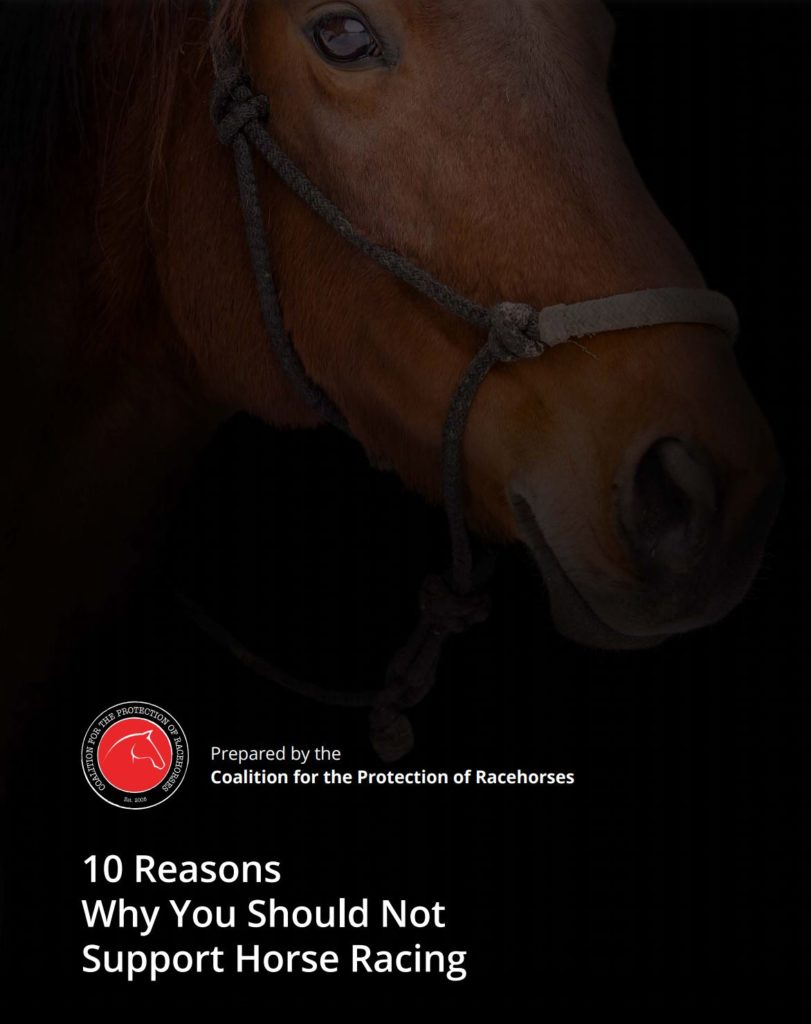
’10 Reasons Why You Should Not Support Horse Racing’ is an easy to read, concise document which highlights the cruel standard practices of horse racing.Please email, message and share it both broadly and ideally also directly with anyone you believe is unaware of exactly what it is they are supporting. You can read, share and download ’10 Reasons Why You Should Not Support Horse Racing’ here.


Just released! 2020 Collector’s T-shirts

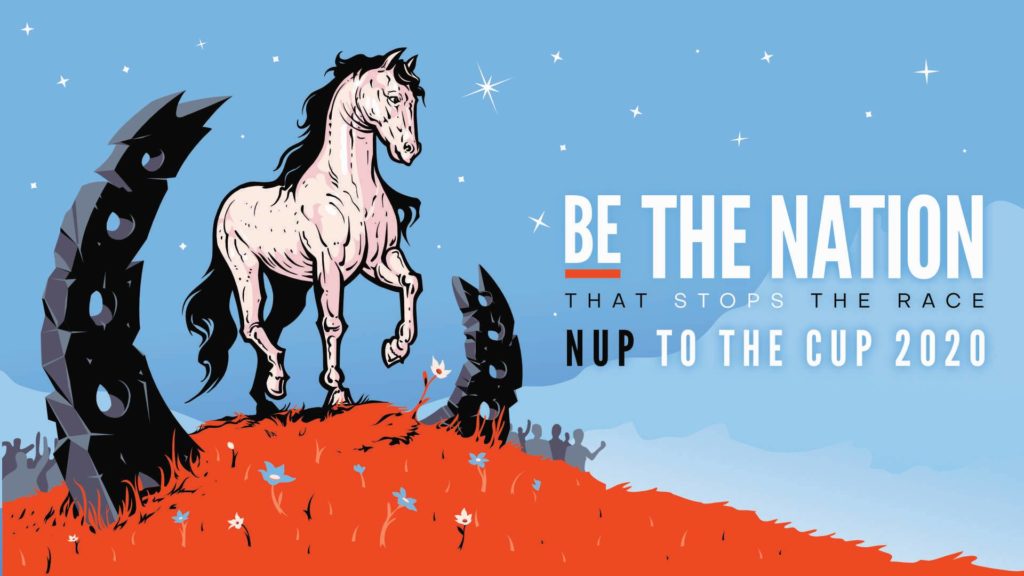
We’ve also just released our brand new Collector’s Item Limited Edition ‘Nup to the Cup 2020’ t-shirts. This eye-catching design by Melbourne artist Sebastian Berto, represents the horse as they should be. Specifically created as part of our campaign against the 2020 Spring Carnival season, the artwork compliments our 2020 Farshuns on the Field – Nup to the Cup theme. Available here. 


Melboure Cup Sweep
It’s a long running (but slowly dying) tradition to have a Melbourne Cup Sweep in the workplace, community group or local pub on Melbourne Cup Day. However, there’s a new tradition that’s emerging and that’s to say “Nup to the Cup”. It can be an awkward moment for some, especially if you are the only one in your group who objects to it, but please remember you are not alone – you are joining the countless others across the country who are refusing to take part in cruelty, even under social pressure. 
We suggest you do the following:

  • Download and print one of our posters and display it wherever you can to get the message across – available here.
  • Wear your CPR merchandise everywhere you go – available here.
  • Politely refuse to watch or partake in any Melbourne Cup celebrations and if possible join other likeminded individuals as a sign of respect for the horses.
  • If you are in the company of others who agree, hold an alternative celebration.
  • Donate the money that you would have otherwise spent on a sweep to an animal charity of your choosing.
  • If you are having an alternative celebration, try to make sure it respects all animals, not just horses by making it vegan.
  • Perhaps, as an alternative to watching the Melbourne Cup, you could invite people to watch the ABC investigation “The Final Race’ that aired in October 2019 here and the more recently released investigative documentary by the Animal Welfare Foundation Tierschutzbund Zurich here.
  • Join our Virtual ‘Nup to the Cup’ Farshuns on the Field picnic. Stay tuned for updates here.
  • Join our Virtual ‘Nup to the Cup’ Action for Horses. Details here.

Peter V’landys vs ABC defamation case update
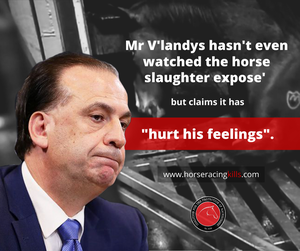
As previously reported, Peter V’landys is suing the ABC for defamation over 7:30’s The Final Race – watch here. The court case was heard on the 23rd and 24th September however due to delays and prolonged questioning from both sides, another two days have been set aside to re-commence on the 14th October. It was interesting to note that Mr V’landys acknowledged it was good that the program exposed animal cruelty, yet he still maintains that he has not yet watched it. Read more here.

One Year On – a CPR documentary
We will soon be releasing a documentary that looks deeper into what happened at the Meramist slaughterhouse in QLD and what, if anything, has changed in the last 12 months in the treatment of discarded/retired racehorses. The documentary will also delve into other cruel standard industry practices. Keep an eye out on our website, Facebook page or YouTube channel for its release.  Once again, thank you for your ongoing support for the horses used and abused by the racing industry.

Remember… speak up, always!


Image by Dayaal

News

Your E-News Update: Deathwatch 2020 Report released and more…

September 21, 2020 by admincpr Leave a Comment

Dear Supporter,

 It’s been a while since our last newsletter and there’s so much to talk about. Despite Covid-19 wreaking havoc in all facets of our lives, CPR is still working behind the scenes on many different fronts whilst we also prepare for the upcoming Spring Carnival, in whatever shape or form it takes, and beyond. 

In this Newsletter: 
Racing continues through COVID-19
Ongoing fall out from ABC’s ‘The Final Race’
CPR makes a submission to the Thoroughbred Aftercare Welfare Working Group
Racing NSW CEO Peter V’landys legal action
Racing Victoria announces moves towards banning the whip
Jumps Racing 2020 Update
Deathwatch 2020
CPR New Zealand presents petition to Parliament
International groups against horse racing are growing
Spring Carnival plans 

RACING CONTINUES THROUGH COVID-19    
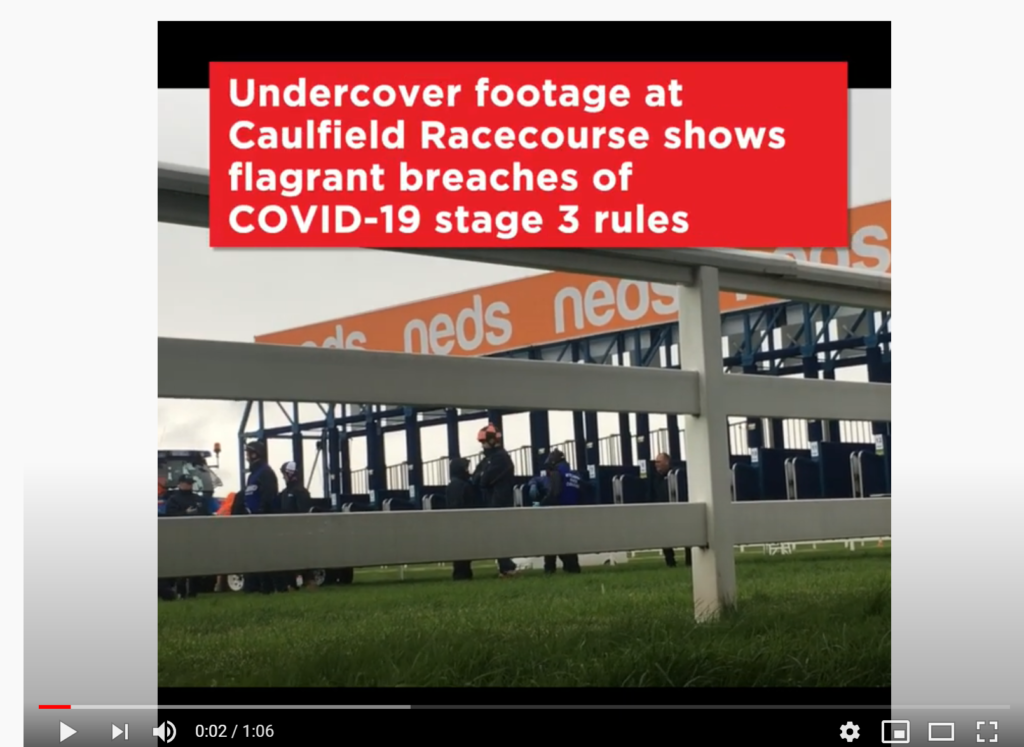
So much is up in the air at the moment. However, one thing that isn’t is horse racing. Racing has been the only “sport” allowed to continue in Victoria throughout the state’s Stage 4 lockdown. Horse racing has recently had its first COVID-19 case confirmed. Instead of doing what the rest of the state is forced to do (shut down), Racing Victoria is allowed to self-regulate and stewards are left to determine which horses, jockeys and trainers can participate.  According to this article, Racing Victoria had the authority to allow stood down jockeys and trainers to compete in races the very next day at Moe and Ballarat subject to test results. Now, we’re confident that if the rest of us were in a similar situation, we’d be quarantined for 2 weeks and for obvious reasons – test results aren’t always accurate so soon after infection.
Why is the racing industry yet again allowed to make their own rules and risk the well-being of every Victorian?
We’d also like Victorian premier Daniel Andrews to explain what “the significant animal welfare issues” are that he states as a reason for the industry needing to continue when so many others cannot? It’s quite simple really. You can still exercise the horses – just don’t race them (here’s just one beautiful example of how that can be done).   Or at least come clean and tell us the real reason why racing is allowed to continue and that is ‘the gambling dollar’.
If there’s another outbreak of COVID-19 as a result, the Andrews Government and Racing Victoria will have human blood on their hands, not just horses.
See our short video on how it is just not possible to social distance in horse racing here and sign our petition to have horse racing shutdown through the COVID-19 crisis here.

FALL OUT FROM ABC’S ‘THE FINAL RACE‘ 
There is no doubt that the 7.30 story The Final Race (watch here) that aired in October last year sent shock waves around not only Australia but also the world. It’s now been 11 months since the story broke and you may be wondering, what has actually changed? Here’s a summary:

Queensland Government Inquiry into Racehorse Abuse 
As was reported in our last newsletter in February this year, the Inquiry into Animal Cruelty in the Management of Retired Thoroughbred and Standardbred Horses in Queenslandrevealed damning evidence of animal abuse and called for widespread sweeping changes to the industry. In case you missed the report and our position on its findings, you can view them here

CPR makes submission to the Thoroughbred Aftercare Welfare Working Group (TAWWG)
The racing industry had to finally act and at least make the effort to appear to be addressing welfare concerns raised in the exposé. They formed a committee headed by former Victorian premier, Denis Napthine, to address the welfare of horses and called for submissions. CPR lodged a submission which you can view here.
CPR had an online meeting with the TAWWG committee on 7 September and we did not hold back in saying that if they are serious about the welfare of horses, there is a long list of issues they need to address.

NSW Racing CEO, Peter V’landys, sues the ABC for defamation
Peter V’landys who was interviewed in the story, The Final Race, is suing the ABC and reporter Caro Meldrum-Hannah for defamation claiming he was hurt by the contents of the story. Whilst in court, V’landys stated he had not even bothered to watch the report he was suing for. 

The Racing NSW CEO claims not to have known about horses being sent to slaughter and that certainly no horses under his jurisdiction were killed. We disagree emphatically. From the story, just one example cited 14 horses killed on the same day from the same NSW stud who were mostly one and two-year-olds that were under his jurisdiction. See our yet to be publicly released short video telling the heartbreaking story of the Hardwicke Stud horses here.
The case continues and the outcome will have important ramifications for future investigative stories. We would like to again personally thank the ABC and Caro Meldrum-Hannah and her team for their courage in telling the story and wish them well with the upcoming court case.


Systemic breaches to EU Commission standards exposed
The horrors of the Australian racing industry’s ruthless treatment of horses caught the attention of the Animal Welfare Foundation Tierschutzbund Zurich. The team made the trip to Australia earier this year and worked with CPR to further investigate Australian practices relating to the export of horse flesh for human consumption to the EU market. This horse flesh all comes from horses killed at the Meramist slaughterhouse. 
 What they unsurprisingly found was ongoing and systemic breaches to the standards set by the EU Commission for horse flesh imports from Australia into European markets, including the high probability that the horse meat being consumed across Europe contains dangerous drug residues.
The group released a powerful documentary (watch here) and detailed dossier resulting in extensive European media coverage on the issue.
Last years Australian senate inquiry into the feasibility of a national horse traceability register had already pointed out this concern, highlighting that the existing Australian horse traceability system does not meet EU standards. Even the last EU audit report from 2019 concludes that the recommendations regarding traceability of previous audits have not been properly addressed, in particular concerning the reliability of the medical treatment declarations of the horse vendors.
An international coalition of animal welfare groups has been formed and is calling for a ban on Australian horse meat imports to the EU market due to ongoing and systemic breaches to EU Commission regulations. The EU Commission and importers must immediately end the import of horse flesh from Australia. You can support their calls by sending a pre-prepared letter to Swiss importers and wholesalers here. 

Charges laid against Meramist workers
As a result of the investigation, three workers were charged. However, no charges were laid against the slaughterhouse or the majority of individuals who carried out the most brutal treatment inside. Two of the workers were transporting the horses and the third was a Meramist employee. The charges were nothing more than a slap on the wrist and highlight the total lack of impetus the government has to prosecute for animal abuse. 

Racing Victoria steps up their welfare program and PR campaign
Racing Victoria has announced it will spend $25 million on horse welfare over three years. It may sound impressive but when you consider that around 4,000 horses are discarded every year in Victoria alone, it can only be considered a start.
They have also launched their #hereforthehorses campaign that seemingly suggests the industry exists to look after horses. They state they spend an amount that adds up to over $300 million caring for their horses but don’t mention the real reason why they spend that money – to get their horse across the finish line first. 
The racing industry needs to give up on their PR campaigns and start to make genuine attempts to care for the horses they profit from. If they genuinely cared for the welfare of racehorses they would immediately start to phase out 2YO racing, jumps racing and, of course, give every single racehorse a retirement plan – without exception.

Racing Victoria announces the first steps towards banning whip use
Racing Victoria recently announced their plans to make further reductions to the number of times a jockey can beat a horse with a whip, with the future goal of banning its use altogether. Read more here. They would, however, like to see jockeys still hold the whip while racing, only to be used for their and the horses’ safety. This move to ban the whip comes from an acknowledgement that the general public will no longer tolerate such blatant acts of cruelty and aims to redeem an industry that is quickly losing its social license.
Whilst we have long advocated for a ban of the whip and we celebrate moves by Racing Victoria to ultimately ban its use, it must be said that:
1) Allowing jockeys to still hold a whip while racing is unnecessary and will still instil fear in the horses, in a similar way the illegal jigger does when jockeys threaten its use on a horse on the race track who was trained under its use
2) Banning the whip will not suddenly make horse racing kind. So long as horses are used as objects for profits there will always be inherent cruelty3) Spurs, tongue ties and even bits are also widely used as tools of control that make horses run out of fear
NB: Norway banned the use of whips, other than for control, in 1982 and then completely in 2009. 

JUMPS RACING UPDATE    

 The jumps racing season has finally come to an end. The final death on track tally (that we know of) is three horses, with 21 falling and 66 failing to even finish the course. This tally of suffering is much lower than previous years, as COVID-19 restrictions prevented jumps races from taking place in South Australia for the entire season. This speaks volumes –  fewer jumps races, fewer dead horses – simple. Of course, we have no doubt the real death tally would be much higher considering horses who are injured and removed from the track to be killed are not recorded in steward reports. See our short video on how easy this is to do here.

CPR continues to lobby Racing Victoria and Thoroughbred Racing SA calling for the phasing out of jumps racing and greater transparency on all deaths caused by horses being raced.  

RIP 2020 jumps racing victims Unabashed, Sir Isaac Newton, The Hotz (featured in that order) and the many others who will simply vanish after being forced to participate in this cruelty.

DEATHWATCH 2020 
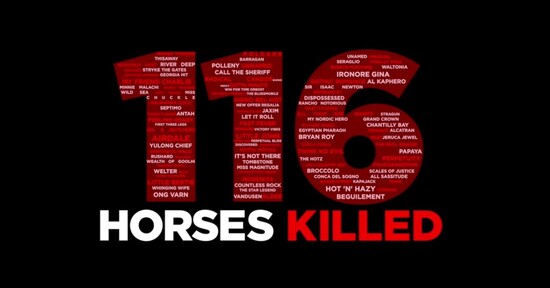
Our 2020 Deathwatch Report has just been released. You can read the full report here. The 2019/20 racing season claimed at least 116 lives meaning at least one horse continues to be killed on Australian racetracks every three days. Thousands more will have sustained injuries that made it more expedient to discard and replace them.

This years report has introduced three new sections covering:the number of horses who suffered visible/grade 4 bleeds or EIPH (exercise-induced pulmonary haemorrhage) whilst being raced;the increasing incidents of racing bodies editing or not releasing video replays of races where horses have been killed; anda list of businesses who sponsored a race where a horse was killedWe have also compiled our Deathwatch 2020 video summary highlighting just how devastating these scenes of horses being killed on track are. Watch here. 

CPR NEW ZEALAND PRESENTS PETITION TO PARLIAMENT 

Earlier this year, to the disgust of a large number of New Zealanders, the NZ government announced a $72.5 million racing industry bailout. Our three NZ satellite teams quickly launched a petition against the bailout.

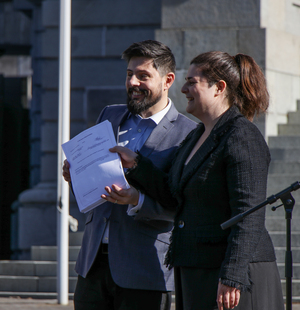
Alongside SAFE’s Campaign Director Ilan Goldberg our petition with over 10,000 signatures was presented to Greens MP Gareth Hughes on the steps of parliament in late July.

Unfortunately the racing bailout looks to be going ahead however the arrogance of the industry has ruffled many feathers across the country from people who do not want to see animal cruelty and gambling industries propped up by their tax dollars, especially when essential services such as St John’s Ambulance are experiencing huge budget cuts.

Learn more about our NZ campaign, our report on NZ wastage estimates and how you can get involved here.

CPR CONTINUES TO GROW INTERNATIONALLY 
 In the last 12 months, CPR has been contacted by several groups around the world who have been inspired by our campaigns and therefore have started their own. We are currently working with these groups and approaching others to join our fight and hope to have more positive news on our progress in our next newsletter. Horse racing exists around the world, so no matter where you are receiving this newsletter, we need you to help spread the word. If you would like to start up a CPR satellite group in your town, please get in touch at [email protected]

SPRING CARNIVAL UPDATE   

CPR targets horse racing sponsors
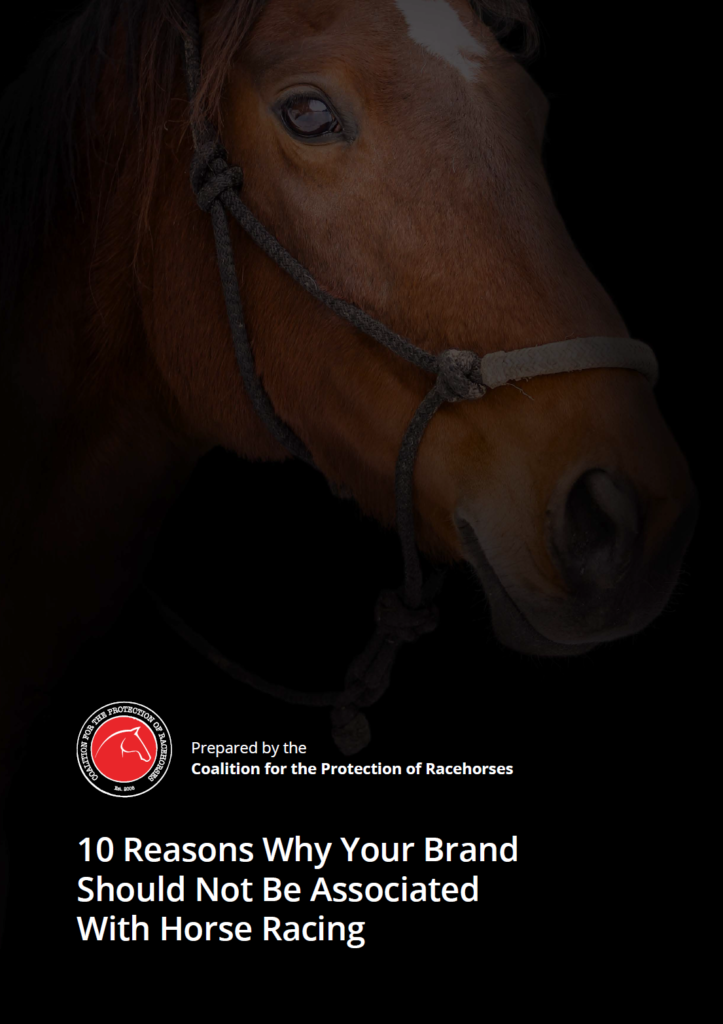
CPR has produced a document targeting horse racing sponsors, alerting them to “10 Reasons Why Your Brand Should Not Be Associated With Horse Racing” – read here. The document not only highlights that supporting what is fundamentally a cruel and exploitative industry is wrong, it also makes poor business sense.

CPR has sent the document to well over 400 sponsors (and counting), from large multinational companies through to small businesses who are not only Spring Carnival sponsors but who have sponsored races across the country over recent months. We will be following them up in the near future and will continue to reach out to future race sponsors.

We look forward to seeing businesses giving the important issues we raise serious consideration and withdrawing support. 

CPR this Spring Carnival
As a result of COVID-19, this Spring Carnival is going to be like no other for the racing industry and for CPR. While CPR has some plans in place, it remains to be seen what we will be allowed to do. At the moment, it appears that our normal Spring Carnival actions will be not permitted in Victoria and our ‘Nup to the Cup’ picnic will also have to be cancelled. However, please stay tuned because we’ll be doing everything we can this Spring Carnival to ensure all our voices for the horses are heard loud and clear, irrespective of where we must do that from. We will at the very least be holding an online event so please stay tuned and please follow us on social media (here) or our website (here) for updates.

WHAT YOU CAN DO THIS SPRING CARNIVAL
There is still lots that you can do to speak out for horses this Spring Carnival.

Inform others
CPR has produced a similar document to the one aimed at sponsors mentioned above. However, this one is for you to share with your friends and family who may not be aware of what really goes on in the horse racing industry. You can view, share and download the document ’10 Reasons Why You Should Not Support Horse Racing’ here. Please share it far and wide. It’s unlikely many people will be allowed to attend the races this Spring Carnival, so let’s use it as an opportunity to spread the word when hopefully people may be more open to hearing our message.
Support us and get your CPR Merchandise for this Spring Carnival
CPR’s 2020 ‘Nup to the Cup’ Collectors Item T-shirt design will soon be available in our online shop. Keep an eye out for this years special one-off design here. 
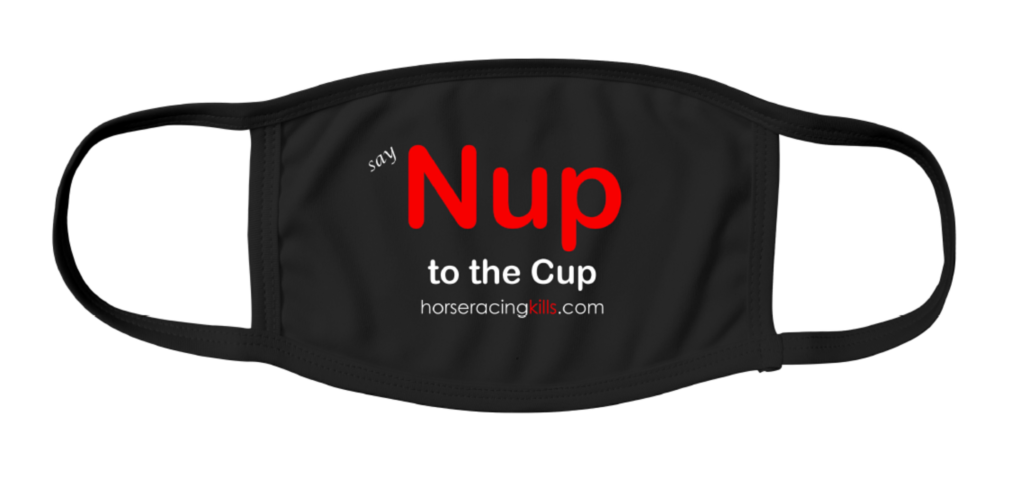
We’ve also just released our brand new ‘Nup to the Cup’ face masks. Be a voice for racehorses this Spring Carnival without even opening your mouth. Available here.
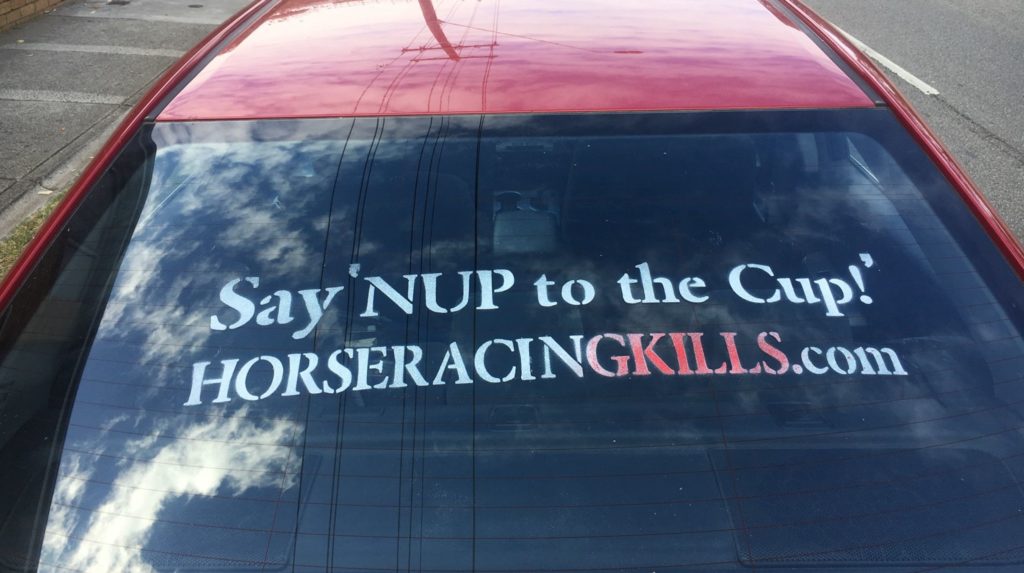
Stencil Your Car

Stencil the back of your car and make it a mini billboard.

See our easy instructional video on how to spray the stencil and where to buy everything you’ll need here. 
Boycott the Melbourne Cup Sweep
 It’s a long running (but slowly dying) tradition to have a Melbourne Cup Sweep in the workplace, community group or local pub on Melbourne Cup Day. However, there’s a new tradition that’s emerging and that’s to say ‘Nup to the Cup”. It can be an awkward moment for some, especially if you’re the only one in your group who objects to it, but please remember you are not alone – you are joining the countless others across the country who are refusing to take part in cruelty, even under social pressure.
We suggest you do the following:   
Download and print one of our posters and display it wherever you can to get the message across – available here.
Wear your CPR merchandise everywhere you go – available here.
Politely refuse to watch or partake in any Melbourne Cup celebrations and if possible join other likeminded individuals as a sign of respect for the horses.
If you are in the company of others who agree, hold an alternative celebration. Donate the money that you would have otherwise spent on a sweep to an animal charity of your choosing.
If you are having an alternative celebration, try to make sure it respects all animals, not just horses by making it vegan.
Perhaps, as an alternative to watching the Melbourne Cup, you could invite people to watch the ABC investigation “The Final Race’ that aired in October 2019 here and the more recently released investigative documentary by the Animal Welfare Foundation Tierschutzbund Zurich here.  

We are still in the process of planning our actions for Melbourne Cup and will be sharing more ways people can join us to speak up for the horses shortly. Let’s make Melbourne Cup Day a day we celebrate animals, not exploit them.

FINALLY, THANK YOU!     
Thank you to all our followers and donors for your ongoing support. Without it we would not exist. Unfortunately, COVID-19 has also hit CPR with many of our regular donors having to suspend or stop their donations. We want you all to know we understand. We’re living in unprecedented times and many people are doing it tough. Our thoughts are with you and we hope that our lives will be back to a much better kind of normal soon.
Speak up, always!

Image by Dayaal


DONATE TO HELP

 CPR relies 100% on donations to fund our investigations and campaigns. Without the generosity of our supporters we would not exist.

Thank you to all of our supporters who have donated recently. It is much appreciated and allows us to continue working toward justice for horses.
 Click here to donate

News

End of Life Welfare Program: An Open Letter to Racing NSW Chairman Russell Balding

September 16, 2020 by admincpr 1 Comment

On September 12 2020, Racing NSW Chairman Russell Balding announced the regulator’s newly established ‘End of Life Welfare Program’, aimed at providing all NSW thorougbred owners access to a free euthanasia service. The announcement stated that “under no circumstances should a NSW thoroughbred horse ever be sent to an abattoir or knackery” and that the program was primarily required for those who could not afford the expense of euthanasia and burial/cremation.

Whilst CPR welcomes all moves toward ending the brutal killing or horses at knackeries and slaughterhouses, we have many concerns over the viability of the program. Our letter, sent to Mr Balding (below), highlights key points that must be addressed for the program to be a success, not just a smoke screen.

We look forward to his response.

14 September 2020

Russell Balding
Racing NSW Chairman
Level 7
51 Druitt Street
Sydney NSW 2000

By email c/o Kathy Reece: [email protected]

Dear Mr Russell Balding,

We write to you out of genuine concern for the welfare of horses who exit the racing industry in New South Wales. We have made this an open letter and will also be sending it to the media, as communication to RNSW and CEO Mr V’landys in particular seem to have been blocked. Over the last two years, at least eleven emails have been sent to his office from our organisation without any response whatsoever. In the interests of the horses’ welfare and transparency, we hope that will change.

We have read your announcement made on the 12th September 2020 about RNSW’s End Of Life Welfare Program that will fund the euthanasia of NSW racehorses exiting the racing industry and your commitment to finding suitable homes for them.

While your commitment to rehoming sounds like a win for the horses, it does raise many questions about the sustainability of the industry and its ability to care for all the horses it breeds.

We believe it is imperative to reduce the numbers of horses bred each year because the homes to care for them are simply not there.

According to the Australian Racing Fact Book, the number of foals born in NSW has been relatively constant in recent years at around 6000. With the overall number of horses involved in racing and breeding in slight decline, approximately the same number are also exiting the industry every year and requiring re-homing. That represents more than 15 horses every day of the year potentially needing homes just in NSW. This is a significant undertaking requiring significant funding and personnel to make sure all NSW horses receive the care RNSW has promised.

We refer you to our proposal submitted to Racing Australia and all Principle Racing Authorities back in 2013 that details what we estimate will be required and how it could be funded – available here. This has also been detailed in our recent submission to the newly formed Thoroughbred Aftercare Welfare Working Group, with updated figures reflecting the industry today – available here.

We also have some questions we would like you to answer in relation to your announcement.

1. Over-breeding

Will RNSW do anything to discourage over-breeding- the source of the wastage problem?

We note that the foal crop Australia wide is in decline, which would seem to be a positive yet RNSW has an initiative called the Breeder Owner Bonus Scheme (BOBS) that commenced in August 2017   (ref https://www.racingnsw.com.au/wp-content/uploads/RNSW-Strategic-Plan-2018_3_Final.pdf ) designed to encourage breeding and counter the declining numbers of foals born annually.

2. Foals who don’t make it

Can you guarantee that all foals born into the industry will be accounted for?

How will foals who are found to not be suitable for racing be managed and re-homed?

3. Retiring breeding mares (brood mares)

There are an estimated 3000 mares who are retired from breeding in Australia each year who are currently unaccounted for by the racing industry. How will RNSW account for the retiring mares in NSW?

4.  Transparency

What records will be kept for racehorses leaving the industry and will the records be made public?

5. Criteria for euthanasia

What criteria will be used to assess if a horse will be euthanised? 

6. Short-term and long-term care of retiring racehorses

With an estimated 15 horses on average exiting the racing industry every day just in NSW, either as foals, unraced horses, raced horses or breeding horses, what plans does RNSW have for these horses? Additionally, what will happen to the horses who are not re-homed?

7. Plans for finding permanent homes

Thoroughbreds, especially those who have raced, have traditionally been difficult to re-home because of the likelihood of injury and psychological trauma. What plans does RNSW have for rehabilitating these horses so they are able to find suitable homes?

We believe CPR represents the views of the majority of Australians who in principle do not condone animal cruelty. Proof of this gets louder with every Spring Carnival. As such, we would like to maintain open dialogue with the racing industry and in particular RNSW for the purpose of reaching the goals outlined in the announcement.

Regards,
Elio Celotto
Campaign Director | Coalition for the Protection of Racehorses


Cover Image: Edgar’s Mission

News, Uncategorized

May Took FIFTEEN Lives on Australian Racetracks

June 22, 2020 by admincpr 2 Comments

May was the most deadly month this racing year on Australian racetracks, with Tasmania not even racing due to COVID-19 restrictions. Racing NSW took the winning prize with seven fatalities from within their jurisdiction.

The racing industry is right on track to maintain their one death on track every three days. Of course, these are just the deaths that are recorded.

The deaths or injuries sustained which led to the decisions to kill the horses are varied. From fractures, to suspensory apparatus ruptures, to major haemorrhage.

At a time when the racing industry is experiencing an unprecedented animal welfare crisis the question is, what is the industry doing about the carnage on racetracks?  Is a modern society willing to accept that horses will continue to suffer and die tragic deaths to sustain a public gambling industry?

The industry refuses to engage in sufficient research and there is no appropriate intervention strategies that compel vets to decide whether a horse is fit to race.  

Ultimately, just allowing unsound horses on to the track is in itself an act of cruelty.

As stated in the NSW POCTA Act Section 13, with similar acts in other states:
A person shall not:
(a) ride, drive, use, carry or convey an animal, or
(b) where the person is a person in charge of an animal–authorise the riding, driving, using, carrying or conveying of the animal,
if the animal is unfit for the purpose of its being so ridden, driven, used, carried or conveyed.

Racehorses should be protected under the various states POCTA Acts, as should all animals, yet we repeatedly see exceptions made which ultimately render our animal protection laws useless. Our state authorities support and frequently endorse an industry that is constantly in flagrant breach of their own codes.

Stay tuned for CPR’s Deathwatch 2020 Report to be released in mid – late August.

News

Australians Are The Worst Gamblers In The World

June 16, 2020 by admincpr Leave a Comment

….topping the list of the highest rates of gambling losses per capita!

Australians spent $25.8 billion gambling on racing in 2017-18, the vast majority of which is directed at thoroughbred racing. Actual sports betting was less than half that at $11.6 billion. More here from savings.com.au

However, even though we do not celebrate any increase in gambling, it was reassuring to note that growth in sports betting (where the participants are actually willing) has recently surpassed growth in animal racing betting whose growth almost halved.

From the article:
“Betting on racing grew by just under 13% from 2015-16 to 2016-17, while sports betting grew by 4%. In 2017-18 there was a far more prominent growth in sports betting, with this category increasing by 14.9% year-on-year while racing grew by 8.1%.”

To try to find other reassuring news in this sad state of affairs, a 2018 Roy Morgan poll found that the age bracket mostly betting on racing and sports was 50-64. The under 25’s bracket was betting the least. More here.

This is one of the reasons we see the racing industry so desperately targeting the younger generations who are more frequently turning their backs on supporting the use of animals for entertainment.

The social cost of all forms of gambling in Victoria alone for year 2014-15 was found to be $7 billion.

From the article:
“Gambling harm encompasses everything from the loss of homes and relationships to the loss of lives through deaths by suicide associated with gambling harm,” Rev Costello said in December 2019 when the report was released.

“There are direct connections in some instances between gambling harm and family violence and mental ill-health.

“When you consider for every person directly experiencing gambling harm it is estimated at least six more people connected to those people experience some impact, we are talking about an issue that affects an extraordinary number of Australians.”

It is high time our state governments stopped spouting all the apparent glorious outcomes from racing and started addressing the true impacts on both humans and other animals.

News

  • « Previous Page
  • 1
  • …
  • 19
  • 20
  • 21
  • 22
  • 23
  • …
  • 25
  • Next Page »

Contact Us

The Coalition For The Protection Of Racehorses
P.O Box 163, South Melbourne
Victoria 3205

Phone: 0412 039 788
Email Us

Join Our Mailing List

Sign-up to our mailing list to keep up to date. Text alerts are available for breaking news and urgent actions if you are in Australia.

Sign-up now

Find us on Social Media

© Copyright 2016 - 2026 All Rights Reserved by Coalititon for the Protection of Racehorses.

Privacy Policy